

Multi-Vehicle Crash Injury Claims · Atlanta & Georgia
Injured in a Multi-Vehicle Crash? Understand Who May Be Responsible
When several vehicles are involved, figuring out who is responsible can feel overwhelming. Attorney Adanna Ugwonali and our team at Ugwonali Law Group explain the legal and medical process in plain language, from the first call through your case.
By Adanna Ugwonali · Published November 2, 2026
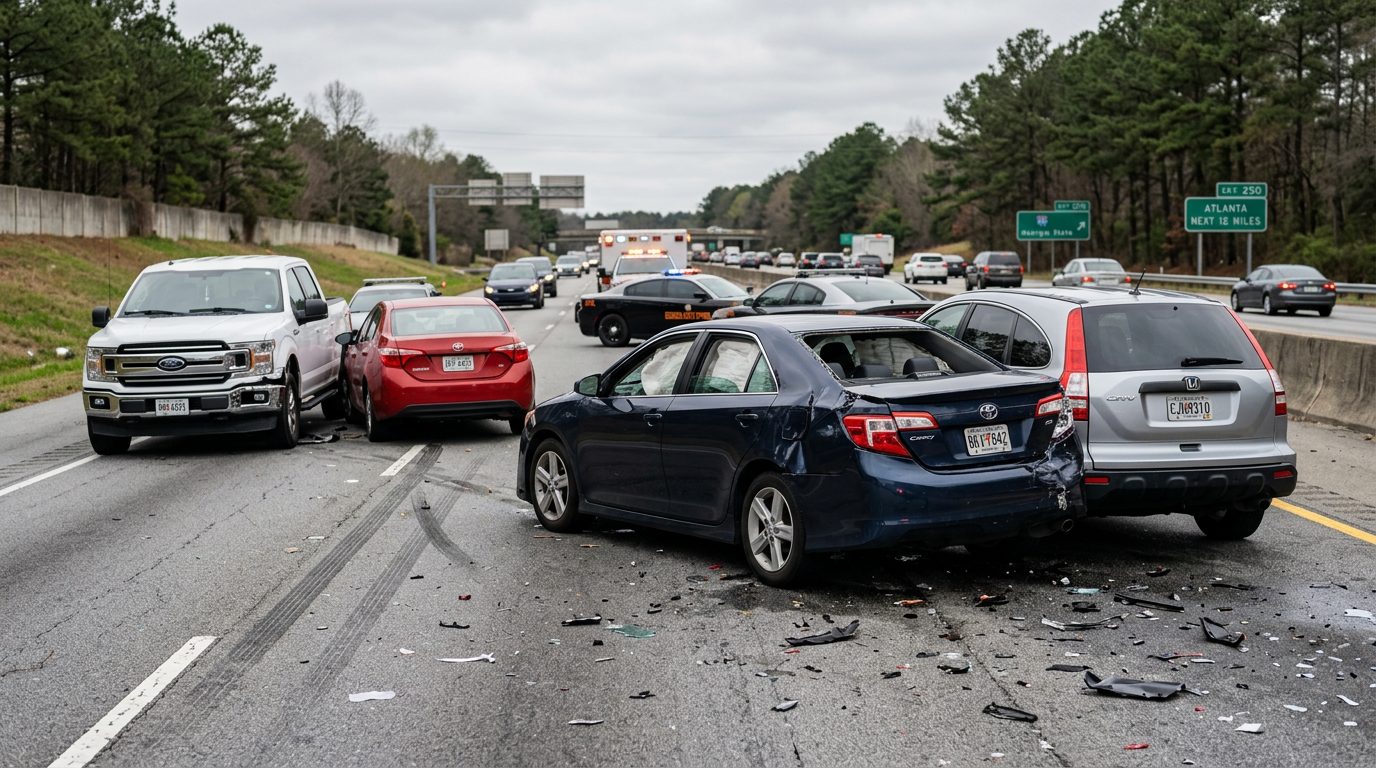
If you were hurt in a pileup on a Georgia road, more than one driver or company may share responsibility. Georgia divides fault among everyone who contributed to the crash, and that split shapes what an injured person can recover. This guide explains how a multi-vehicle crash injury claim Georgia law allows works. It covers who can be held responsible, how fault is shared, and what to expect next.
What a Multi-Vehicle Pileup Injury Claim Is
A multi-vehicle pileup injury claim asks the people responsible for a crash to pay for the harm it caused. A pileup involves several vehicles, often in a chain reaction. One impact sets off the next. A two-car collision has one point of impact and fewer parties to examine.
These claims often involve serious injuries. Examples include broken bones, hospital stays, traumatic brain injuries, and spinal cord injuries. According to MedlinePlus on spinal cord injuries, these injuries can have permanent effects.
This page is written for two groups. The first is people hurt in a multi-car crash. The second is family members of someone who died in one.
If a pileup left you or someone you love hurt, you may have a claim, and our team is ready to talk through the facts with you in English or Spanish. Talk it through with our team — the first consultation is free, confidential, and carries no obligation.
Who Can Be Held Responsible in a Pileup
Several people and companies can share responsibility in one pileup. Responsibility is not limited to the first driver. Possible parties include:
- The driver whose sudden action or impact started the chain.
- Drivers who followed too closely or failed to stop in time.
- A commercial truck driver and the trucking company that employs them. Under O.C.G.A. § 51-2-2, a person is liable for torts of a servant committed within the scope of that person’s business.
- An owner or company that supplied or maintained a vehicle in the crash.
- A parts maker, when a defect such as brake or tire failure played a part.
Each party’s share depends on the facts. A multi-vehicle crash injury claim Georgia courts review often turns on who did what before each impact.
How Georgia Fault Rules Apply to Multiple Drivers
Georgia reduces your damages by your share of fault. You cannot recover at all if you are 50 percent or more responsible. Under O.C.G.A. § 51-12-33, the judge reduces the award in proportion to your percentage of fault.
When more than one driver is involved, the facts of each crash can matter in different ways.
- Each responsible person pays only its own share. The statute says these damages are not joint liability and are not subject to contribution.
- The fact finder must consider the fault of everyone who contributed to the injury. That includes people who were never named in the lawsuit.
- A defendant can point to a nonparty by filing a pleading in the action, no later than 120 days before trial, that designates the nonparty and gives a brief statement of the basis for believing the nonparty at fault.
Fault is usually reconstructed from the order of impacts, following distance, speed, braking, and witness accounts. Each driver’s insurer may dispute the percentage assigned to its own insured. That makes careful early documentation important.
Common Causes and Situations Behind Multi-Car Crashes
Most pileups begin with a sudden slowdown that a following driver cannot stop for in time. Common triggers include:
- Sudden stops in traffic backups, around construction zones, or at merges.
- Following too closely, speeding for conditions, distraction, and fatigue.
- Low visibility from fog, heavy rain, smoke, or glare, and slick roads.
- Impaired driving.
- Large trucks that cannot stop quickly, and cargo or equipment that shifts into traffic.
Commercial trucks also face federal safety rules. Records tied to these rules can matter in a truck-involved claim.
Evidence, Insurance Policies, and Overlapping Claims
The evidence that matters most shows the order of impacts and each driver’s actions before them. Useful evidence includes:
- Police crash reports, photos, and video.
- Vehicle damage patterns and any data the vehicles recorded.
- Names and contact details for witnesses.
- Traffic camera footage, where it exists.
- Medical records that link each impact to each injury.
- A written journal of symptoms, missed work, and treatment visits.
More than one insurance policy can apply to one crash. A commercial truck policy and several personal auto policies may all come into play. Federal law requires minimum financial responsibility for motor carriers under 49 U.S.C. § 31139. Georgia also limits when a motor carrier’s insurer can be joined in the same lawsuit, as set out in O.C.G.A. § 40-1-112. Reporting the crash promptly to your own insurer is part of the process.
What to Expect: Timeline and Steps
Georgia generally allows two years to sue for injuries to a person, but actions for injuries to the person involving loss of consortium must be brought within four years after the right of action accrues. O.C.G.A. § 9-3-33 sets a two-year limit for injuries to a person, running from when the right of action accrues; actions for loss of consortium must be brought within four years, and injuries to reputation within one year. Deadlines depend on the facts, so early action helps protect evidence.
A typical claim follows five steps:
- Consultation and intake. You share the basic facts of the crash. Support is available in English or Spanish.
- Investigation. The team looks into how the crash happened, identifies responsible parties, and collects reports and records.
- Treatment documentation. Medical records and bills are gathered. Under O.C.G.A. § 51-12-1.1, medical expenses are limited to the reasonable value of medically necessary care.
- Demand and negotiation. The claim goes to the insurers. Each settlement offer can be accepted or rejected.
- Filing suit if needed. If the claim does not resolve, a lawsuit may be filed. How long each step takes depends on the facts.
Not sure what your next step is?
Talk it through with our team — the first consultation is free, confidential, and carries no obligation.
How Ugwonali Law Group Approaches These Claims
Ugwonali Law Group is a personal injury firm in Atlanta, Georgia. Adanna Ugwonali is the responsible lawyer for this page. Our team includes support staff who handle intake and case coordination, and our lawyers represent injured people and their families.
The firm serves clients across metro Atlanta, including Fulton, Clayton, Cobb, and Rockdale counties and the cities of Marietta, Jonesboro, and Conyers. It also serves clients statewide in Georgia. Our office is at 3400 Peachtree Road NE, Atlanta.
Free case reviews are available, and intake is offered in English or Spanish. The first consultation is free, confidential, and comes with no obligation to continue.
Frequently Asked Questions About Pileup Injury Claims
Can I still bring a multi-vehicle crash injury claim Georgia allows if I was partly at fault?
Yes, if your share of fault is under 50 percent. Your damages are reduced by your percentage of fault under O.C.G.A. § 51-12-33.
Can more than one driver or company be responsible?
Yes. Each responsible party pays only its own percentage of the damages.
What if a commercial truck was involved?
The trucking company may be liable for an employee’s negligence within the scope of the job. Early evidence, such as the truck’s records, often matters.
How long do I have to file?
Georgia generally allows two years for injuries to a person. Deadlines depend on the facts of each case.
Can a family bring a claim after a fatal pileup?
Yes. A surviving spouse, or children if there is no surviving spouse, may recover the full value of the decedent’s life, as shown by the evidence, under O.C.G.A. § 51-4-2.
What should I bring to a first call?
Bring the crash report number, witness names, photos, and a list of your medical providers.
Talk Through Your Crash With Our Team
If you’re waiting on test results, juggling a rental car and missed paychecks, or helping a relative through a crash they didn’t expect, you don’t have to sort out fault alone. Start by sharing the basics: how many vehicles were involved, where the crash happened, and where you are in treatment. You can call our intake team or send a request through our free case evaluation form, in English or Spanish.
This page is general information, not legal advice. Responsible lawyer: Adanna Ugwonali, Ugwonali Law Group, 3400 Peachtree Road NE, Atlanta, Georgia. Contact: attorneyadanna.com/contact.
What Can Make a Multi-Vehicle Crash Claim Complex
More than one driver
A chain-reaction or pileup can involve several drivers, each with a different part in how the crash unfolded.
Commercial vehicles
Trucks, delivery vans, and buses are often insured under commercial or corporate policies, which can add more parties to the picture.
Serious medical care
Fractures, head and spinal injuries, and hospital stays often require ongoing treatment by a medical doctor, which affects how a claim is documented.
Records and evidence
Police reports, vehicle damage, witness accounts, and medical records all help show what happened and who was involved.
Before You Speak With an Insurance Company
Insurance adjusters may contact you soon after a crash. Talking with a lawyer first can help you understand what to say, what to keep, and how your medical treatment fits into your claim.
How We Help
Free first consultation
Your initial consultation is free, confidential, and comes with no obligation to continue.
English or Spanish
Our intake staff can speak with you in English or Spanish from your very first call.
Focus on your recovery
We explain medical and legal steps clearly so you can concentrate on your health and your family.
Serious injury focus
Our practice focuses on serious injuries, wrongful death, and crashes involving trucks and cars across metro Atlanta and Georgia.
Fees and costs explained
Ask us how fees work in your case. Where a fee is contingent on recovery, you may still be responsible for court costs and case expenses.