


Premises Liability · Atlanta, Georgia
Injured on Someone Else's Property? Here Is How Your Georgia Case Moves Forward
A plain-language, step-by-step guide from Ugwonali Law Group to what happens after a slip and fall, trip and fall, or other unsafe-property injury, from the first call to resolution.
How We Work With You
Free
Initial consultation, confidential and without obligation
EN / ES
Intake in English or Spanish
Statewide
Representing injured people across Georgia
By Adanna Ugwonali · Published November 2, 2026
Where You Are Right Now After an Injury on Someone Else’s Property
If you were hurt on someone else’s property, you’re probably juggling pain, medical visits, and questions you never planned to ask. Many readers are researching for a parent, spouse, or child. This page walks through the premises liability case process Georgia residents can expect, one stage at a time.
Ugwonali Law Group, located at 3400 Peachtree Road NE in Atlanta, Georgia, wrote this guide for people across metro Atlanta and statewide. Adanna Ugwonali is the responsible lawyer for this page. The page is general education. It does not predict how any particular claim will turn out.
If the injury involved the head, our traumatic brain injury page covers that condition in more detail.
If a fall or injury on someone else's property has you or someone you love facing medical care and hard choices, our team is glad to talk it through with you. Talk it through with our team — the first consultation is free, confidential, and carries no obligation.

Steps to Take After an Injury on Someone Else’s Property
The first steps are getting medical care, reporting what happened, and saving proof before the scene changes. These steps protect your health and your ability to show what happened later.
- Get medical care and follow the plan. Medical records are the main way to show how you were hurt and what treatment you needed. Missed appointments can become a question later.
- Report the incident and ask for a copy of the report. Tell the owner or manager what happened. Ask for an incident report and keep a copy for yourself.
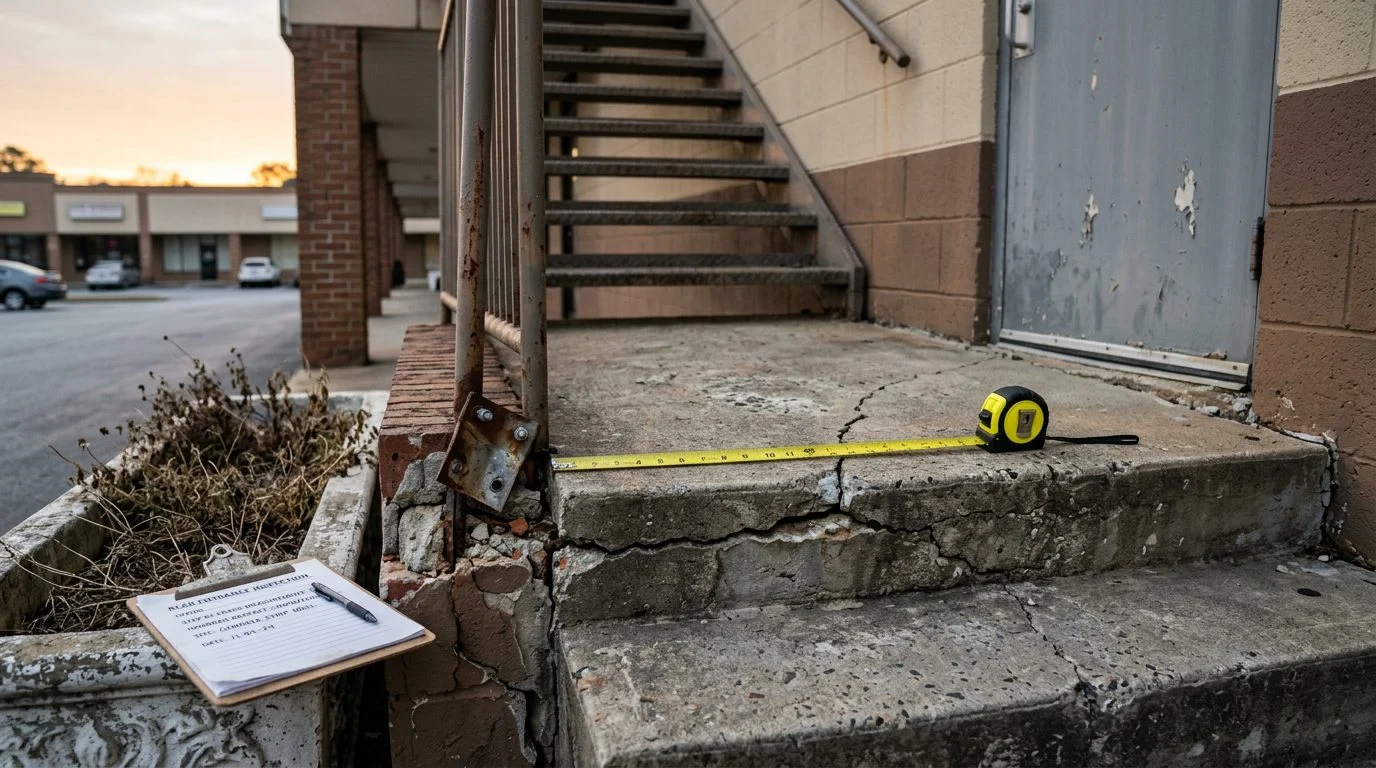
- Photograph the hazard before it changes. Take pictures of the spot, the floor or surface, the lighting, any signs, and the area around it. Write down the date and time.
- Write down witness names and phone numbers. Memories fade quickly. A short list of people who saw the fall can help later.
- Keep bills, receipts, and a simple daily log. Note symptoms, missed work, and tasks you can’t do. Specific notes show how the injury affects daily life.
- Think before you sign anything from an insurer. Don’t rush into a recorded statement or a release. Ask what the form covers first.
What Georgia Law Requires a Property Owner to Do
Under Georgia law, an owner or occupier must use ordinary care to keep its premises and approaches safe for people it invites or leads onto the property for a lawful purpose. Georgia premises liability law sets out that duty.
Georgia law also defines ordinary diligence as the care that ordinarily prudent people use under similar circumstances. Failing to use that care is ordinary negligence under Georgia law.
Visitor status matters. An invitee is someone invited onto the property, such as a customer.
A premises claim usually raises a few questions. What was the hazard? What did the owner know or should have known about it? Did the owner fix it or warn about it? How did it cause your injuries and losses?
How Does a Georgia Premises Liability Case Progress From the First Consultation Through Investigation, Negotiation, and Possible Trial?
A Georgia premises liability case usually moves through clear stages. It begins with a first consultation, then investigation and evidence gathering, then a demand and negotiation with the property owner’s insurer. If the claim does not resolve, it may move into a lawsuit, discovery, and possibly trial. The timing of each stage depends on the facts. The sections below walk through each step in order, so you can see what each one is for.
Stage One: The First Consultation
The first consultation is a conversation where the team learns how the incident happened, what injuries you have, and what medical care you’ve received. The first consultation is free, confidential, and comes with no obligation to continue. In Spanish, this is a consulta inicial gratuita, confidencial y sin compromiso. Intake staff take first calls in English or Spanish.
Bring whatever you have, even if it’s incomplete. Useful items include medical records and bills, photos, incident reports, and any letters from an insurance company. Write your questions down. Ask about court costs and case expenses before you decide anything, so you know what they are.
Stage Two: Investigation and Evidence Gathering
Investigation means gathering the records and proof that show how the hazard formed and how it affected you. Some evidence doesn’t last. Video may not be kept indefinitely, maintenance records get filed away, and a hazard is often repaired soon after an incident.
A typical investigation includes requesting the incident report and asking the owner to keep relevant evidence. This is often done through a preservation letter, which asks the owner to keep video, logs, inspection records, and cleaning schedules. Investigators also document the scene and review medical records to connect the injury to the incident.
The investigation can reveal more than one responsible party. A management company or a contractor may have worked on the property. Georgia law addresses when an employer can be liable for a contractor’s negligence. One example is when the employer keeps the right to direct how and when the work is done.
Not sure what your next step is?
Talk it through with our team — the first consultation is free, confidential, and carries no obligation.
Stage Three: Demand and Negotiation With the Insurer
A demand letter is a written summary sent to the property owner’s insurance company. It lays out how the incident happened, your injuries, your treatment, and your losses. The letter gives the insurer a clear picture of the claim.
Insurers work on their own timelines. An insurer may ask for more records or request an independent medical examination. Negotiation then becomes a back-and-forth exchange of offers, responses, and new information. Some claims resolve at this stage, while others do not.
Georgia law recognizes different kinds of damages, including special damages, which must be proved. Medical expenses are one example of special damages that need documentation.
Whether to accept any offer is your decision. Take time to understand what the offer covers before you respond.
Stage Four: Filing Suit, Discovery, and Possible Trial
If a claim does not resolve, a lawsuit may be filed. Georgia generally gives two years to bring an action for injuries to the person, under the Georgia injury limitation statute. That statute also sets a four-year period for loss of consortium claims. Some exceptions can change the deadline, so ask about your own timeline early.
After a suit is filed, discovery begins. Discovery is the exchange of information. It can include written questions, requests for documents, and depositions, which are sworn interviews taken outside the courtroom.
Georgia’s comparative fault rules can affect recovery (O.C.G.A. § 51-12-33; Quynn v. Hulsey (2020)). When more than one person may be responsible for an injury, how fault is divided can depend on the facts of the case and on Georgia law.
Some cases go to mediation, a meeting with a neutral helper, before trial. A case that does not resolve may go to trial, where a judge or jury decides the outcome.
Talking Through Your Situation With Our Team
If you’re weighing a fall or injury on someone else’s property, you don’t have to sort out the next steps alone. Maybe you were seriously injured and needed hospital care after a crash or a fall on unsafe property, or you are a family member facing a loss.
How long do I have to file a premises liability claim in Georgia?
Georgia generally allows two years for injury claims under O.C.G.A. § 9-3-33, with some exceptions. Ask about your deadline early, because waiting can narrow your options.
Do I have to go to trial?
Not every claim goes to trial. Many matters are discussed through negotiation or mediation, and a case that does not resolve may go to trial.
Do I have to pay court costs?
Court costs and case expenses are a topic to raise at your first call. Ask about them before you decide anything, so you understand them clearly.
If a fall or injury on someone else’s property has you or someone you love facing medical bills and hard choices, our team is glad to talk it through with you. You can request a case evaluation and start that conversation at your own pace.
Disclaimer: This page is general information, not legal advice, and it is not a promise of any result. Ugwonali Law Group, 3400 Peachtree Road NE, Atlanta, Georgia. Responsible lawyer: Adanna Ugwonali.
What to Expect From Our Team
A Real Person on the First Call
Our intake staff will listen to what happened, answer your questions in English or Spanish, and explain the next steps in plain language.
Clear Explanations at Every Stage
We explain the legal and medical process as your case moves forward, so you always know what is happening and why.
Focus on Your Recovery
Your health comes first. We coordinate around your medical treatment so you can concentrate on getting better.
Support for Your Whole Family
When an injury affects the people who depend on you, we take time to understand how it changes daily life at home.
Important: Get Medical Care First
Seek medical evaluation as soon as possible after a fall or injury, even if you feel you can wait. Keep copies of every bill, record, and discharge paper, and avoid giving recorded statements to a property owner or insurance adjuster before you have talked with a lawyer.
The Premises Liability Process, Step by Step
1. Free Case Review
You tell us what happened, where, and how you were hurt. We review the basics and explain what information will help us evaluate your situation.
2. Investigation and Evidence
We work to preserve photos, incident reports, surveillance footage, maintenance records, and witness information while it is still available.
3. Medical Records and Treatment
Your treating doctors' records, diagnoses, and bills document your injuries. We help organize this information so it is clear and complete.
4. Claim Presentation and Negotiation
We present your claim to the responsible party and their insurer and discuss the value of your losses through negotiation, which is how many matters are resolved.
5. Mediation or Litigation, If Needed
If a fair resolution is not reached, we explain the options, including mediation or filing a lawsuit, and prepare for each step with you.
6. Resolution and Next Steps
We walk you through any settlement terms or court outcome, explain what is paid and what costs may apply, and answer your questions before anything is finalized.