

Car Accident Claims · Atlanta and Statewide Georgia
Hurt in a Car Crash? Learn How a Georgia Lawsuit Really Works
Ugwonali Law Group, led by attorney Adanna Ugwonali, explains what shapes a car accident case, why some claims take longer than others, and how a free case review can help you decide what comes next.
Getting started with our firm
Free
First consultation, confidential and with no obligation to continue
2
Languages: English and Spanish, with intake staff on the first call
Atlanta
Office at 3400 Peachtree Road NE, serving metro Atlanta and statewide Georgia
By Adanna Ugwonali · Published November 13, 2026
After a crash, many people ask one question first: how hard is it to win a car accident lawsuit in Georgia? The short answer is that it depends on the facts. A claim is usually harder when fault is disputed, injuries are poorly documented, or the at-fault driver carries little insurance.
Georgia law sets the rules. This guide explains the main ones in plain terms, from what you must prove to the deadline that can end a claim before it starts.
What “winning” a car accident lawsuit means
Winning usually means you reach a resolution that pays for your losses. Most often, that happens through a settlement, which is an agreement with the other side to pay a set amount. Some cases go to trial, where a judge or jury decides who was at fault and how much the injured person should receive.
Many injury claims settle before any trial begins. Neither path can be promised in advance. The result depends on the specific injuries, the evidence, and the parties involved. Two crashes can look alike on paper and still move in very different directions.
So it helps to focus on the factors that shape the outcome. The sections below cover the ones that matter most in a Georgia claim.

What you must prove under Georgia law
To win a negligence claim, you generally must show that the other driver failed to use reasonable care and that this failure caused your harm. Georgia describes ordinary diligence as the care that ordinarily prudent persons use under similar circumstances. Without that care, the law calls it ordinary negligence.
The proof usually breaks into four parts:
- Duty. Every driver owes others reasonable care on the road.
- Breach. The driver failed to meet that duty, such as following too closely or running a red light.
- Causation. The breach must be a real cause of the crash and the injuries that followed. A distracted driver who rear-ends a car on a metro Atlanta highway, causing a neck injury and fractures, is a simple example.
- Damages. You must show actual harm. Georgia treats general and special damages differently. General damages, such as pain and suffering, are presumed to flow from the wrongful act. Special damages, such as medical bills and lost wages, must be proved.
Damages is often where the most paperwork happens. Each bill, wage record, and treatment note must connect back to the crash.
How fault and comparative negligence affect a claim
Georgia uses modified comparative fault. That means your award shrinks by your share of fault. Under O.C.G.A. § 51-12-33, the judge reduces damages in proportion to your percentage of fault. If you are 50 percent or more responsible, you receive no damages at all.
The same statute says each liable person pays only their own share. Responsibility is not joint, and it is not shared with others through contribution.
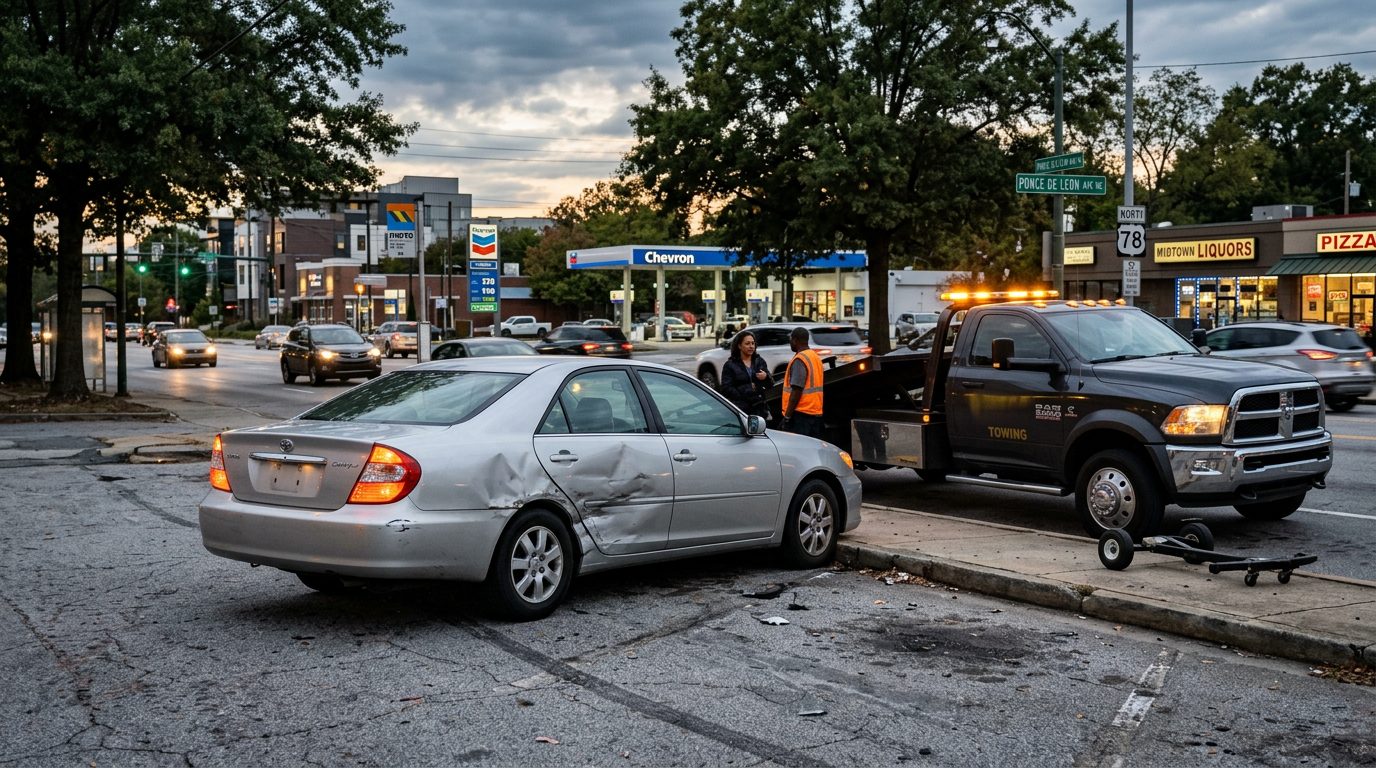
Disputed liability makes a claim harder. Picture two drivers who each say they had the green light. The police crash report, witness statements, and vehicle data become important. Georgia’s crash reporting information explains how to obtain these reports through BuyCrash or the Georgia Department of Transportation.
The at-fault driver’s insurer may also dispute fault. When it does, the claim often takes longer. That delay is common, and it can be frustrating for families who are still recovering.
Proving your injuries: what makes a claim harder or easier
Injuries with clear objective findings are usually easier to prove than symptoms with no imaging behind them. A fracture confirmed on X-ray or CT, or a surgery record, gives the claim a fixed anchor.
Medical costs follow their own rules. Under O.C.G.A. § 51-12-1.1, medical expenses are limited to the reasonable value of medically necessary care. If you have health insurance, the evidence can include both the amounts billed and the amounts actually needed to satisfy those charges under your insurance contract. Either side may challenge the reasonableness of the bills or whether the treatment was necessary. If treatment was billed under a letter of protection, that letter and itemized charges are relevant and can be requested.
Soft-tissue injuries and concussions can be harder to prove. Consistent care, neurological testing, and imaging help connect symptoms to the crash. Gaps in treatment are often used to question the claim, so prompt evaluation by a medical doctor, and following the treatment plan, matter a great deal.
For traumatic brain injury and spinal cord injury, the records of neurologists, neurosurgeons, and rehabilitation providers often form the core of the proof. The Model Systems Knowledge Translation Center publishes research-based guidance on life after spinal cord injury.
Symptoms you report still matter. A claim is easier to present when those symptoms also appear in the medical record.
Insurance coverage and the at-fault party
A lawsuit is only as useful as the coverage behind the at-fault party. Policy limits cap what an insurer pays under a policy. If the at-fault driver has low limits, the recovery can be limited too.
Your own policy may also matter. Review your own policy early, so you know what it covers.
Commercial truck crashes add another layer. A trucking company may carry its own policy as well as the driver’s. Records such as driver qualification files, hours of service logs, and maintenance records often become important evidence.
Joining a carrier’s insurer to a lawsuit is limited. Under O.C.G.A. § 40-1-112, joinder of the insurance carrier is permitted only when one or more related motor carriers are insolvent or bankrupt, or when personal service cannot, after reasonable diligence, be effected against the driver or the motor carrier.
Georgia deadlines that can end a claim
Georgia generally allows two years to bring an action for injuries to the person. Under O.C.G.A. § 9-3-33, that period runs after the right of action accrues. Claims for loss of consortium have four years under the same section.
A missed deadline can bar a claim even when the facts are strong. That makes timing one of the few factors you can plan from the start. Keep the crash date, medical dates, and all records in one place so nothing is lost while you focus on recovery.
Talking to insurance adjusters: what to be careful about
An adjuster works for the insurance company, not for you. Anything you say or sign can be used later to evaluate the claim. A recorded statement is not the same as a casual conversation.
Stick to facts you know. Avoid guessing about speed, distance, or what the other driver did. Don’t describe your injuries as minor before a full medical evaluation is complete. Early soft language like “I’m fine” is often recorded and repeated later.
Review any request to sign a medical authorization or release before you sign it. These documents can reach far beyond the crash. Questions about them can be raised with a lawyer before you agree.
Keep a simple log. Write down symptoms, appointments, missed work, and expenses as they happen. A clear log helps you and your attorney, if you choose one, tell the story accurately.

If you are weighing this now, talk it through with us
You may be reading this beside a hospital bed, during a long recovery, or after losing a family member in a crash. Deciding whether to pursue a claim can feel like one more weight on top of everything else. You don’t have to sort out every legal question alone.
Ugwonali Law Group is located at 3400 Peachtree Road NE, Atlanta, Georgia. Adanna Ugwonali is the responsible lawyer for this page. Our team can talk through your crash, your injuries, and your deadlines. Spanish-language intake is available. Our first consultation is free, confidential, and carries no obligation to continue. In Spanish: consulta inicial gratuita, confidencial y sin compromiso.
Can I still have a claim if I was partly at fault?
Possibly. Georgia reduces your damages by your share of fault, and you receive nothing if you are 50 percent or more responsible (O.C.G.A. § 51-12-33; Quynn v. Hulsey (2020)).
How long do I have to file?
Georgia generally gives two years for an injury lawsuit, so it’s wise to act early.
Contact Ugwonali Law Group to talk through your situation.
What shapes a car accident lawsuit
Your injuries and treatment
Medical records, imaging, and the treatment a doctor recommends are central to showing how a crash affected your health and daily life.
Evidence from the crash
Police reports, photos, witness accounts, and vehicle data help build a clear picture of what happened on the road.
Insurance coverage
The policies behind the other driver and, where relevant, a commercial carrier can affect how a claim is handled and resolved.
Time and patience
Recovery, record gathering, and negotiations often unfold over months, and some cases do go to court when a fair resolution cannot be reached.
Be careful with the insurance company
An adjuster for the at-fault driver's insurer is not on your side. Think twice before giving a recorded statement, signing a release, or accepting an early offer before you understand your injuries and options.
Questions people ask before filing
Why do some cases take longer?
Doctors may still be treating you, records take time to collect, and insurers often need several rounds of discussion before any resolution is considered.
Does every case go to trial?
Many claims are resolved outside the courtroom, but some are not. Our team explains each possible path so you can make informed decisions.
What happens in a free case review?
You describe the crash, your injuries, and your treatment. We explain the legal and medical process in plain language and outline possible next steps.
Can my family pursue a claim after a fatal crash?
Families facing a wrongful death case often have many questions about process and paperwork. Our intake team can walk through them in English or Spanish.