

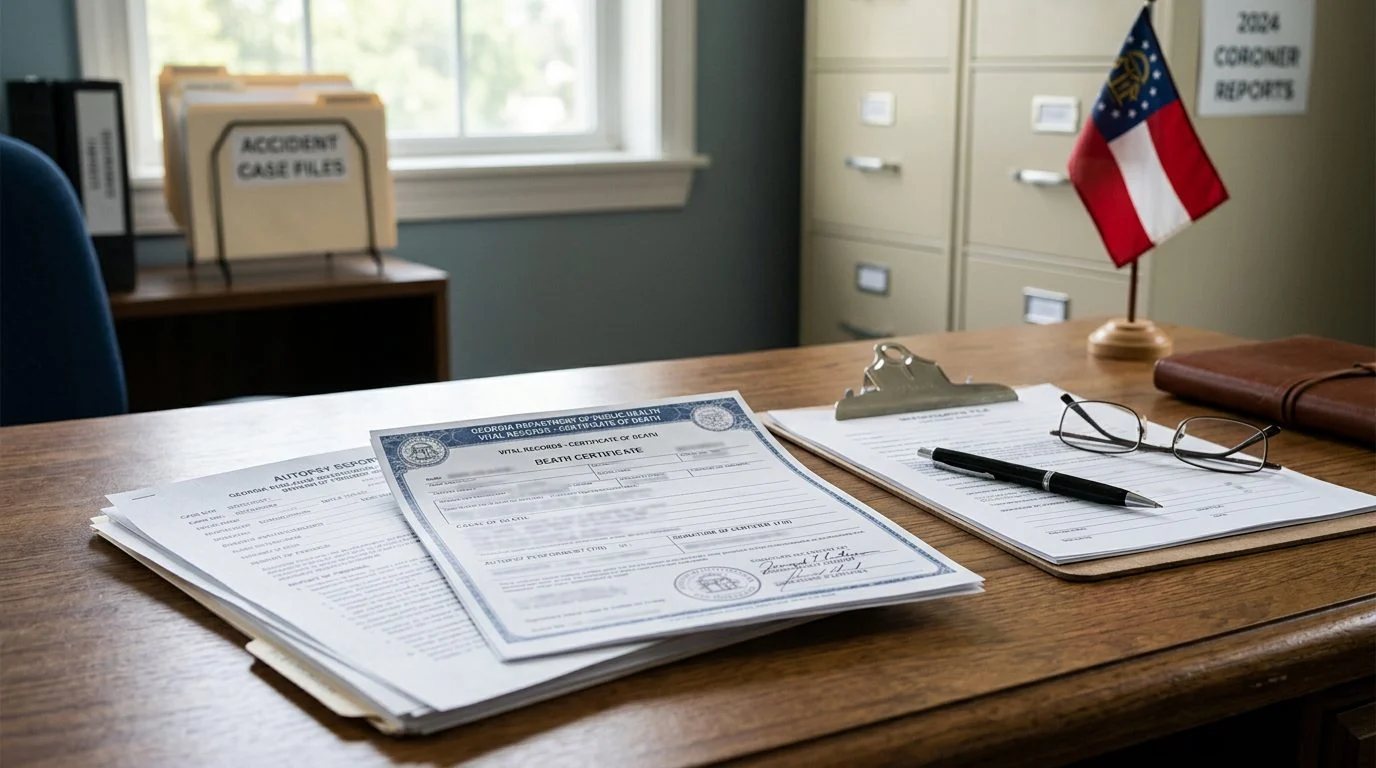
Wrongful Death | Metro Atlanta and Georgia
Fatal Crash Death Certificate and Autopsy Report: What Families Should Know
After a fatal crash, families often have to request records while they are still grieving. Here is a plain-language guide to what these documents show, how to request them, and how they fit into a wrongful death case.
Ugwonali Law Group at a glance
Free
First case review, confidential with no obligation to continue
EN / ES
Intake in English or Spanish
Atlanta
3400 Peachtree Road NE, Atlanta, GA
By Adanna Ugwonali · Published October 30, 2026
After a fatal crash in Georgia, a family usually needs two records: the death certificate and the autopsy report. They come from different offices, and many families need both. This guide explains who can ask for each one, where to start, and how the records connect to a possible wrongful death claim.
Why These Two Records Matter After a Fatal Crash
The death certificate and the autopsy report answer different questions. The certificate records the basic facts of the death and a cause of death. The autopsy report explains what the examiner found on the body and how the death was classified.
You may be handling this while grieving. Many families are also planning a funeral, answering insurance calls, and filling out forms they never expected to see. It’s a lot to carry at once.
This page walks through the steps in order. It covers who may request each record, where to start in Georgia, how cause and manner of death appear, and how these records fit into a wrongful death claim. You can take one step at a time.
If you're waiting on a death certificate or autopsy report after a crash that killed someone you love, our team can talk it through with you, in English or Spanish. Talk it through with our team — the first consultation is free, confidential, and carries no obligation.

What a Georgia Death Certificate Contains and Who Can Order One
A death certificate lists the basic facts of a death, including the cause of death as the certifier wrote it. Certified copies are the versions banks, insurers, and courts usually ask for.
The certificate typically includes the person’s identifying information, the date and place of death, and the cause of death. A physician or medical examiner completes that section. Because it is written early, its wording may differ from later findings in an autopsy report.
Immediate family members are the most common requesters, but rules can vary, so confirm eligibility with the office before you apply.
Order more than one certified copy. Families often need several for life insurance, Social Security, bank accounts, vehicle titles, and claim paperwork. Ordering extra copies at the start is easier than ordering more later.
Where to Request the Death Certificate in Georgia
You can request a certified death certificate from a vital records office. Start with the office in the county where the death occurred, or ask about the state’s process if that county office can’t help.
The steps are usually the same. Fill out the application completely. Provide a valid photo ID and proof of your relationship to the person who died. Pay the fee, then choose how to send the request: by mail, in person, or online where the office offers it.
Processing times and fees vary by office and can change over time. Confirm the current amount, the expected wait, and the accepted payment methods before you send anything. A funeral home often files the first paperwork, so ask the director what has already been submitted.
A certificate can take time to appear after a death is registered. If you haven’t received a copy in the expected window, ask the office about the registration status. Keep the receipt or confirmation number from every request.
Medical Examiner or Coroner: Who Performs the Autopsy
An autopsy after a crash death is usually ordered by a medical examiner or a coroner, depending on the county. Both offices investigate deaths that are sudden, violent, or unexplained.
A medical examiner’s office is staffed by medical professionals, including forensic pathologists, who are physicians trained to determine cause and manner of death. A coroner is an official whose role and qualifications vary by county. The paperwork will name the office that handled your loved one’s case.
Georgia uses a mixed system. Some counties have their own medical examiner office. The Georgia Bureau of Investigation’s Division of Forensic Sciences runs medical examiner services in other counties. Fulton County’s medical examiner office covers part of the city of Atlanta.
A crash death often involves several agencies. Police or sheriff’s investigators look at the crash. The medical examiner or coroner examines the body. A physician completes the death certificate. Each keeps its own file, so ask each one for its records.
Cause of Death Versus Manner of Death
Cause of death is the injury or medical condition that led to the death. Manner of death is the category that describes how the death happened.
In a crash, the cause might be a traumatic brain injury, blunt force injuries, or internal bleeding. Manner of death uses categories such as accident, homicide, natural, suicide, or undetermined. The examiner assigns these labels.
Read both entries closely. The death certificate and the autopsy report can use different words. This can happen when the autopsy is finished after the certificate was first signed, so ask about any difference you see.
Families often ask for the full autopsy report, not only the certificate. The manner entry is short, but the report explains how the examiner reached it. It may also describe injuries the certificate summarizes in one line.
Are Autopsy Results Public Record in Georgia?
Autopsy reports are not simply open for anyone to read. Who can get a copy depends on the office that holds the file and on who is asking.
Each medical examiner or coroner’s office sets its own release process. Next of kin and people with a legal interest in the case are the most likely to receive a report. A member of the public with no family or legal connection to the case may not be able to obtain it.
A death investigation file can hold more than the autopsy report. It may include investigator notes, scene reports, and lab results. Different parts may go to different people. Ask the office which parts you can receive, and name each part you want.
Not sure what your next step is?
Talk it through with our team — the first consultation is free, confidential, and carries no obligation.
How to Request the Autopsy Report After a Crash Death
To request an autopsy report, write to the office that performed the autopsy. Identify the person who died and the case. Include the full name, date of death, and case number if you know it.
Show that you have a right to the file. This usually means proof of your relationship to the person who died, or a written statement of your legal interest, along with a photo ID. Keep copies of everything you send.
Expect a wait. A medical examiner report may need to be finished and signed before release. Lab results can take longer. If the crash investigation is still open, the timeline can stretch. Ask the office for its current estimate.
Fees and delivery methods vary by office. Ask about the current cost, whether payment is due up front, and whether the report comes by mail or electronically. Then keep a dated log of each call, each name, and each reply. A simple log helps you track what is still pending.
How These Records Fit Into a Georgia Wrongful Death Claim
Georgia law lets certain family members bring a wrongful death claim. The death certificate and autopsy report often become part of the evidence reviewed.
Under Georgia’s wrongful death statute, a surviving spouse may recover for the homicide of a spouse. If there is no surviving spouse, a child or children may recover for the homicide of a parent. The recovery is the full value of the life of the decedent, as shown by the evidence (O.C.G.A. § 51-4-2).
When no one is entitled to sue under those sections, the administrator or executor may bring the action for the next of kin (O.C.G.A. § 51-4-5).
Cause and manner of death, the crash report, and medical records help show how the death happened. Georgia’s fault rules can also reduce a claim, and under O.C.G.A. § 51-12-33, a plaintiff who is 50 percent or more responsible shall not be entitled to receive any damages.
Georgia sets time limits for filing. For injuries to the person, the general rule is two years after the right of action accrues (O.C.G.A. § 9-3-33). How these rules apply depends on the facts, so ask early.
Talking Through Your Family’s Next Step
If you are waiting on records and unsure what comes next, you don’t have to sort it out alone. Many families reach this point with an unclear cause of death, a certificate that doesn’t match what they were told, or questions about who can request the autopsy report.
Ugwonali Law Group represents families in wrongful death cases across metro Atlanta and statewide in Georgia. The firm is at 3400 Peachtree Road NE, Atlanta. You can reach our team through the firm’s contact page in English or Spanish. The first consultation is free, confidential, and carries no obligation to continue.
Common Questions
Confirm eligibility with the issuing office before you apply.
Are autopsy reports public record in Georgia?
Access depends on the office that holds the file and on who is asking. Ask that office what it will release to you.
How long do families have to file a wrongful death claim?
Georgia sets time limits, and the general two-year rule for injuries to the person is a reason to ask early. A criminal case may pause that clock, up to six years, under O.C.G.A. § 9-3-99.
Disclaimer: This page is general information, not legal advice. Adanna Ugwonali is the responsible lawyer for this page. Ugwonali Law Group, 3400 Peachtree Road NE, Atlanta, Georgia. Contact: attorneyadanna.com/contact.
How our team can help your family
Organizing the records
We can help you identify which documents matter for your situation, including the death certificate, the autopsy report, and crash reports.
Explaining the medical language
Medical examiner and coroner reports use technical terms. We explain them in plain language so you understand what they say.
Supporting the family
Our intake team speaks with families in English or Spanish and can walk you through next steps at a pace that works for you.
Protecting the claim
We look at how these records connect to a possible wrongful death claim against the parties responsible for the crash.
Ask early, and keep copies
Records can take time to arrive, and offices may release different documents to different people. Write down who you spoke with, the date of each request, and keep copies of everything you receive.
Common questions about these records
What a death certificate shows
A Georgia death certificate records basic facts such as the date, place, and cause of death as certified by the responsible official. It is often the first document families need for estate and insurance matters.
What an autopsy report contains
An autopsy report describes the examination of the body, the injuries found, and the medical examiner's findings about cause and manner of death. Reports can include detailed injury descriptions that may be hard to read.
Where the records come from
The medical examiner or coroner's office usually holds the autopsy file, while vital records offices issue death certificates. Each office sets its own process for who may receive copies.
How records support a wrongful death case
Medical findings, crash reports, and witness statements can all help explain what happened. Our team reviews these documents together to understand how they fit the facts of your case.