


Wrongful Death | Atlanta & Georgia
Requesting an Autopsy Report After a Loss in Your Family
A plain-language guide to what the autopsy report is, how families in Georgia go about requesting it, and how our team can help you understand it during a difficult time.
By Adanna Ugwonali · Published October 31, 2026
How to obtain an autopsy report in Georgia?
If you need to know how to obtain an autopsy report in Georgia, start here: you submit a formal records request to the agency that holds it. For many families, this comes at a hard time, soon after a sudden death in a crash or an unsafe-property incident. This guide explains the steps in plain language. It also shows how the report can fit into a wrongful death claim. This is general information, not legal advice.
If you're waiting on an autopsy report after a sudden death, you don't have to sort out the records alone; our team can talk it through in English or Spanish. Talk it through with our team — the first consultation is free, confidential, and carries no obligation.
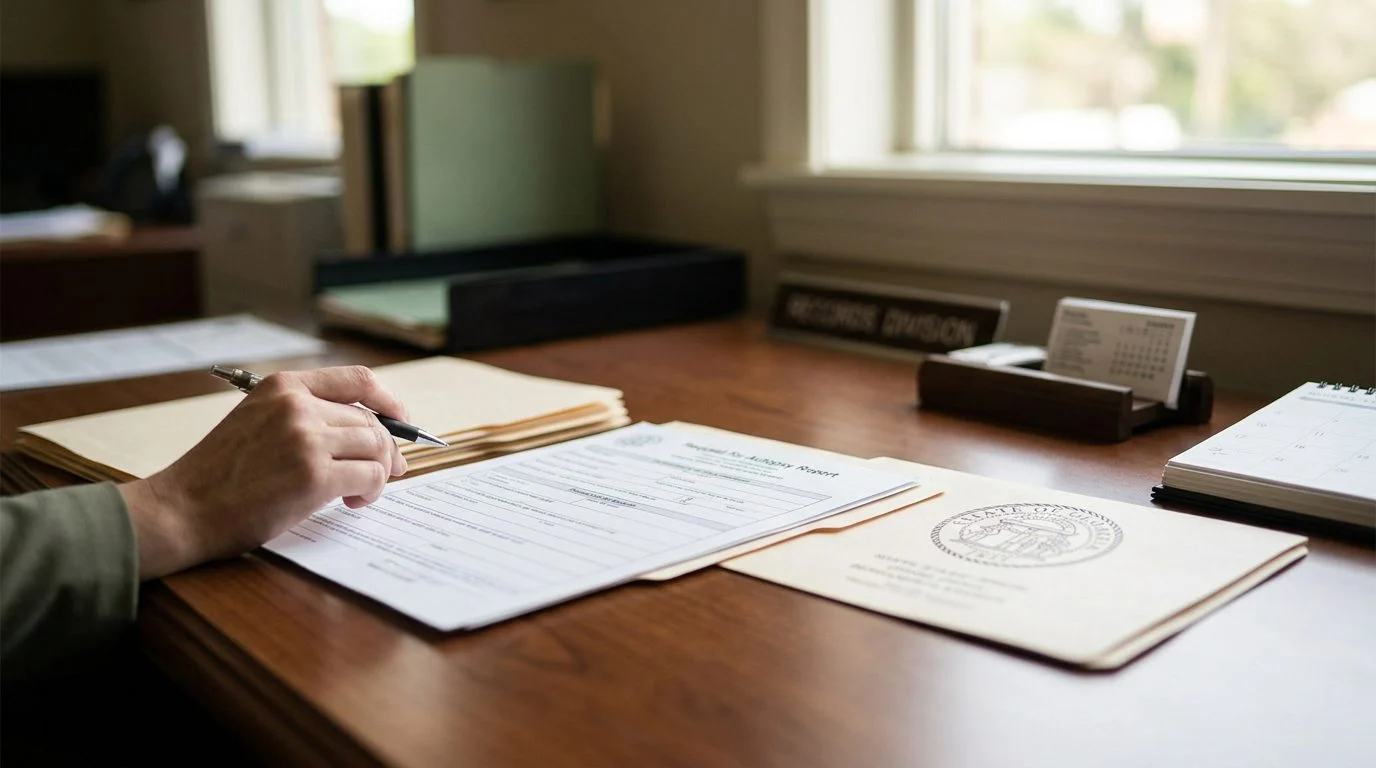
What an autopsy report is and who prepares it in Georgia
An autopsy report is the written record of a post-mortem examination. It sets out the findings, the cause of death, and the manner of death. In Georgia, autopsies are performed either by the Georgia Bureau of Investigation or by a county medical examiner’s office, depending on the county where the death occurred.
The report can also record injuries. That matters in many crash and injury deaths, because the findings can help show what happened to the person. Think of the autopsy report as one part of the death record, not the entire story.
You may also hear the terms medical examiner and coroner. When you make a request, name the office that issued the report. That helps your request reach the right place.
Who can request an autopsy report and how the request works
Requests for an autopsy report go through a formal records process. Send your request to the office that performed the autopsy, which is either the GBI or the county medical examiner who handled the case.
Include the details that help the office find the right file. Give the full name of the person who died, the date of death, and the county where the death happened. Add your name, your relationship to the person, and the phone number and email where the office can reach you. Keep a copy of everything you send.
Whether a particular person can get a copy depends on the facts of the case and on the agency’s rules. If you are unsure of your status, ask the records office before you submit. Asking first can save time.
Fees, timing, and when the report may not be ready yet
A report can take time to finish. Some findings depend on laboratory tests, and those results can take longer to arrive. An open investigation can also affect when records are released.
Ask the office whether anything is holding up the file. That way, you know what to expect.
Fees are the next question to ask. Before you submit, ask the agency whether it charges for copies and how much. Fee rules can differ by agency, so confirm the current amount with the office directly.
Ask how the office delivers copies, too. Save the date you sent each request and every reply you receive. A written timeline helps if you need to follow up.
How an autopsy report fits into a wrongful death claim
The autopsy report is one record in a wrongful death claim, not the whole case. Hospital, emergency medical, and police records also help document how a death or serious injury happened.
If there is no surviving spouse, a child or children may recover. The amount is the full value of the life of the decedent, as shown by the evidence. See O.C.G.A. § 51-4-2.
Under Georgia law, if there is no person entitled to bring a wrongful death action under O.C.G.A. § 51-4-2 or § 51-4-4, the administrator or executor of the decedent may bring the action for the benefit of the next of kin (O.C.G.A. § 51-4-5).
Under Georgia law, actions for injuries to the person generally must be brought within two years after the right of action accrues (O.C.G.A. § 9-3-33).
Under O.C.G.A. § 51-12-1.1, special damages for medical and healthcare expenses in a personal injury or wrongful death civil action are limited to the reasonable value of medically necessary care, treatment, or services, and the trier of fact determines that amount.
Reviewing the report with the other records is part of how a claim is looked at. Reviewing these records does not tell anyone how a claim will turn out. For background, read about wrongful death claims in Georgia.
Common questions families ask while they wait
Families often ask a few practical questions while they wait for the report. The answers below are short.
Can a family member who is not next of kin get a copy?
The records office sets the rules for who may receive a copy. Ask the office before you submit your request.
What if my request is incomplete?
Send the missing details in a follow-up. Keep copies of everything you send.
What if the report uses medical terms I don’t understand?
Medical findings can be hard to read. A lawyer can explain what the findings mean for a possible claim, in plain words.
Not sure what your next step is?
Talk it through with our team — the first consultation is free, confidential, and carries no obligation.

Talk with our team about your family’s situation
Waiting on an autopsy report after a sudden death is hard. Learning how to obtain an autopsy report in Georgia adds one more task to a painful time. If you’re waiting on a report, you don’t have to sort out the records alone.
Ugwonali Law Group represents families in wrongful death cases across metro Atlanta and statewide in Georgia. Our intake team speaks English and Spanish. Our first consultation is free, confidential, and without obligation to continue.
To talk through your family’s situation, contact our team. Our office is at 3400 Peachtree Road NE, Atlanta, Georgia.
General information only, not legal advice. Responsible lawyer: Adanna Ugwonali, Ugwonali Law Group, 3400 Peachtree Road NE, Atlanta, Georgia.
Steps to Requesting the Report
1. Confirm who performed the autopsy
Autopsies are often performed by a county medical examiner or coroner's office, or by a hospital or forensic pathologist. Knowing which office holds the report tells you where to send your request.
2. Put your request in writing
Many offices ask for a written request that includes the decedent's full name, date of death, and your relationship to the person. Keep a copy of everything you send.
3. Ask about the office's requirements
Each office sets its own procedures, fees, and rules for who may receive a copy. Ask before you submit so you do not have to resend your request.
4. Review the report with support
Autopsy reports use medical and technical language. Many families bring questions to their attorney or medical provider to better understand the findings.
Keep Track of Your Requests
Record the date you sent each request, the office you contacted, and the name of the person you spoke with. Save any confirmation numbers. If you are unsure how to proceed, you do not have to figure it out alone.
How Ugwonali Law Group Supports Families
Compassionate, plain-language guidance
We explain legal and medical terms in clear language so you know what to expect at each step.
Help understanding the report
Our team can help you make sense of the autopsy findings and how they relate to your family's questions.
English or Spanish
Our intake staff can speak with you in English or Spanish, whichever is more comfortable for you.
Free first consultation
Your first consultation is free, confidential, and carries no obligation to continue.