

Atlanta & Georgia Injury Claims
When More Than One Vehicle Is Involved, Who Can Be Named?
Ugwonali Law Group, led by attorney Adanna Ugwonali, represents people seriously injured in truck and car crashes across metro Atlanta and Georgia. Here is how multi-vehicle crash claims are organized, in plain language.
How We Work With You
Free
First consultation, confidential and with no obligation to continue
2
Languages at intake: English and Spanish
Statewide
Serving metro Atlanta and Georgia from 3400 Peachtree Road NE, Atlanta
By Adanna Ugwonali · Published November 1, 2026
Multi-vehicle crash liability in Georgia asks who must answer for injuries when several drivers or companies may have contributed. Georgia does not simply blame the car that hit you last. Fault is split by percentage among everyone whose conduct played a part. This guide explains how that split works, who may be named, and what to watch for if you were seriously hurt in a pileup or chain-reaction crash.
What Makes a Multi-Vehicle Crash Different Under Georgia Law
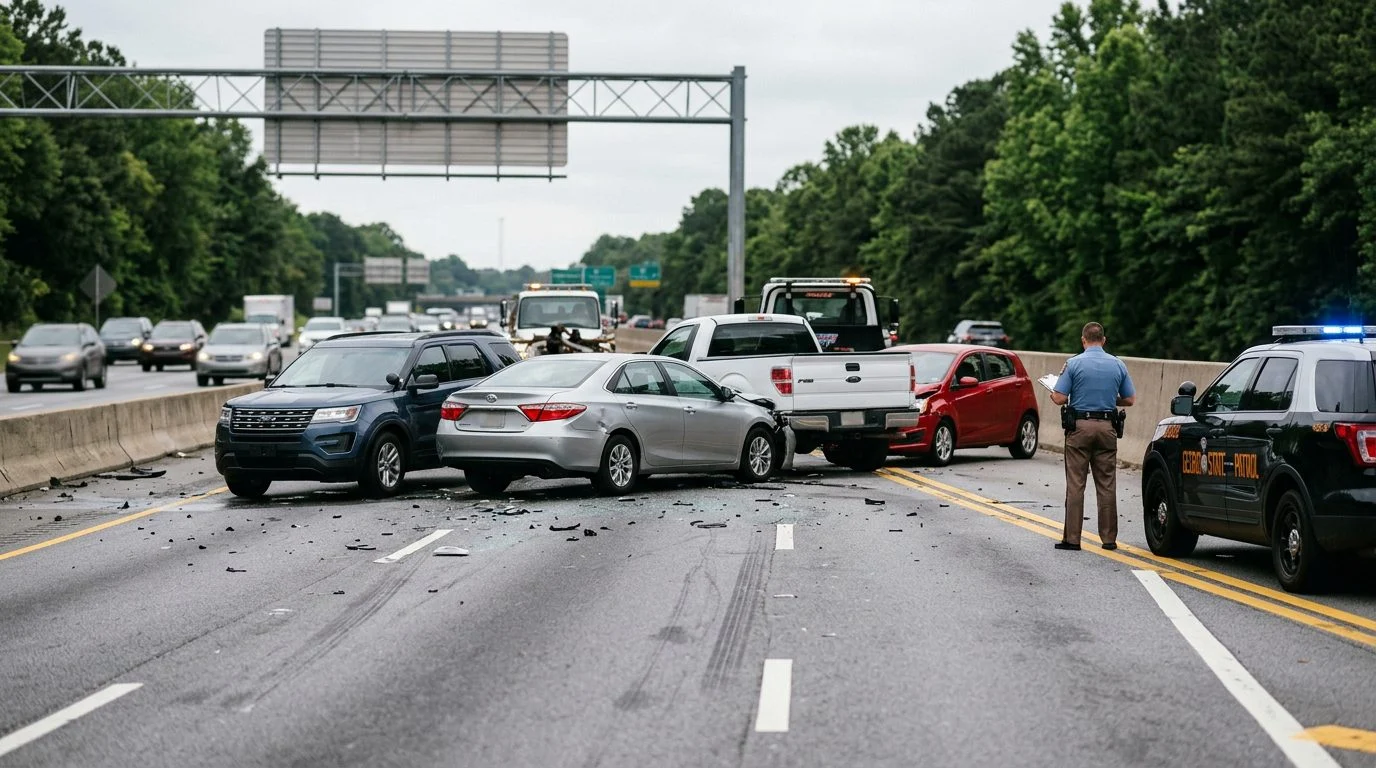
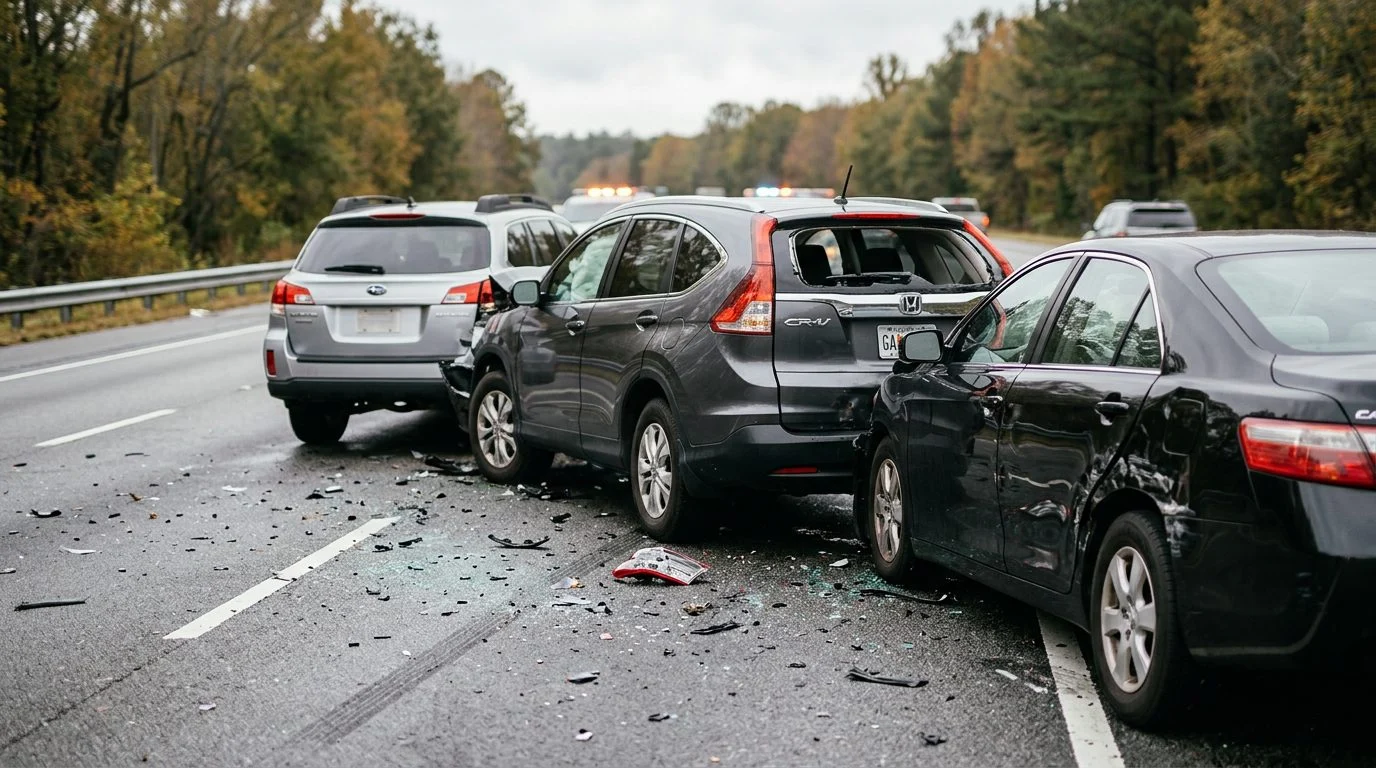
A multi-vehicle crash is different because one injury can come from several separate mistakes. A chain-reaction crash often starts when one driver fails to stop in time, and the next driver cannot stop either. In a pileup, one impact can push cars into others within seconds. Each impact may cause its own harm.
That is why the first impact does not settle the question. The driver who started the sequence may not be the only one responsible. A driver who followed too closely, or who changed lanes without looking, may have added to the damage. Another driver may have pushed a car into the vehicle ahead.
Serious injuries often come from the later impacts. A broken leg, a head injury, or a spinal injury can result from a second or third collision. Medical records and timing matter here.
This page covers who may be named, how fault is split, what evidence matters, which insurance layers may apply, and which time limits to keep in view.
If several vehicles were involved in your crash and you're unsure who may be responsible, our team can talk it through with you in a free, confidential first consultation. Talk it through with our team — the first consultation is free, confidential, and carries no obligation.
How Georgia Divides Fault Among Several Parties
Georgia divides fault by percentage, and each liable party pays only its own share. Under O.C.G.A. § 51-12-33, the judge first reduces damages by the injured person’s own share of fault. The award is then split among the people found liable, based on each person’s percentage.
The statute also says these shares are not joint liability. Damages apportioned to each person are that person’s own liability and are not subject to contribution. In plain terms, one party’s share does not automatically become another party’s bill.
The injured person’s own share matters too. Under the same statute, a plaintiff who is 50 percent or more responsible cannot receive any damages. Under O.C.G.A. § 51-12-33, when a plaintiff is to some degree responsible for the injury or damages claimed, the judge shall reduce the amount of damages otherwise awarded to the plaintiff in proportion to his or her percentage of fault. A separate rule, O.C.G.A. § 51-11-7, addresses cases where the injured person could have avoided the consequences of the defendant’s negligence with ordinary care, in which case the injured person is not entitled to recover.
Under O.C.G.A. § 51-12-33(c), the trier of fact must consider the fault of all persons or entities who contributed to the injury, whether or not they were or could have been named in the lawsuit. Nonparty fault is also addressed in subsection (d). Under O.C.G.A. § 51-11-7, if the plaintiff by ordinary care could have avoided the consequences to himself caused by the defendant’s negligence, he is not entitled to recover. Percentages depend on the facts of each crash, and the same collision can look different depending on who saw what and when.
Drivers Who May Be Named in a Chain-Reaction Crash
Common conduct in pileups includes following too closely, sudden braking, distraction, speeding for conditions, fatigue, and impairment. Each of these can turn a slowdown into a multi-car collision.
A driver who pushed a vehicle into the car ahead may share responsibility for that impact. So may a driver who cut into traffic and forced others to brake hard. The question is not only who hit the car last. It is who did what, and when.
A driver who was also hurt can have a claim too. Being injured does not erase a driver’s role in the crash. Each vehicle’s role should be looked at separately, because the first driver to brake may have done nothing wrong while a later driver did.
The police report, any citations, and what each driver said at the scene are starting points. They are not the final word. Reports can be incomplete, and early statements can be corrected later. A careful review compares them with physical evidence and other records.
Employers, Trucking Companies, and Other Businesses Behind a Driver
A company can be responsible for a driver’s negligence when the driver was doing the company’s work. Georgia’s rule is that every person is liable for torts committed by his servant in the prosecution and within the scope of his business, whether by negligence or voluntarily. That language comes from O.C.G.A. § 51-2-2.
This matters most in truck and delivery crashes. When a commercial driver causes a pileup while working, the trucking company may be named. Whether the driver was working at the time depends on the facts, such as the trip, the load, and the schedule.
A company can also face claims for its own decisions. These claims often look at how it hired, trained, supervised, or kept a driver, and what it knew or should have known. A vehicle owner who let an unfit driver use the vehicle may also be part of the picture.
Federal rules show how closely motor carriers must track drivers. 49 CFR 391.23 requires each motor carrier to make investigations and inquiries about each driver it employs, except as provided in subpart G and other than a person who has been a regularly employed driver of the motor carrier for a continuous period which began before January 1, 1971. In Montgomery v. Caribe Transport II, LLC (2026), the U.S. Supreme Court held that a state-law negligent-hiring claim against a broker fell within a safety exception and was not preempted, as the Court’s opinion explains.
Evidence That Shows Who Did What in a Pileup
The evidence that shows who did what often includes the crash report, photographs, dashcam and traffic camera footage, witness statements, and the timing of each impact. Together, these show the order of events. The order often shapes how fault is weighed.
Commercial trucks often carry electronic data recorders, which can capture speed, braking, and throttle before impact. 49 CFR 382.303 requires employers to test surviving drivers for alcohol and controlled substances after certain crashes. Those include crashes involving loss of human life, where the employer must test each surviving driver who was performing safety-sensitive functions for alcohol and for controlled substances as soon as practicable; if a controlled substances test is not administered within 32 hours, the employer must stop attempting it. Under 49 C.F.R. § 382.303, an employer must test a surviving driver for alcohol if the driver receives a citation within 8 hours of the occurrence under State or local law for a moving traffic violation arising from the accident, and the accident involved bodily injury that, as a result of the injury, immediately receives medical treatment away from the scene, or one or more motor vehicles incurring disabling damage requiring a tow truck or other motor vehicle to transport them away from the scene; and if a required controlled substances test is not administered within 32 hours following the accident, the employer must cease attempts to administer it and keep a record of the reasons.
The timing rules are specific. If an alcohol test is not given within two hours, the employer must keep a record of why. If it is not given within eight hours, the employer must stop trying. For controlled substances, the employer must stop attempting the test after 32 hours and keep a record.
Medical records help connect harm to the impact that caused it. Records showing the type and order of injuries from each collision can clarify what happened.
Early action matters. Electronic data and video can be overwritten on routine schedules. A written request to preserve evidence, made early, helps keep it from being lost.
Insurance Layers in a Multi-Vehicle Claim
Several insurance policies may apply in one pileup. Those policies can have different limits and conditions, and each may respond to a different share of the claim.
Motor carriers have their own rules. O.C.G.A. § 40-1-112 limits when a carrier’s insurance company can be joined in a lawsuit. Joinder is allowed in limited situations, such as when a related carrier is insolvent or bankrupt, or when the driver or carrier cannot be served after reasonable diligence. The same statute says a missed filing does not reduce a person’s right to pursue the carrier’s insurer directly.
Your own coverage can matter too.
Insurers for different parties may each dispute their share. Avoid signing statements or releases until you understand what they cover. Planning the order of claims can prevent a costly misstep.
Not sure what your next step is?
Talk it through with our team — the first consultation is free, confidential, and carries no obligation.
Time Limits and Serious Injury Damages to Keep in View
Georgia generally gives two years to file most injury lawsuits, but other deadlines can apply. Under O.C.G.A. § 9-3-33, actions for injuries to the person must be brought within two years after the right of action accrues. Loss of consortium claims have a four-year period under the same statute. Because deadlines depend on the claim, it helps to track dates from the start.
Medical expenses have limits too. O.C.G.A. § 51-12-1.1 limits special damages for medical and healthcare expenses to the reasonable value of medically necessary care, treatment, or services. Traumatic brain and spinal cord injuries can affect care needs and work for a long time. The record of lost earning capacity builds over time, as explained in this guide to lost earning capacity after brain injury.
When a crash causes a death, the medical expense rules still apply, since Georgia’s medical expense statute covers any civil action to recover damages resulting from injury or death to a person. O.C.G.A. § 51-4-5 says that when death of a human being results from a crime or from criminal or other negligence, the personal representative may recover funeral, medical, and other necessary expenses that resulted from the injury and death. Medical bills incurred before death are covered in this wrongful death billing guide. For the wider process, see the catastrophic injury overview.
Talking With a Georgia Injury Firm About Your Crash
A first conversation can sort out the parties, the timeline, and the treatment you have had so far. Bring what you have, such as the crash report, names of the drivers and companies involved, insurance details, and medical records. Missing pieces can be identified together.
Ugwonali Law Group offers a free first consultation. It is confidential and comes with no obligation to continue. Intake staff can speak with you in English or Spanish. The firm is located at 3400 Peachtree Road NE, Atlanta, Georgia, and serves clients across metro Atlanta and throughout Georgia. Adanna Ugwonali is the responsible lawyer for this page. You can read more about serious injury claims in Atlanta.
If your crash involved several vehicles and you’re trying to work out who may be responsible, request a free case evaluation and our team will review it with you.
Frequently asked questions
Georgia considers the fault of everyone who contributed to the injury.
Can I recover if I was partly at fault?
Under O.C.G.A. § 51-12-33, damages are reduced in proportion to the plaintiff’s percentage of fault, and the plaintiff shall not be entitled to receive any damages if he or she is 50 percent or more responsible for the injury or damages claimed. Your damages are reduced by your percentage, and you cannot recover if you are 50 percent or more responsible (O.C.G.A. § 51-12-33; Quynn v. Hulsey (2020)).
How long do I have to file?
Georgia generally allows two years after the right of action accrues for most injury claims. Other deadlines can apply, so track dates early.
This page is general information, not legal advice. Ugwonali Law Group, 3400 Peachtree Road NE, Atlanta, Georgia. Responsible lawyer: Adanna Ugwonali.
Parties Who May Be Part of a Multi-Vehicle Claim
The Drivers Involved
Every driver whose conduct may have contributed to a crash can be examined, including drivers of cars, pickups, and commercial trucks.
Employers and Companies
When a driver was working, the company that employed or dispatched that driver may be part of the claim.
Vehicle Owners
The owner of a vehicle may be named in some situations, depending on how and by whom the vehicle was being used.
Maintenance and Repair Providers
Companies that inspected, serviced, or repaired a vehicle may be relevant if a mechanical failure played a role.
Cargo and Loading Parties
Those who loaded, secured, or shipped cargo can be part of the investigation when an improperly secured load contributed to the crash.
Property Owners and Others
In some crashes, a road or property condition or another responsible party may be relevant to the injuries and losses.
Why Early Action Matters
Multi-vehicle crashes often involve several insurers, companies, and records that can change or disappear over time. Accident reports, vehicle data, driver logs, and witness information are easier to protect when they are gathered early. Contact our intake team as soon as you can after a serious crash.
What Helps a Multi-Vehicle Claim Move Forward
Identify Every Vehicle
Note the make, model, plate number, and direction of each vehicle involved, along with any photos you or others took at the scene.
Ask Who Employed the Driver
If a commercial vehicle was involved, knowing the employer, carrier, or company name can help identify the parties who may be responsible.
Keep Medical Records
Ongoing treatment from a medical doctor, including emergency care, imaging, surgery, and therapy, documents the injuries and their impact on your life.
Share Your Questions
Our team explains the legal and medical process step by step, so you can make informed decisions about your case.