

Rear-End Crashes | Atlanta and Georgia
Hurt in a Rear-End Crash? Start With the Facts.
A plain-language guide to injuries, medical care, insurance calls, and the records that help after a serious collision on Georgia roads.
Getting started with Ugwonali Law Group
Free
First consultation, confidential and with no obligation
EN / ES
Intake in English or Spanish
Atlanta
Office at 3400 Peachtree Road NE
By Adanna Ugwonali · Published November 11, 2026
Can You Be at Fault If You Are Rear-Ended in Georgia?
Getting rear-ended is jarring. Your neck aches, your car is damaged, and an insurance adjuster may already be asking what happened.
Can you be at fault if you are rear-ended in Georgia?
Yes. A driver who was rear-ended can share responsibility for the crash, depending on what each driver did in the seconds before impact. Being hit from behind does not settle fault by itself. Speed, following distance, how and why the front car stopped, working brake lights, traffic, and road conditions all matter.
Many people reading this are still hurting. They are dealing with repair bills, medical appointments, and an insurance claim they never planned to make. That is a lot to take in at once. The plain facts below can help you understand how fault gets decided. Nobody can predict how a particular crash will end, because each one turns on its own facts.
Why the driver behind is usually where fault starts
The driver behind is where most rear-end claims begin.
Under Georgia law on ordinary negligence, ordinary diligence is that degree of care which is exercised by ordinarily prudent persons under the same or similar circumstances, and the absence of such diligence is termed ordinary negligence. Insurers and courts often ask a simple question. Did the following driver keep enough space and attention to stop safely?
Many claims start from the idea that the trailing driver could have stopped in time. That starting point is a common framework, not an automatic finding. The facts of the crash still decide how the blame is split.
When the driver in front can share or carry fault
The driver in front can share fault when their own driving played a part in the crash. Common examples include:
- Sudden or unsignaled stops. A stop that was abrupt, unneeded, or announced too late can leave the following driver no real time to react.
- Brake-checking. Slamming the brakes to punish or provoke a tailgater is treated differently from braking for traffic or a hazard.
- Reversing or cutting in. A driver who backs up or merges in front of a car too closely can shrink the gap the other driver had to work with.
- Stopping in a travel lane for no clear reason. A stop that blocks traffic without a hazard may get close examination.
- Lights or signals that did not work. Brake lights that were out can affect what the following driver could see.
Some stops are caused by a hazard, such as an animal, debris, or a sudden emergency. Those stops are judged on their own facts. A reaction to an emergency is judged in context, with the time pressure the driver faced.
How Georgia’s comparative negligence rule affects a rear-end claim
Georgia uses modified comparative negligence, which means fault is divided by percentage. O.C.G.A. § 51-12-33 reduces an injured person’s damages in proportion to that person’s own share of fault.
The same statute says a plaintiff who is 50 percent or more responsible for the injury or damages claimed is not entitled to receive any damages (O.C.G.A. § 51-12-33; Quynn v. Hulsey (2020)).
The statute also says each liable person pays only the damages apportioned to that person’s share of fault. Those damages are not a joint liability among the persons liable. Georgia also follows an avoidance rule. Under O.C.G.A. § 51-11-7, a plaintiff who by ordinary care could have avoided the consequences of the defendant’s negligence is not entitled to recover. In other cases, the defendant is not relieved just because the plaintiff contributed in some way. These rules work together, so the actions of each driver carry weight.
Parking-lot rear-ends and chain-reaction crashes
Parking-lot collisions usually turn on who was backing up, who was moving, and who had room to stop. A parked car struck by a moving vehicle raises different questions than two cars rolling through a lane. The location, the speed, and the traffic around the crash all shape how fault gets examined.
Chain-reaction crashes add more drivers. Georgia law requires the judge or jury, called the trier of fact, to consider the fault of all persons who contributed to the injury. That includes people who were never named in the lawsuit. O.C.G.A. § 51-12-33 then divides the damages by each person’s share, so each liable driver pays only its own part.
That is why a multi-car highway crash can look very different from a simple two-car collision. Each driver’s following distance, braking, and reaction time may be reviewed in turn.
Not sure what your next step is?
Talk it through with our team — the first consultation is free, confidential, and carries no obligation.
Evidence that helps show who was at fault
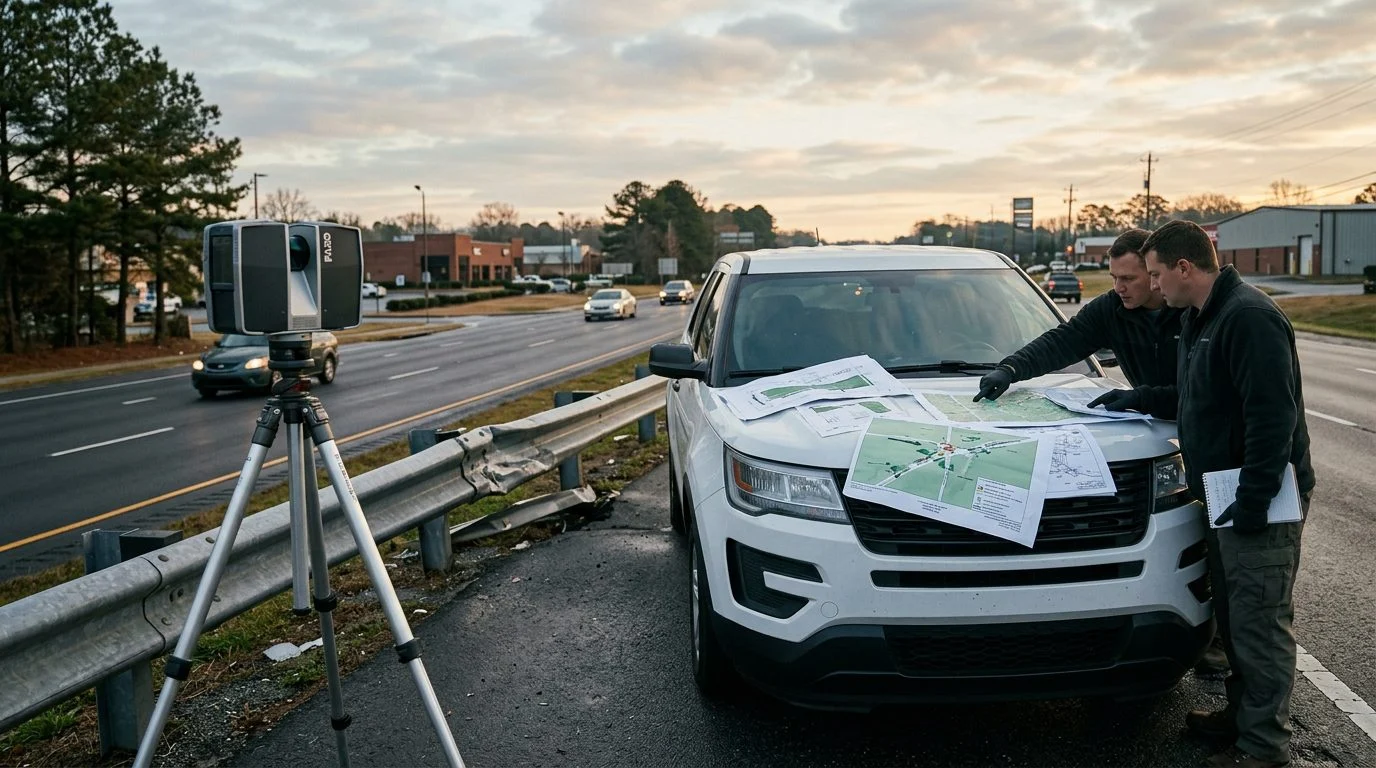
The strongest proof usually comes from records made close to the crash. The police report records what the officer saw and heard. The officer’s conclusions are one part of the picture, not the final word.
Other evidence can help:
- Photos of vehicle damage, brake lights, skid marks, and road conditions, taken soon after the crash.
- Dashcam or camera footage from a nearby business or traffic camera, which can show how each car braked and moved.
- Vehicle event data from the cars involved, which can record speed and braking before impact when it is preserved.
- Witness names and statements, plus your own written account made soon after the crash.
- Medical records that connect your injuries to the collision, from the first emergency or urgent care visit through follow-up care with a medical doctor.
Georgia gives patients a way to get their records. Medical bills also get reviewed. O.C.G.A. § 51-12-1.1 limits medical expense damages to the reasonable value of medically necessary care, treatment, or services.
Insurance, medical treatment, and time limits after a rear-end crash
The at-fault driver’s liability insurance is usually where an injury claim gets paid from.
If the other driver is uninsured, your own policy may matter. Under O.C.G.A. § 33-7-11, Georgia auto policies include an endorsement that pays the insured for damages caused by an uninsured owner or operator, within limits the insured can choose.
Get checked by a medical doctor promptly, and follow the treatment that is recommended. Insurers often raise gaps in care, so keeping appointments matters. How long a claim takes depends on the injuries, how long treatment lasts, and how quickly the evidence is reviewed. Nobody can promise a timeline.
Georgia generally gives two years to bring an injury claim. Under O.C.G.A. § 9-3-33, actions for injuries to the person must generally be brought within two years after the right of action accrues, except as otherwise provided in this article; actions involving loss of consortium must be brought within four years after the right of action accrues, and injuries to reputation within one year after the right of action accrues.
Quick answers
Can the driver in front be at fault?
Yes. A driver in front can share fault if an action of their own, such as a sudden or brake-checking stop, helped cause the crash.
Does shared fault reduce damages in Georgia?
Yes.
How long do I have to file an injury claim?
O.C.G.A. § 51-12-33 does not set a filing deadline; it governs how fault and damages are divided where an action is brought against one or more persons for injury to person or property.
Who pays in a chain-reaction crash?
Each liable driver pays only its own apportioned share of the damages.
Talk with Ugwonali Law Group about your rear-end crash
If the pain from your crash and the calls about fault have you stuck, you don’t have to sort it out alone. Our team is ready to listen. You can request a free case review through our contact page.
Our first consultation is free, confidential, and without obligation to continue. Intake staff can speak with you in English or Spanish. Ugwonali Law Group is located at 3400 Peachtree Road NE, Atlanta, Georgia, and Adanna Ugwonali is the responsible lawyer for this page.
This page is general information, not legal advice. For more background, see our Georgia car accidents guide.
What to Keep Track Of After the Crash
Photos and the scene
Pictures of vehicle damage, the road, traffic signals, and any skid marks can help show what happened while it is still fresh.
Every medical visit
Keep discharge papers, imaging results, prescriptions, and notes about pain, headaches, or limited movement, even when symptoms seem minor at first.
A running timeline
Write down dates, missed work, and changes in daily life so the full impact of the injury is easier to explain later.
Insurance correspondence
Save letters, emails, and call notes from every insurance company involved in the crash.
Think Before You Give a Recorded Statement
An insurance adjuster may ask for a recorded statement soon after a crash. Before you agree, consider whether you fully understand your injuries and the medical picture. Speaking with a lawyer first can help you decide how to respond.
Questions Injured Drivers Often Ask
What if I have a pre-existing condition?
Prior back, neck, or head problems do not always end a claim, but records from before the crash help doctors and attorneys separate old symptoms from new injuries.
Why does medical treatment matter?
Consistent care by a medical doctor creates a record that connects your symptoms to the crash and documents your recovery over time.
Will I be charged for a first call?
No. Our first consultation is free, confidential, and carries no obligation to continue.