

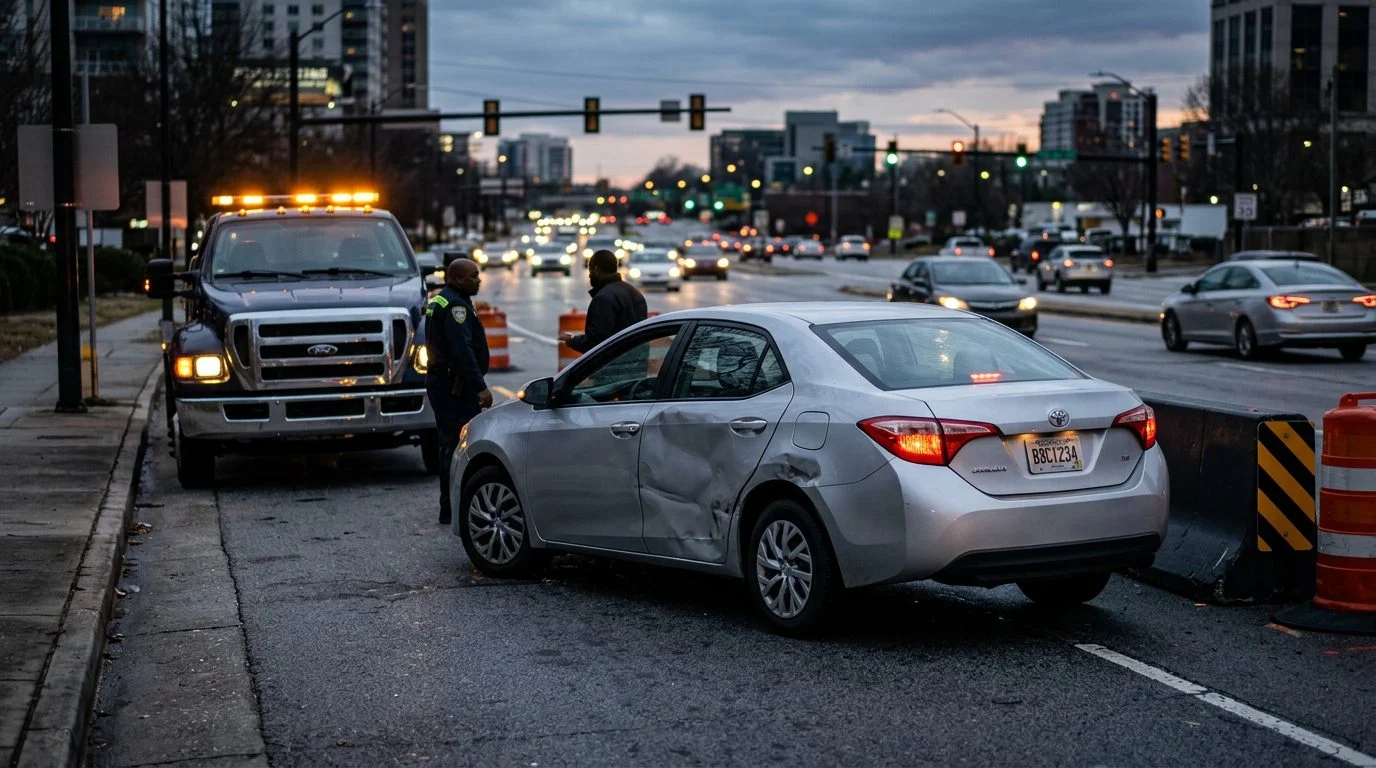
Car Accidents | Atlanta and Georgia
A Construction Zone Crash Can Involve More Than One Responsible Party
Ugwonali Law Group helps people seriously hurt in work zone crashes across metro Atlanta and statewide understand who may share responsibility and what the legal and medical process involves. Free case reviews, in English or Spanish.
By Adanna Ugwonali · Published November 3, 2026
A construction zone car accident in Georgia can involve more than one party. The driver may share fault with a trucking company, a general contractor, a subcontractor, or a private traffic control firm. Which of them played a part depends on the facts of the crash.
If you’re reading this after a crash, you may be in a hospital room, caring for someone who was hurt, or trying to make sense of a crash report. This page explains, in plain words, who may be part of these cases and how Georgia divides fault among them.
Why Construction Zone Crashes Happen and Who Gets Hurt
Construction zone crashes usually happen when the road changes faster than drivers expect. Lanes shift or narrow. Traffic slows suddenly near the front of a backup. Pavement can be uneven, and barrels, barriers, and signs sit close to moving cars and trucks. Workers may stand just feet from live lanes.
Each change leaves a driver less room to react. A driver who is looking at a phone, or following a truck too closely, has even less time.
Drivers, passengers, and the workers on the road can all be hurt. A crew member struck by a passing car can suffer injuries as serious as those of a driver in a crash. Because several private companies often work in the same zone, responsibility is often shared. The sections below walk through each group that may be part of a claim.
If a crash in a work zone left you or a family member hurt, you don't have to sort out who is responsible alone, and our team can review the facts with you. Talk it through with our team — the first consultation is free, confidential, and carries no obligation.

The Driver Who Caused the Crash
A driver who fails to slow, follows too closely, speeds, or gets distracted in a work zone may be negligent. Negligence means failing to use proper care. Georgia defines ordinary diligence as “that degree of care which is exercised by ordinarily prudent persons under the same or similar circumstances” (O.C.G.A. § 51-1-2).
A claim against a driver depends on the facts of the crash and the injuries that followed. Did the driver owe a duty to drive with care? Did the driver break that duty? Did the broken duty cause the crash? Did the crash cause real injury or loss? Each answer needs facts, such as photos of the scene, witness statements, and the crash report.
If the driver was working for a company at the time, that company may also be part of the picture. The next sections explain how.
Commercial Trucks and the Companies Behind Them
When a commercial truck is involved, the company that operates it may share responsibility with the driver. Federal rules apply to many interstate truck drivers, and they limit driving time. A driver may not drive without first taking 10 consecutive hours off duty, and may not drive after a period of 14 consecutive hours after coming on duty following 10 consecutive hours off duty; a driver may drive a total of 11 hours during that specified 14-hour period (49 CFR 395.3).
Trucks must also pass inspections. Each vehicle in a combination, including the trailer, must pass an inspection within the preceding 12 months, and proof must be on the vehicle (49 CFR 396.17). Inspection records can show whether those checks were done.
Company records can show how the truck was run. Driver logs, maintenance files, and dispatch records matter here. Companies must keep records for minimum periods. After the required retention periods, the records may be destroyed at the discretion of each company’s management. The provisions of this part shall not be construed as excusing compliance with the lawful requirements of any other governmental body prescribing longer retention periods for any category of records (49 CFR 379.3). That is why asking for these records early matters.
Brokers can also be part of a claim. Insurance coverage affects how a claim is handled, but it does not decide who is at fault.
Contractors, Subcontractors, and Equipment Operators
A general contractor or subcontractor may share responsibility when its work or equipment helps cause a crash. Georgia law makes an employer answerable for a contractor’s negligence in certain situations. Two examples apply here. One is when, according to the employer’s previous knowledge and experience, the work is in its nature dangerous to others however carefully performed. Another is when the employer keeps the right to direct or control the time and manner of the work (O.C.G.A. § 51-2-5).
A crash may involve a dump truck left in a live lane, a paving machine that blocked a shoulder, or a crane parked too close to traffic. It may also involve a worker who did not follow the site’s safety plan. Each one raises a different question about who controlled the work.
The contract and the site safety plan can show what the company agreed to do. Those documents are often central to how responsibility is reviewed. Photos of the site taken soon after the crash can show where equipment and workers were positioned.
Traffic Control and Lane-Closure Companies
A private traffic control company can share responsibility when the lane closure it set up fails to warn drivers in time. These firms place barrels, signs, arrow boards, and flaggers. When that setup breaks down, drivers may have too little warning to stop or move over.
Common problems include a sign placed in the wrong spot or missing, a lane closure marked too late for a driver to change lanes safely, and a flagger who did not stop traffic when a lane was still active. Each problem is a question of fact, and the details matter.
Traffic control plans and photos of the setup can show what was in place at the time of the crash. Ask for these early, while the scene is still easy to document. This page focuses on private companies, not government crews.
Georgia Traffic Rules and How Fault Is Divided
In a construction zone car accident in Georgia, fault is often divided among several parties. Georgia reduces an injured person’s damages by their own share of fault. A person found 50 percent or more responsible cannot recover damages. The judge reduces the award by the plaintiff’s percentage of fault (O.C.G.A. § 51-12-33). For example, a 20 percent share of fault would reduce the award by 20 percent.
In a multi-party crash, the statute works in several steps. Each liable party owes only its own share. The damages are not joint, so one party does not pay another’s share, and there is no right of contribution between them. A defendant may also give notice, at least 120 days before trial, that a nonparty was at fault.
That is why identifying every party early matters. A party overlooked early can still come up in the fault analysis later.
Opposing parties may argue about speed, lane changes, and distraction. Those arguments turn on facts. How fault is divided depends on the facts of each crash.
Not sure what your next step is?
Talk it through with our team — the first consultation is free, confidential, and carries no obligation.
When a Worker Is Hurt or Killed: Injury Claims and Wrongful Death
A worker hurt in a work zone may have a claim against a driver or another private party, even while on the job. Workers’ compensation generally makes the employer’s benefits the exclusive remedy against that employer. Each path works differently, and the facts decide how they fit together.
When a crash causes a death, Georgia law provides a wrongful death claim.
Medical records often matter most. Emergency department notes, imaging such as X-rays and scans, treating physician notes, and records of ongoing care show the injury and its treatment. Families can learn more about wrongful death claims in Georgia.
Evidence to Preserve and the Deadlines That Apply
Georgia’s general deadline for injury claims is two years, so early evidence work helps. Under Georgia law, actions for injuries to the person generally must be brought within two years after the right of action accrues, except as otherwise provided in the statute. Actions involving loss of consortium must be brought within four years (O.C.G.A. § 9-3-33).
Useful evidence often includes:
- Photos of the work zone, signs, barrels, and lane markings
- The police crash report
- Dashcam or traffic camera footage, if it exists
- Names and contact details for witnesses
- Photos of vehicle damage
- Medical records from the first visit onward
The Georgia Department of Transportation’s crash reporting page explains how crash data and police reports are made available. Trucking company logs and maintenance files follow the retention rules described above, so they should be requested early.
Frequently Asked Questions
Who can be responsible for a construction zone car accident in Georgia?
The at-fault driver, a trucking company, a broker, a general contractor, a subcontractor, or a private traffic control firm may each share responsibility. Which of them applies depends on the facts.
Can I still recover damages if I was partly at fault?
Georgia reduces damages by your share of fault. A person who is 50 percent or more responsible cannot recover damages (O.C.G.A. § 51-12-33; Quynn v. Hulsey (2020)).
How long do I have to file a claim?
Georgia’s general deadline for injury claims is two years under O.C.G.A. § 9-3-33 (Kenneth B. Cameron v. Jmp Pizza, Inc (2026)). Loss of consortium claims have four years.
Can a construction worker sue a driver who hit them?
Georgia law keeps a worker’s right to sue a third-party driver. That right is separate from workers’ compensation against the employer.
Talk With Ugwonali Law Group About Your Work Zone Crash
Crash cases come with hospital bills, time off work, and unfamiliar insurance calls. If a family member was hurt or killed in a work zone, or you’re still sorting out who may be responsible, you don’t need every answer before you call.
Ugwonali Law Group is located at 3400 Peachtree Road NE, Atlanta, and serves metro Atlanta and Georgia statewide. Adanna Ugwonali is the responsible lawyer for this page. Our first consultation is free, confidential, and comes with no obligation to continue. It is available in English or Spanish (Spanish: consulta inicial gratuita, confidencial y sin compromiso).
If a crash in a work zone left you or a family member hurt, you don’t have to sort out who is responsible alone. Our team can review the facts with you through a free case evaluation.
Attorney advertising. Adanna Ugwonali is the responsible lawyer for this page, at Ugwonali Law Group, 3400 Peachtree Road NE, Atlanta, Georgia. Every case turns on its own facts, and results cannot be predicted.
Parties That May Share Responsibility
The At-Fault Driver
The driver who failed to follow posted speed limits, lane closures, or flagging instructions may be one party to a claim, depending on the facts of the crash.
The Trucking Company
When a commercial truck is involved, the motor carrier or vehicle owner may be a party, particularly where company policies or driver supervision are at issue.
The General Contractor
The contractor in charge of a work site may have duties to plan, mark, and maintain safe traffic patterns through the zone.
Subcontractors and Traffic Control Firms
Crews that set up lane closures, signs, barriers, or flaggers may share responsibility if their work was not performed safely.
How Our Firm Can Help
Reviewing the Crash Facts
We look at the crash report, work zone plans, photos, and witness information to help identify the parties involved.
Connecting Medical Care to the Crash
Fractures, head injuries, and spinal injuries often need ongoing treatment. We help you understand how medical records fit into the claim.
Plain-Language Guidance
We explain each step of the legal process in clear terms, in English or Spanish, so you know what to expect.
Support for Families
When a crash results in death, we help surviving family members understand their options in a wrongful death matter.
Protect Your Claim From the Start
Insurance adjusters may contact you soon after a crash. Before giving a recorded statement or signing any document, consider speaking with a lawyer. Keep your medical records, photos of the scene, and any notes about the work zone.