

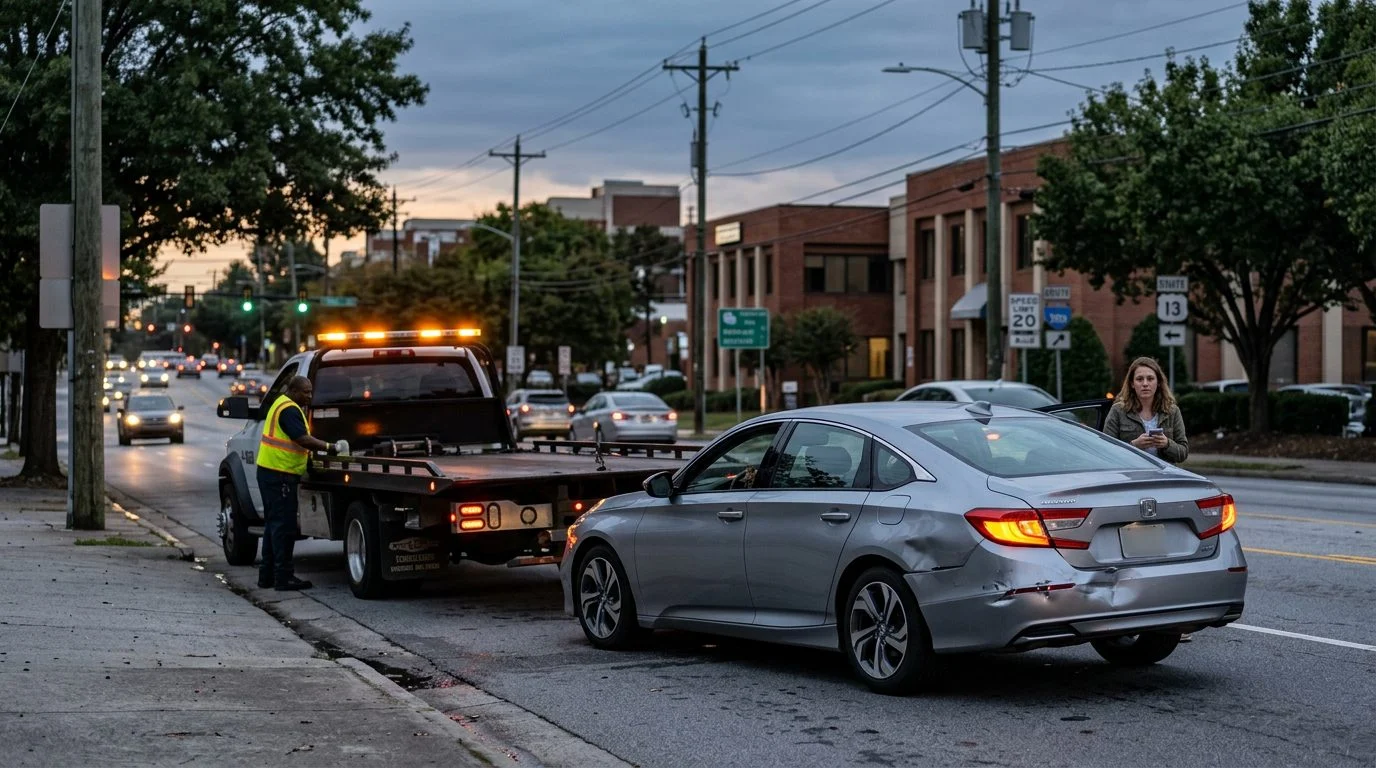
Car Accidents | Atlanta and Statewide Georgia
Hurt in a Rear-End Crash? Learn How Georgia Fault Rules Work
A plain-language guide to how fault, insurance, and medical treatment connect after a rear-end collision, and what to do next.
By Adanna Ugwonali · Published November 18, 2026
Being rear-ended can leave you with a broken bone, a stiff neck, and a car you can’t drive. You may also be asking who pays. Georgia is an at-fault state, so the driver who caused the crash is generally responsible for the losses that crash caused.
Is Georgia an At-Fault State for Car Accidents?
Yes. In a no-fault state, your own insurer pays your losses first, no matter who caused the crash. Georgia works differently, so the question of who was at fault sits at the center of the claim.
That matters more when injuries are serious. Fractures, surgery, and hospital stays can bring medical bills that run far beyond a basic property claim. Georgia law limits medical damages to the reasonable value of care that was medically necessary. The trier of fact, the jury or judge who hears the case, decides that amount under O.C.G.A. § 51-12-1.1. That is why treatment records from the start carry so much weight.
If a rear-end crash left you hurt and unsure who should pay, our team can talk through your situation with you in English or Spanish. Talk it through with our team — the first consultation is free, confidential, and carries no obligation.
Who Is at Fault in a Rear-End Collision?
A rear-end crash does not decide fault on its own. Fault depends on the facts, so each crash is examined on its own details. Investigators and insurers look at how fast each car was moving, how hard and how suddenly the front car braked, and whether road or weather conditions played a role. Distraction, such as a phone in a driver’s hand, is also part of the picture.
Several situations come up again and again. A driver may stop suddenly in traffic for no clear reason. A vehicle may pull into a lane right in front of another car. A chain-reaction crash can involve three or more vehicles. In these cases, Georgia law requires the trier of fact to consider the fault of everyone who contributed to the injury, whether or not they were named in the suit, under O.C.G.A. § 51-12-33.
If the other driver was working, the company may face its own claims. In Quynn v. Hulsey, the Georgia Supreme Court held that claims against an employer for its own negligent hiring, supervision, training, and entrustment of a vehicle are based on the employer’s own alleged negligent acts. Claims for negligent hiring, training, supervision, and retention are based on the alleged negligent acts of the employer, as set out in Quynn v. Hulsey, 310 Ga. 473 (2020). Those claims rest on the employer’s alleged negligent acts (Quynn v. Hulsey, 310 Ga. 473 (2020)).
Evidence Used to Prove Fault
The strongest proof of fault is collected early, before memories fade and video is overwritten. Start with the crash report and photos of both vehicles, the scene, and any skid marks or debris. Write down the names and phone numbers of anyone who saw the crash. Note the weather, the time of day, and what traffic looked like just before impact while it’s still fresh.
Video is often the most fragile piece. A dashcam, or a nearby business’s security camera, may record over itself within days. Ask for footage as soon as possible.
Medical proof is the other half. Emergency room records, imaging, and treatment notes should describe the crash and the symptoms that followed. Keep bills, pharmacy receipts, and proof of missed work. Under Georgia law, special damages like these must be proved in order to be recovered.
A common mistake is a casual statement to the other driver’s insurer about how you feel, made before your injuries are fully known. Stick to facts and let your medical records speak to the rest. A long gap between treatments can also give the other side something to argue about.
Georgia’s Modified Comparative Negligence Rule
Georgia uses a modified comparative negligence rule. You can still recover if you were partly at fault, as long as you were less than 50 percent responsible. Under O.C.G.A. § 51-12-33, the judge reduces the award in proportion to your percentage of fault. If you are 50 percent or more responsible, you cannot receive damages under this rule.
Here is how the math works. If the damages total a certain amount and the injured driver is found 20 percent at fault, the award is reduced by 20 percent. Each at-fault person then owes only its own share. The statute says those shares are not joint liability, so one party does not pay another’s share.
The rule can be harsh. The percentages come from the facts, which is why each crash’s details matter.
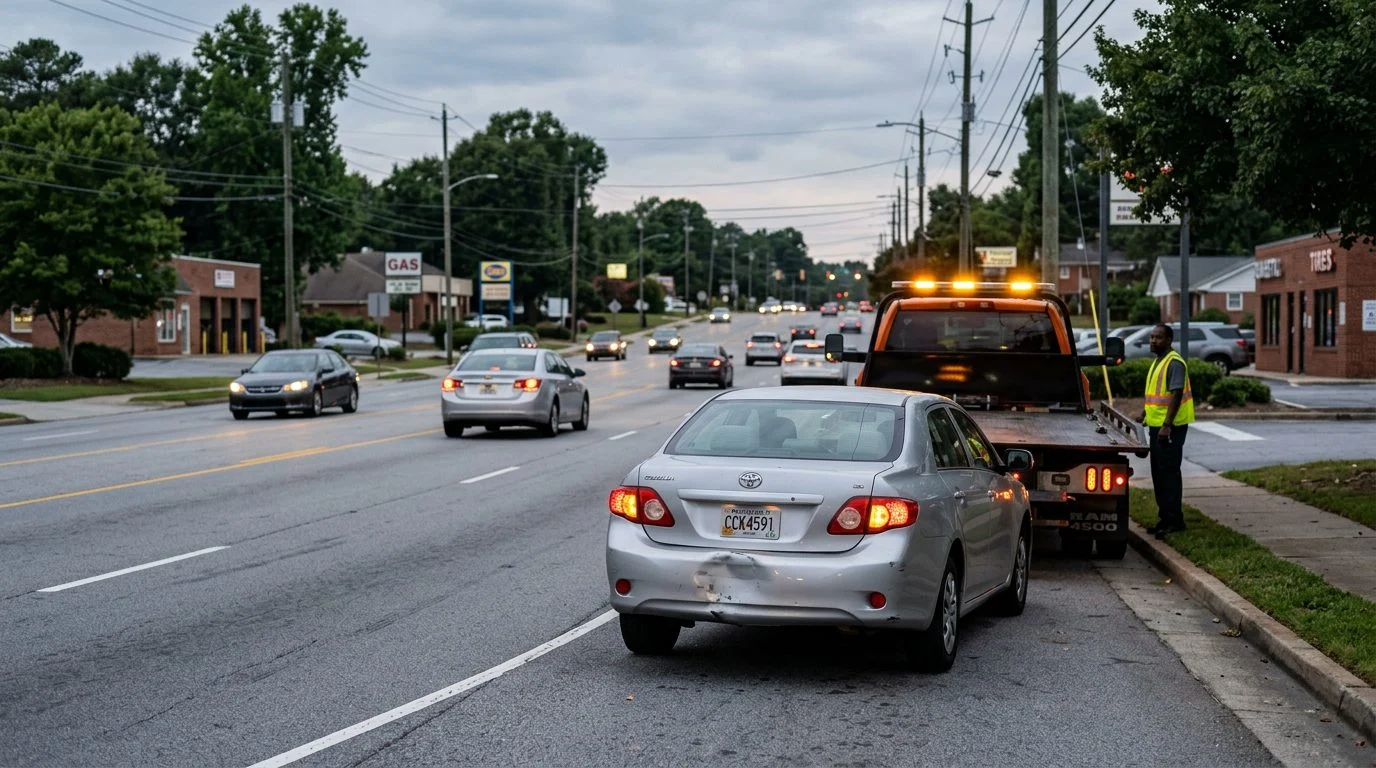
Can You Still Recover After a Rear-End Crash?
Yes, if another driver’s fault caused your losses and you can prove them. Georgia law separates losses into two kinds. Special damages are actual losses, like medical bills and lost wages, and they must be proved.
Georgia law also allows only nominal damages when an injury is small or mitigating circumstances are strong. That is one reason clear medical records matter from the first visit.
When a crash causes a death, the rules shift. If there is no surviving spouse, a child or children may recover for the homicide of a parent the full value of the decedent’s life, as shown by the evidence, under O.C.G.A. § 51-4-2. Results turn on the proof in each case.
Insurance Limits and How Claims Interact With Your Policy
O.C.G.A. § 40-9-37 sets conditions for a liability policy to count under Code Section 40-9-34. Generally, the policy must be issued by an insurance company authorized to do business in Georgia. There is an exception for a vehicle that was not registered in Georgia, or was registered elsewhere, when the policy took effect or was last renewed. In that case, a policy from an insurer not authorized in Georgia can still qualify if the insurer executes a power of attorney authorizing the commissioner to accept service of notice or process on its behalf in any action on the policy arising out of the accident. The limits must also be subject to limits, exclusive of interest and costs, of not less than the amounts specified in subparagraph (a)(1)(A) of Code Section 33-7-11, as referenced in O.C.G.A. § 40-9-37.
Those minimums are a floor, not a ceiling. A serious injury can cost more than a minimum policy pays. That is why it helps to learn the at-fault driver’s coverage early. Ask the insurer to confirm the policy limits in writing.
Written settlement offers in motor vehicle cases also follow rules. Under O.C.G.A. § 9-11-67.1, an offer made with an attorney’s help, from the time a cause of action accrues until the filing of an answer by the named defendant, must include medical records sufficient to evaluate the claim. Its payment date must be at least 40 days after receipt. Your own auto policy may also include coverage that applies after a crash. Its language controls what it pays, so read it closely.
Not sure what your next step is?
Talk it through with our team — the first consultation is free, confidential, and carries no obligation.
Deadlines: Georgia’s Statute of Limitations
For most injury claims, Georgia generally allows two years after the right of action accrues to file suit, under O.C.G.A. § 9-3-33. A claim for loss of consortium, such as a spouse’s loss of companionship, generally has four years under the same statute. Damage to property, such as your car, generally has four years under O.C.G.A. § 9-3-31.
These clocks run separately. Track them from the day of the crash, because a missed deadline can bar a claim.
Can I recover if I was partly at fault?
Yes, if you are less than 50 percent responsible. Your award is reduced by your percentage of fault (O.C.G.A. § 51-12-33; Quynn v. Hulsey (2020)).
How long do I have to sue after a car accident in Georgia?
For most injury claims, generally two years. Property damage generally has four years.
Talking Through Your Rear-End Crash With Our Team
If a rear-end crash left you or someone you love hurt, you don’t have to sort out fault and deadlines alone. Pain, medical appointments, a damaged car, and calls from the other insurer can all arrive at once.
Ugwonali Law Group, led by attorney Adanna Ugwonali, represents people seriously hurt in car and truck crashes, unsafe-property injuries, and wrongful death cases across metro Atlanta and Georgia. If you want to learn more about how Georgia’s rules apply to your crash, you can read our guide to Georgia’s law on auto accidents.
If a rear-end crash left you hurt and unsure who should pay, our team can talk through your situation with you in English or Spanish. Request a free case evaluation at 3400 Peachtree Road NE, Atlanta, Georgia.
La consulta inicial es gratuita, confidencial y sin compromiso de continuar. The first consultation is free, confidential, and comes with no obligation to continue.
Responsible lawyer: Adanna Ugwonali, Ugwonali Law Group, 3400 Peachtree Road NE, Atlanta, Georgia. This page is general information, not legal advice.
How Our Firm Works With Injured Clients
Free First Consultation
La consulta inicial es gratuita, confidencial y sin compromiso de continuar. Our intake team answers calls and can talk with you in English or Spanish.
Medical Care Comes First
Our team encourages every injured person to get evaluated by a medical doctor, and we help you understand how treatment records fit into a claim.
Plain-Language Explanations
We explain the legal and medical process step by step, so you can make informed decisions at your own pace.
Based in Atlanta
Ugwonali Law Group is located at 3400 Peachtree Road NE, Atlanta, Georgia, and represents injured people across metro Atlanta and throughout Georgia.
Be Careful Before You Talk to an Insurer
The other driver's insurance company works to limit what it pays. Before giving a recorded statement or signing anything, consider speaking with a lawyer about your situation.
Steps Many Injured Drivers Find Helpful
Get Checked by a Doctor
Seek medical care promptly, even if your injuries feel minor at first. Keep every appointment and follow your treatment plan.
Keep Your Records
Save the police report, photos of the vehicles and scene, repair estimates, bills, and notes about missed work.
Track Your Symptoms
A simple daily journal of pain, sleep, and limits on daily activities can help your medical team and your lawyer understand your injuries.
Ask Questions Early
Our team offers a free case review, so you can learn how Georgia's fault rules may apply to your crash before you decide on next steps.