


Slip and Fall | Atlanta, Georgia
Hurt in a Hospital Fall? Understand Your Options Before You Decide.
Ugwonali Law Group helps people with serious injuries from falls on private property, including some falls in medical facilities, across metro Atlanta and Georgia. Your first consultation is free, confidential, and comes with no obligation to continue.
How we work with you
Free
Case reviews and first consultations
EN / ES
Intake in English or Spanish
Atlanta
3400 Peachtree Road NE
By Adanna Ugwonali · Published October 25, 2026
The short answer: yes, a hospital can be sued for a slip and fall
A privately owned or operated hospital can be sued for a slip and fall when an unsafe condition on its property causes the fall. Georgia law says an owner or occupier that invites people onto its land must use ordinary care to keep the premises and approaches safe (O.C.G.A. § 51-3-1). Visitors and others invited onto hospital property for a lawful purpose are the people this rule covers.
Whether a particular fall supports a claim depends on the facts. Every fall is different. The details of where, how, and why it happened shape most of the picture.
This guide explains what a hospital owes, the hazards that often cause falls, the evidence that matters, how a claim is judged, and the time limits to keep in mind.
What a hospital owes visitors and patients
A hospital owes a duty of care to people lawfully on its property. Georgia law measures that duty by ordinary care. Ordinary diligence means the care that prudent people use in similar circumstances. Failing to use it is ordinary negligence (O.C.G.A. § 51-1-2).
A fall claim usually asks three questions. First, did the hospital fail to use ordinary care? Second, did the unsafe condition cause the fall? Third, did the fall cause the injury, and what losses followed?
General damages are those the law presumes flow from a wrong. Special damages actually flow from it and must be proved (O.C.G.A. § 51-12-2). Medical bills are a common example of special damages. Those bills are limited to the reasonable value of medically necessary care (O.C.G.A. § 51-12-1.1).
Common hazards that lead to falls in hospitals
Hospital falls often come from ordinary hazards. Wet floors are near the top of the list. Spills, freshly mopped floors without warning signs, rain tracked in at entrances, and leaking equipment all create slip risks.
Clutter is another common problem. Carts, supply stacks, cords, and equipment left in hallways can trip people or block the way.
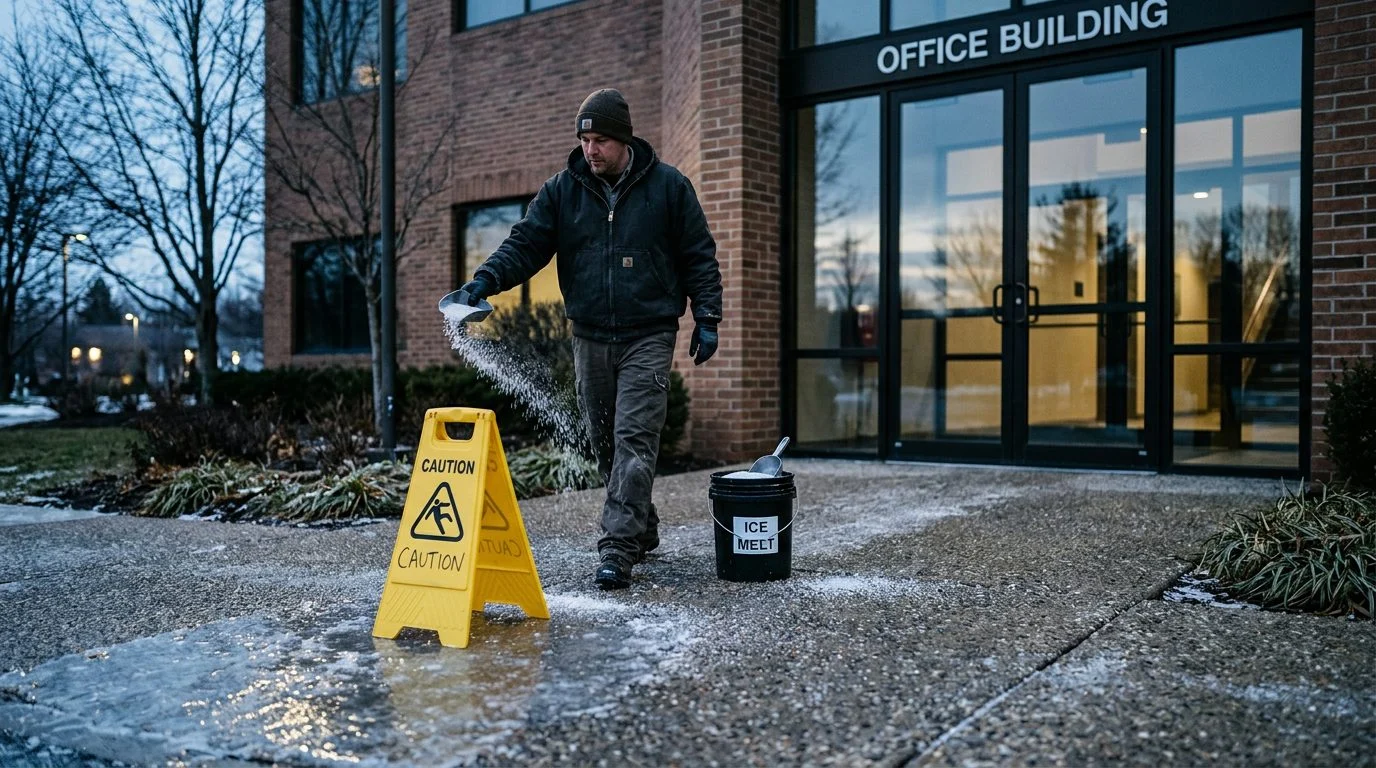
Poor lighting can hide a step or a wet patch. That includes stairwells, parking garages, corridors, and restrooms. Damaged flooring, such as loose tiles or worn transitions between floor types, can cause a trip. Stairs and handrails that are loose, missing, or poorly marked are another frequent cause (OSHA walking-working surface guidance). Ice and standing water at entrances and drop-off areas add to the risk.
They do not decide a claim by themselves.
Patients, visitors, and staff: why the circumstances matter
Visitors and family members on hospital property for a lawful purpose are usually looked at under the premises rule described above. A patient’s fall can raise different questions.
This page addresses falls caused by conditions on a property, not falls caused by how a patient was monitored, assisted, or treated. Those situations can call for a different set of questions than a plain floor hazard.
Where the fall happened also changes which facts matter most. A fall in a hallway often turns on the floor, the warnings, and the traffic in the area. A fall in a parking deck often turns on lighting and the surface. A fall in a restroom often turns on the floor condition and any signs posted.
Describe the fall in detail early. Write down what you were doing just before it. Note whether you were carrying something, walking to a room, or reaching for something. Write down who was nearby. Details fade quickly, and a written timeline made while memory is fresh is more reliable than one written weeks later. If you are acting for a family member, write down what that person told you as soon as you can.
Injuries and medical records after a hospital fall
Falls can cause fractures, head injuries, spinal injuries, and soft-tissue injuries (Georgia slip-and-fall report). Some symptoms appear hours or days later. Get a medical evaluation promptly, even when pain seems minor at first.
Keep every follow-up appointment. Tell each provider exactly how the fall happened. Clear records tie the injury to the fall and show the timeline of treatment.
Ask the treating provider for copies of your records and bills as they become available. Keep a folder with discharge papers, imaging results, prescriptions, and bills.
Some providers treat patients under a letter of protection, which is a promise to be paid from any later settlement or judgment. Ask your provider how your care is being billed, and keep copies of those papers.
Evidence that helps show what happened
Ask whether an incident report was completed after your fall. If it was, request a copy in writing. Write down the name of each staff member you spoke with and the time of the conversation.
Photos or video of the spot are very helpful. Capture the floor surface, the lighting, and any warning signs or the lack of them. Take photos as soon as you safely can, because conditions change fast in a busy building.
Names and phone numbers of witnesses matter. Witnesses can include other visitors, family members, and staff. Ask for their contact details while they are still nearby.
Keep the shoes and clothing you wore at the time. Keep any personal items that were damaged in the fall. Do not throw them away.
If you know of earlier complaints or repairs at the same spot, write those down too. Facts about prior problems can help show the hospital knew or should have known about the hazard.
How a claim is evaluated and what affects compensation
A lawyer looks at the cause of the fall, the evidence, the medical picture, and the losses. The review is a conversation about your facts, not a promise about a result.
Compensation is not a fixed number. It depends on the injuries, the treatment, lost income, and the proof available. General information cannot predict an amount or an outcome.
Georgia also uses a fault rule. If the injured person is partly at fault, the award is reduced in proportion to that person’s share of fault (O.C.G.A. § 51-12-33). A plaintiff who is 50 percent or more responsible for the injury cannot receive damages (O.C.G.A. § 51-12-33).
Fault can also be assigned to others who contributed to the injury. That is true even when those people were not named in the suit (O.C.G.A. § 51-12-33). A claim can take time whether it settles or goes to court.
Time limits and next steps
Georgia generally allows two years to bring an action for injuries to the person. The clock starts when the right of action accrues. The statute includes some exceptions (O.C.G.A. § 9-3-33). Claims for loss of consortium that involve an injury have a four-year period under the same statute.
Do not wait to act on the basics. The first days matter for evidence. Photos, witness names, and the incident report are easier to secure early.
Find out who owns and runs the property, and who handles its floors and maintenance. Knowing the correct entity early helps any review of your fall.
Talk through your hospital fall with our team
Common questions
Can you sue a hospital for a slip and fall?
Yes, if an unsafe condition on hospital property caused the fall. Whether a claim exists depends on the facts.
How long do you have to file?
Georgia generally allows two years for injury claims, with some exceptions under O.C.G.A. § 9-3-33.
If a fall in a hospital hallway, room, or parking deck left you in treatment and you are wondering whether a claim is possible, you do not have to sort that out alone. Ugwonali Law Group offers a free case review at 3400 Peachtree Road NE, Atlanta, Georgia. You can reach the intake team by phone or chat, in English or Spanish. The first consultation is free, confidential, and carries no obligation to continue. To start, visit the contact page.
Responsible lawyer: Adanna Ugwonali, Ugwonali Law Group, 3400 Peachtree Road NE, Atlanta, Georgia.
What to expect when you contact our team
A direct call with intake
Our intake staff listen to what happened, when it happened, and how you have been treated since the fall.
Plain-language explanations
We explain the legal and medical steps in terms you can follow, so you can make informed decisions at your own pace.
Support in English or Spanish
Our team can walk you through every step in English or Spanish, whichever you prefer.
Attention to serious injuries
Our practice focuses on people with fractures, hospital care, brain or spinal injuries, and families facing a wrongful death.
Respect for your recovery
We keep your health and treatment at the center of the conversation, and we respect your time and privacy.
Keep your records
Save your discharge papers, bills, and any written paperwork from the fall. Note the names of staff who responded and any witnesses. Bringing these to your free case review helps our team understand your situation more quickly.
Questions people ask after a fall at a medical facility
Is a hospital fall always the same as a store fall?
Not always. Some falls involve a dangerous condition on the property, such as a wet floor or poor lighting. Others involve how staff assessed, supervised, or assisted a patient. These situations can raise different legal questions, and our team can help you understand which applies to your case.
Why do medical records matter?
Your chart, imaging, and treatment notes show what injuries you had and how they were treated. Clear records help explain how the fall affected your health and daily life.
What if my loved one died after a fall?
Families facing a wrongful death often have many questions at once. Our team takes time to explain the process, the medical side, and the paperwork, so you understand each step.
Do I have to decide right away?
No. Your first consultation is confidential and comes with no obligation to continue. You can ask questions, learn how the process works, and decide what makes sense for you.
Talk with our team about your fall
Related practice areas
- Slip and Fall Injuries in Georgia: What to Know After a Serious Fall on Someone Else’s Property
- How Long Do You Have to File a Slip and Fall Claim in Georgia?
- Slipped in a Store? What to Do in the First 48 Hours to Protect a Georgia Claim
- Why Seeing a Medical Doctor After a Fall Matters for Your Health and Your Georgia Claim