

Atlanta and Georgia | Delivery Van Crash Claims
Hurt in a Delivery Van Crash? Learn Who May Be Held Responsible
A single delivery van collision can involve several companies, people, and insurance policies. Understanding how those pieces fit together can help you decide your next step with more confidence.
By Adanna Ugwonali · Published November 10, 2026
A delivery van crash can leave you with broken bones, a brain injury, or a family facing a death. Many people in that spot ask whether they can sue the company, not just the driver.
Often, yes. Georgia law lets an injured person name the company, the driver, and others whose fault helped cause the crash. Whether that fits your case depends on the facts, including who employed the driver and who owned the van.
This guide explains who can be named, the legal theories involved, Georgia’s two-year deadline, and how fault and insurance affect a claim (O.C.G.A. § 9-3-33; Kenneth B. Cameron v. Jmp Pizza, Inc (2026)). It covers serious injuries that needed real medical treatment.
The Short Answer: Who You Can Sue After a Delivery Van Crash
You can often sue the delivery company, the driver, and any other party whose negligence contributed to the crash.
Georgia’s fault rules look at every party who contributed to the harm. The trier of fact must consider the fault of everyone who contributed to the harm, even someone who was never named in the suit, but such nonparty fault is used only in determining the percentage of fault of named parties. See O.C.G.A. § 51-12-33.
This page focuses on crashes that caused real injuries needing medical treatment. Examples include fractures, hospital care, traumatic brain or spinal cord injuries, total-loss crashes, and deaths. Our catastrophic injury information covers that wider category.
If a delivery van crash left you with fractures, a brain or spinal injury, or a family loss, you may have a claim against the company, and our team can walk you through it. Talk it through with our team — the first consultation is free, confidential, and carries no obligation.
Who Can Be Named in the Claim
The driver. The driver’s own careless driving can directly cause the crash. That means the driver can be named personally.
The delivery company. Georgia makes a person liable for torts committed by a servant “in the prosecution and within the scope of his business.” That rule is the core of an employer’s responsibility for a worker’s job-related conduct. See O.C.G.A. § 51-2-2.
Who controls the van and the driver matters.
A contractor or subcontracted driver. An employer can be liable for a contractor’s negligence in certain situations. One example is when the employer keeps the right to direct how the work is done. See O.C.G.A. § 51-2-5.
A maintenance or repair vendor. If a repair or maintenance failure helped cause the crash, the company that did that work may also be named. The vendor’s own negligence has to be shown.
Legal Theories Georgia Claims Use Against Delivery Companies
A claim against a delivery company can rest on two kinds of fault. One is the driver’s conduct on the job. The other is the company’s own negligence.
Respondeat superior (the employer answers for a worker’s job-related wrongs) is the first theory. Georgia’s servant-liability statute is the starting point for it.
Negligent hiring and retention. A company must use ordinary care not to hire or keep an employee it knew or should have known posed a risk of harm. The harm must be reasonably foreseeable from that employee’s tendencies or propensities. The Georgia Supreme Court stated this in Munroe v. Universal Health Services.
Negligent supervision. A supervision claim needs enough evidence that the employer knew or should have known of the employee’s tendencies. Those tendencies must relate to the behavior that caused the injuries. See Novare Group v. Sarif.
Negligent training. Georgia’s Court of Appeals has said, in passing, that an injured person may bring a claim against a company for negligently training an employee. See Beasley v. A Better Gas Co..
Negligent entrustment. This claim targets handing a vehicle to a driver the company should not have trusted with it. Georgia courts have said that showing the company should have known is not enough by itself. See Western Industries, Inc. v. Poole.
Here is an important point. In Quynn v. Hulsey, the Georgia Supreme Court held that the old rule ending these claims after an employer’s admission is gone. An employer that admits it answers for its driver can still face claims for its own hiring, training, supervision, or entrustment.
When a Delivery Van Crash Is a Serious-Injury Case
A delivery van crash becomes a serious-injury case when it causes harm that needs real medical treatment.
Fractures, internal injuries, hospital admission, traumatic brain injury, spinal cord injury, and total-loss crashes all fall in this group. So does a death. Minor fender-benders without real injury are not the focus of this page.
Medical records from a medical doctor show the diagnosis and the treatment. They also show how the injury affects daily life and work. Those records matter because they explain why each part of the care was needed.
Medical bills get special treatment under Georgia law. Medical damages are limited to the reasonable value of medically necessary care, treatment, or services. See O.C.G.A. § 51-12-1.1.
Georgia’s Two-Year Deadline and Why Early Action Matters
Georgia generally gives two years to bring an action for injuries to the person. The clock is counted from when the right of action accrues. Other rules can apply in some cases. See O.C.G.A. § 9-3-33.
A spouse’s loss of consortium claim, which covers lost companionship, has four years under the same statute.
Evidence is time-sensitive too. Federal rules set minimum keep times for some motor carriers. Under 49 C.F.R. § 395.8(k), a motor carrier must retain records of duty status and supporting documents for each of its drivers for a period of not less than 6 months from the date of receipt. See 49 CFR 395.8.
Driver qualification files must be kept while the driver works for the carrier. They must also be kept three years after that, except as provided in paragraph (d) of this section, which lists records that may be removed three years after the date of execution. See 49 CFR 391.51.
These are minimums. After the minimum period, certain records, such as the annual driver record inquiry and the annual review note, may be removed from a driver qualification file three years after the date of execution. Dashcam video, GPS data, and dispatch notes can also be overwritten. Early steps help keep that evidence intact.
How Georgia Fault Rules Affect a Delivery Van Claim
Georgia reduces your damages by your share of fault. If you are 50 percent or more responsible, you cannot recover damages at all (O.C.G.A. § 51-12-33; Quynn v. Hulsey (2020)).
The jury, called the trier of fact, sets your percentage of fault. The judge then reduces your award by that share. See O.C.G.A. § 51-12-33.
Each liable party pays its own share of the damages. Those shares are not joint liability. That is why identifying every responsible party matters.
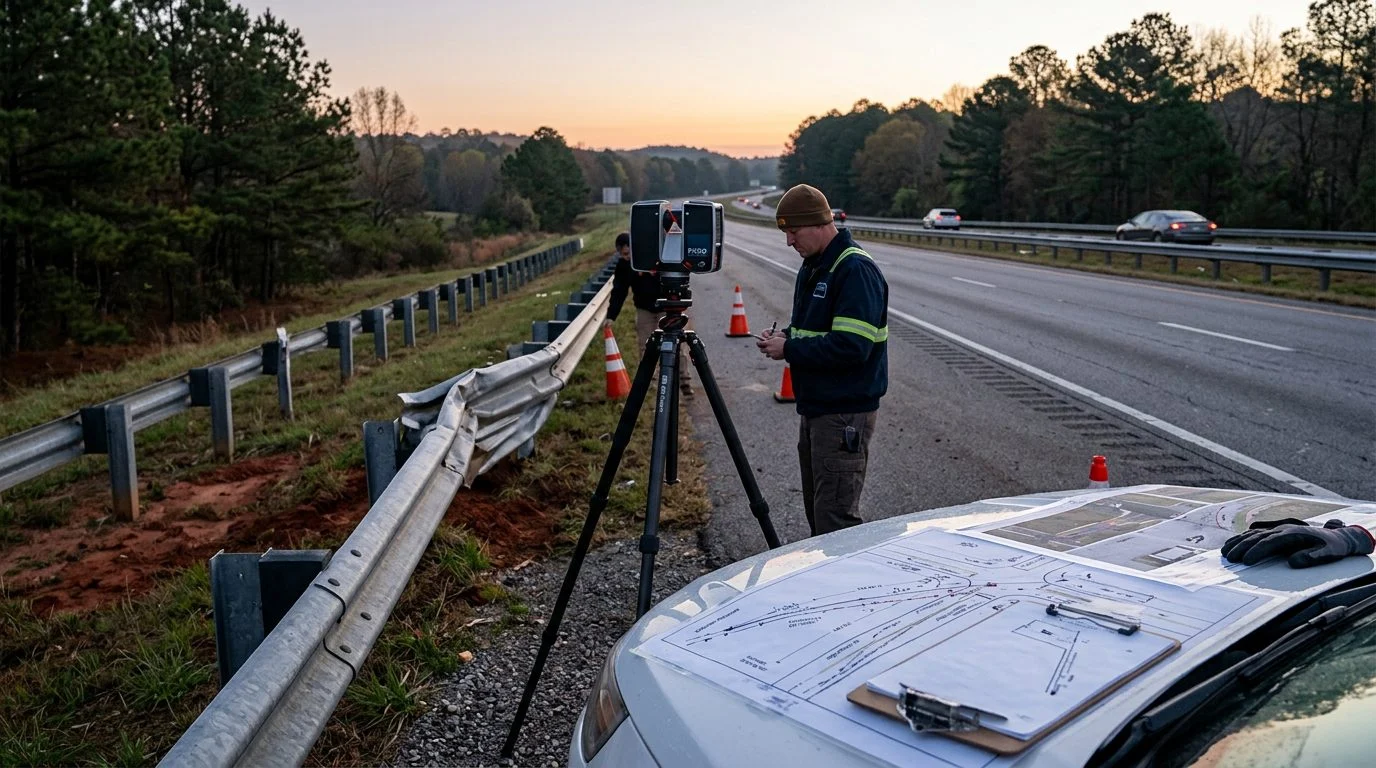
Police reports, witness statements, scene photos, vehicle damage, and crash data from the van all help. A driver’s account is one piece of that evidence.
Not sure what your next step is?
Talk it through with our team — the first consultation is free, confidential, and carries no obligation.
Insurance Coverage, Policy Limits, and Calls From the Insurer
Coverage for a delivery company’s crash usually comes from its commercial insurance. Every policy has a limit. Limits can be lower than the total losses in a serious injury or death case, so the policy terms matter early.
Georgia law sets insurance rules for some carriers. A for-hire intrastate motor carrier cannot be registered unless a certificate of insurance is filed. Under O.C.G.A. § 40-2-140, “No for-hire intrastate motor carrier shall be issued a registration unless there is filed with the commissioner a certificate of insurance for such applicant or holder, on forms prescribed by the commissioner, evidencing a policy of indemnity insurance by an insurance company licensed to do business in this state.” That policy must provide for the protection of passengers in passenger vehicles and the protection of the public against the negligence of that for-hire intrastate motor carrier, and its servants or agents, when it is determined to be the proximate cause of any injury. See O.C.G.A. § 40-2-140. See O.C.G.A. § 40-2-140.
An insurance adjuster may call early and ask for a recorded statement. Be careful with what you say before you understand your injuries. Talk with a lawyer before giving a statement.
Keep medical records, bills, and crash paperwork in one place. Be careful about signing releases or accepting early offers. Do this before you know the full extent of your injuries.
Next Steps After a Serious Delivery Van Crash
If a delivery van crash left you hurt or grieving, the next step is learning who may be responsible.
You may be facing hospital bills. A brain or spinal injury may be changing your work. Or a family may be living without a loved one after a crash with a delivery van. Deciding whether to bring a claim against the company is a big choice.
Your first consultation is free and confidential, with no obligation to continue. Reach out for a free case evaluation and our team can help you sort out who may be responsible. Intake is available in English or Spanish.
Ugwonali Law Group is located at 3400 Peachtree Road NE, Atlanta. The firm represents injured people across metro Atlanta and statewide in Georgia, including Fulton, Clayton, Cobb, and Rockdale counties.
Can I sue a delivery company after a crash in Georgia?
Often, yes. Georgia law may allow a claim against the company, the driver, and others whose negligence contributed to the crash.
How long do I have to sue after a delivery van crash in Georgia?
Georgia generally gives two years for an action for injuries to the person. See O.C.G.A. § 9-3-33.
Can I sue the driver too?
Yes. The driver’s own negligence can make the driver a party to the claim.
Does fault reduce what I can recover?
Yes. Your award is reduced by your share of fault (O.C.G.A. § 51-12-33; Quynn v. Hulsey (2020)). You cannot recover if you are 50 percent or more responsible.
Adanna Ugwonali is the responsible lawyer for this page. This page is general information, not legal advice. Ugwonali Law Group, 3400 Peachtree Road NE, Atlanta, Georgia.
Parties That May Be Connected to a Delivery Van Crash
The Driver
The person operating the van may be named when their driving contributed to the crash, such as speeding, distraction, or fatigue.
The Delivery Company
The business that dispatched the van, or that employed the driver, may be a party to the claim, depending on the facts of the case.
The Vehicle Owner or Lessor
Whoever owns or leases the van may be connected to the crash, especially where maintenance or ownership questions arise.
Maintenance and Other Contractors
Companies that repaired, loaded, or serviced the van may be involved when a defect or improper work played a role.
How Our Firm Approaches These Cases
Clear Explanations
We explain the legal and medical process in plain language, so you understand each step before you make a decision.
Attention to Every Party
Delivery crashes often involve more than one company and insurer. We look at each potential source of responsibility.
Focus on Serious Injuries
Our work centers on crashes that cause fractures, hospital care, brain and spinal injuries, and wrongful death.
English and Spanish Intake
Our intake staff can speak with you in English or Spanish from your first call.
Be Careful With Early Insurance Calls
Insurance representatives for the delivery company or its insurer may contact you soon after a crash. Before you give a recorded statement or sign any document, consider talking with a lawyer about what you are being asked to agree to.