

Atlanta Spinal Cord Injury Care After a Crash
A serious crash can leave you facing a spinal cord injury and a long list of unfamiliar medical and insurance steps. Spinal cord injury care in Atlanta usually moves in stages, from emergency treatment through hospital care, rehabilitation, and long-term living. Each stage creates records that can shape how a Georgia injury claim is documented.
This guide walks through those stages in plain language. It explains what each one involves and why the paperwork matters, so you can ask better questions as you go.
What a Spinal Cord Injury Means After a Crash
A spinal cord injury damages the nerves that carry signals between the brain and the rest of the body. Model Systems spinal cord injury factsheets offer research-based guidance on life after this kind of injury.
Doctors often describe the injury as complete or incomplete. A complete injury means little or no function is preserved below the injury. An incomplete injury means some signals still pass through.
The level of the injury also matters. Injuries in the cervical (neck), thoracic (upper and mid back), or lumbar (lower back) area can affect different functions. These can include arm and hand use, trunk balance, leg movement, and bladder and bowel control.
Early signs can be unclear. Follow-up exams and imaging often matter as the medical picture develops. High-speed car collisions and large truck impacts are among the crashes that can cause this kind of injury. Every case turns on its own medical facts.
Emergency and Hospital Care in the First Days
In the first days, the care team works to protect the spine, support breathing and blood pressure, and find out how much damage there is.
Emergency crews usually keep the neck and back still during transport. This is called spinal immobilization. At the hospital, doctors often order CT and MRI scans to look at bone and soft tissue. Those images help the team plan treatment.
Ask for copies of discharge papers and imaging reports as they become available. Under O.C.G.A. § 31-33-2, a provider having custody and control of any evaluation, diagnosis, prognosis, laboratory report, or biopsy slide in a patient’s record must generally retain that item for not less than ten years from the date it was created, but the statute lists exceptions to that requirement. The statute also includes an exception for hospitals, so the full text should be reviewed, under O.C.G.A. § 31-33-2. Early records often become central to a later claim, because they show how the injury was first found.
Surgery, Stabilization, and Medical Monitoring
Surgery is sometimes needed to relieve pressure on the spinal cord or to stabilize the spine. Whether it is needed depends on the medical facts of each case.
After surgery, or while treatment is stabilizing, the care team watches for complications. These can include infection, blood clots, pressure injuries on the skin, and blood pressure changes. Monitoring is a routine part of care for many patients.
Follow-up visits with physicians who treat spinal injuries are part of the plan. Keep every appointment, and tell your doctor about every symptom, even small ones. Those visits protect your health. They also create the medical record that shows how your care has progressed.
Inpatient and Outpatient Rehabilitation
Rehabilitation usually starts in the hospital and continues in outpatient therapy as strength and skills improve.
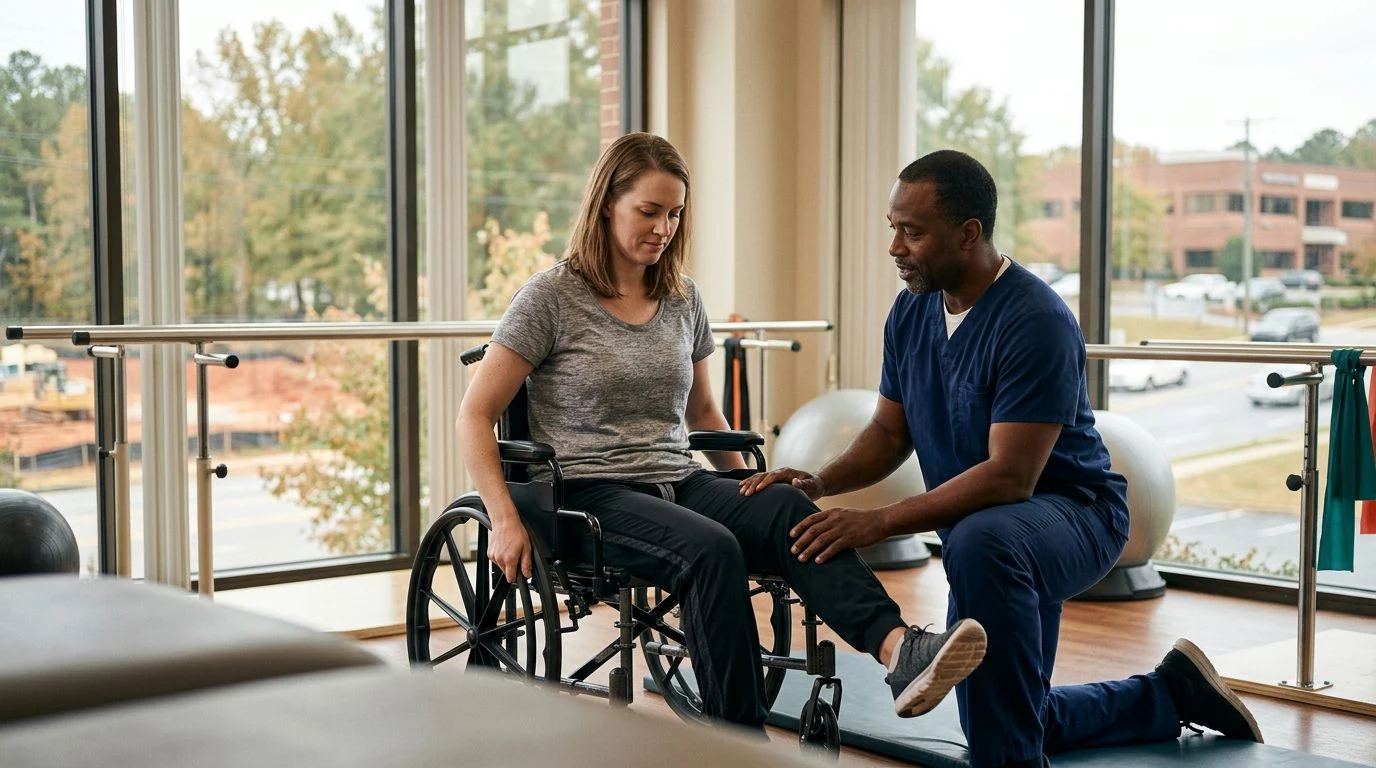
Inpatient rehabilitation often includes physical therapy and occupational therapy. Patients practice daily tasks such as dressing, transfers, and bathing. Many learn these skills from a seated or wheelchair position. Speech therapy, bladder and bowel programs, and pain management can also be part of the plan.
When discharge comes, outpatient therapy often continues. Therapists measure progress over time and write it down. Those therapy notes and discharge summaries become part of the record. Progress differs from person to person, so the plan changes as the body and goals change.
Long-Term Care, Equipment, and Home Changes
Many people with a spinal cord injury need equipment, home changes, and ongoing care long after the hospital stay.
A doctor may prescribe wheelchairs, braces, and bathroom equipment. This is called durable medical equipment. Home changes can include ramps, wider doorways, and an accessible bathroom. Some people also need attendant care, and doctors should document that need in writing.
Georgia law treats necessary expenses from an injury as a legitimate part of the damages estimate, under O.C.G.A. § 51-12-7.
Caregiver and Family Support
Families often become the daily care team, and their work is part of the recovery picture.
Family members often handle rides to appointments, scheduling, medication reminders, and help at home. Keep a simple log of appointments, hours of care, and out-of-pocket costs such as parking, mileage, and supplies. Those notes help show what care was needed and when.
Work and income can change too. A parent may cut hours, or a spouse may leave a job to provide care. Write these changes down alongside the medical records.
Emotional health matters. Counseling and mental health care are a legitimate part of recovery, and doctors can note them in the record.
How Spinal Cord Injury Care Connects to a Georgia Claim
In a Georgia injury claim, medical records and bills are the main way to show what care was needed and what it cost.
Medical expenses are limited to the reasonable value of medically necessary care, as O.C.G.A. § 51-12-1.1 explains. Insurance and letter-of-protection arrangements can change what the evidence looks like, so itemized bills matter.
Future costs may be reduced to present value. The law allows a 5 percent discount rate or another rate the trier of fact deems appropriate, under O.C.G.A. § 51-12-13.
Fault matters too. Under O.C.G.A. § 51-12-33, a judge reduces damages in proportion to the plaintiff’s share of fault. A plaintiff who is 50 percent or more responsible may not receive any damages. For more on shared fault, see the catastrophic injury resource.
Georgia also sets a time limit. Under O.C.G.A. § 9-3-33, most claims for injuries to the person carry a two-year filing deadline measured from when the right of action accrues, while claims for injuries to the person involving loss of consortium carry a four-year deadline, under O.C.G.A. § 9-3-33.
Early insurance offers may not reflect future care, so review the records before you accept any offer.
When a crash causes a death, Georgia law provides a separate wrongful death claim. Under Code Section 51-4-2, the surviving spouse or, if there is no surviving spouse, the children may recover for the homicide of a spouse or parent. When there is no person entitled to bring a wrongful death action under Code Section 51-4-2 or 51-4-4, the administrator or executor of the decedent may bring it under O.C.G.A. § 51-4-5.
Talking With Ugwonali Law Group About Your Injury
If you’re facing a spinal cord injury after a truck or car crash, a free case review is a direct next step.
Ugwonali Law Group represents people seriously hurt in truck and car crashes, unsafe-property injuries, slip and falls, and wrongful death cases across metro Atlanta and Georgia. Adanna Ugwonali is the responsible lawyer for this page.
Common Questions
How long do I have to file a spinal injury claim in Georgia? Georgia generally requires injury claims to be brought within two years after the right of action accrues. Certain exceptions exist, so the facts of your case matter.
Can I recover damages if I was partly at fault? Georgia reduces damages by your share of fault. If you are 50 percent or more responsible for the injury or damages claimed, you are not entitled to receive any damages (O.C.G.A. § 51-12-33).
Can family members pursue a claim after a fatal crash? The surviving spouse, or the children if there is no surviving spouse, may bring a wrongful death action for the homicide of a spouse or parent; for the death of a child, who may bring the claim is set by O.C.G.A. § 51-4-4, which refers to Code Sections 19-7-1 and 53-1-5. The administrator or executor of the deceased person’s estate may bring it for the next of kin only when no one is entitled to bring it under Georgia’s wrongful death statutes.
Our team can answer your questions in English or Spanish. The first consultation is free, confidential, and carries no obligation to continue. Reach our Atlanta office at 3400 Peachtree Road NE, or use the contact page to request a free case evaluation.
Disclaimer: This page is general information, not legal advice. Results depend on the facts of each case. Responsible lawyer: Adanna Ugwonali, Ugwonali Law Group, 3400 Peachtree Road NE, Atlanta, Georgia.