

Atlanta and Statewide Georgia | Injury Guidance
Was Someone Else Responsible for Your Serious Injury?
A plain-language guide for people hurt in crashes and accidents, and for the families who are left behind.
By Adanna Ugwonali · Published November 18, 2026
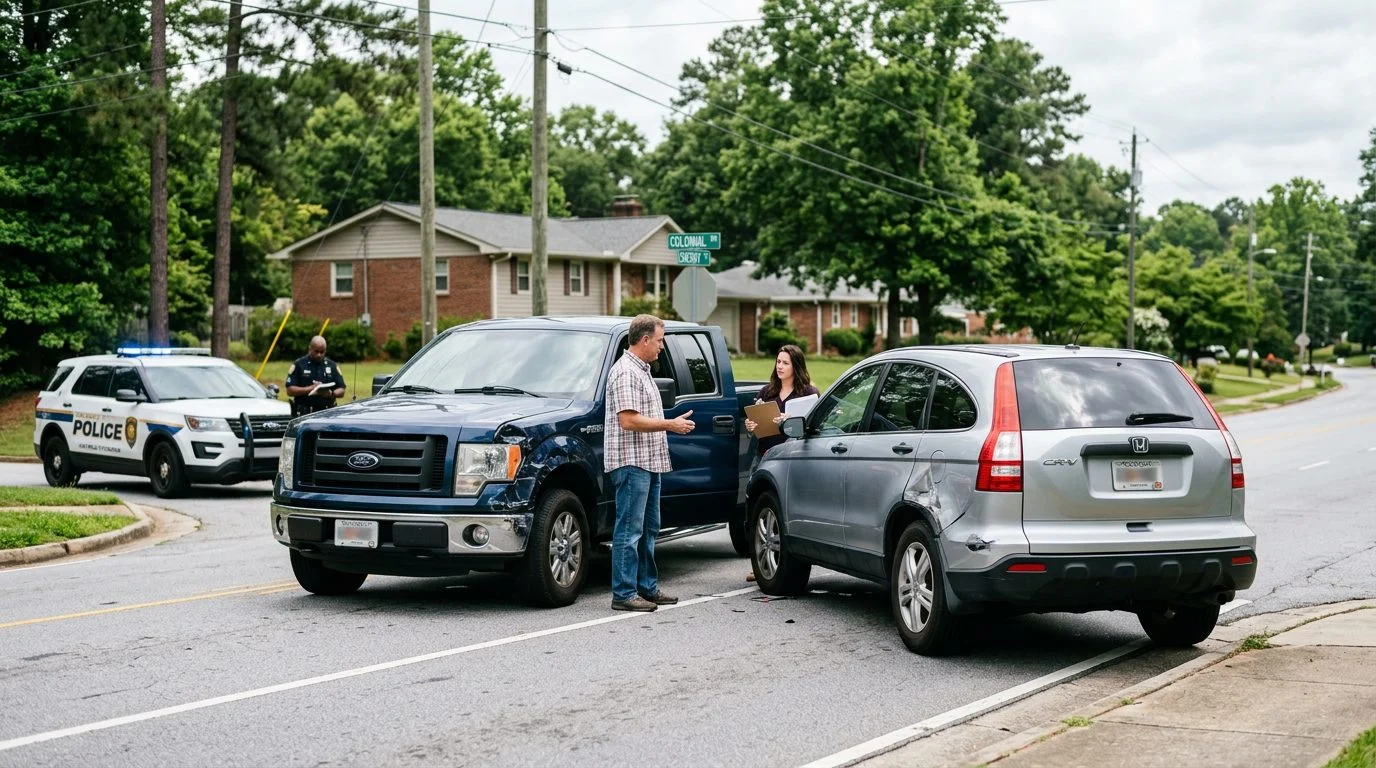
If a crash left you hurt, you may be asking what qualifies as an at-fault accident. In short, it is a crash that a driver’s careless or unlawful conduct caused, and that led to the injuries.
In Georgia, fault is a legal question. A court or jury decides it from the evidence, not from who got a ticket at the scene. This page explains how that works.
What “at-fault” means in a Georgia car accident
The at-fault driver is the person whose careless or unlawful conduct caused the crash and the injuries that followed. Fault is about cause. It is not about who looked guilty right after the crash.
A police report or traffic citation can be useful evidence. Neither one settles the question alone. Insurers and courts ask the same core question: who did what, and did it cause the harm?
Why does this matter for an injury claim? An injured person generally seeks compensation from the at-fault party’s liability coverage. Georgia law allows recovery for harm caused by a breach of a legal duty, as O.C.G.A. § 51-1-6 states.
This page covers general principles. The details of your own crash will shape how these rules apply.
If another driver's choices left you hurt and unsure how bills will be paid, our team can talk through your facts on a free, confidential first call. Talk it through with our team — the first consultation is free, confidential, and carries no obligation.
Negligence has four parts behind most at-fault findings
In plain terms, negligence means a driver did not use the care a reasonable driver would use, and that failure caused harm.
Four parts usually matter:
- Georgia defines ordinary diligence as the care that ordinarily prudent people use in similar circumstances. The absence of that care is ordinary negligence (O.C.G.A. § 51-1-2).
- Breach. The driver failed to meet that standard. Examples include speeding, running a red light, following too closely, or driving while distracted or impaired.
- Causation. The breach must have led to the crash and the injuries. A near miss, or damage with another cause, does not fit this part.
- Damages. The injured person suffered real harm, such as fractures, hospital care, or treatment by a medical doctor. In a wrongful death case, the harm is the death itself.
Special damages are those that actually flow from the act, and they must be proved to be recovered (O.C.G.A. § 51-12-2). For medical bills, the law limits recovery to the reasonable value of medically necessary care (O.C.G.A. § 51-12-1.1).
Common at-fault crash situations
Common at-fault crashes include rear-end collisions, failures to yield, unsafe lane changes, impaired driving, and some commercial truck crashes. Each one turns on what the driver did and whether it caused the injury.
Rear-end collisions. Following too closely or not paying attention is often central to fault.
Failure to yield. Left turns across traffic, running a red light or stop sign, and pulling out in front of others are common examples.
Lane changes and merges. Moving into an occupied lane can make the driver who changed lanes the at-fault party.
Impaired or drowsy driving. A driver who is impaired or too tired to drive safely may bear fault for the harm that follows. Our drunk driver crash page covers this scenario in more detail.
Commercial trucks. Fault can involve the driver, the motor carrier, maintenance, or rest rules. Georgia’s Department of Public Safety states that moving violations and driver error are major contributors to truck-at-fault crashes (Georgia DPS truck crash fact sheet). An employer can also answer for a worker’s conduct within the scope of the job (O.C.G.A. § 51-2-2). Claims for negligent hiring, training, supervision, and retention are based on the alleged negligent acts of the employer (Quynn v. Hulsey).
Property and road conditions. A property owner or another party may share fault when a dangerous condition contributed to the harm.
How fault is determined: evidence and investigation
Fault is decided from evidence, not from a single document. The main sources are the police crash report, photos, vehicle damage, witness accounts, and video.
The police crash report. The report records what the officer saw and heard. It helps, but it is not the final word on fault.
Physical evidence. Photos, damage patterns, skid marks, and where vehicles came to rest can show how the crash happened.
Witnesses and video. Witness statements, traffic camera footage, business surveillance video, and dashcam recordings can fill gaps in the story.
Commercial truck data. Many commercial trucks carry electronic data recorders that log speed and braking. Early preservation matters. The duty to preserve evidence can arise before a lawsuit is filed, once litigation is reasonably foreseeable to the party that controls the evidence (Phillips v. Harmon).
Reconstruction. When facts are disputed, accident reconstruction professionals may analyze speed, angles, and sight lines.
The insurer’s view. Adjusters review the same kinds of evidence.
Georgia’s modified comparative fault rule
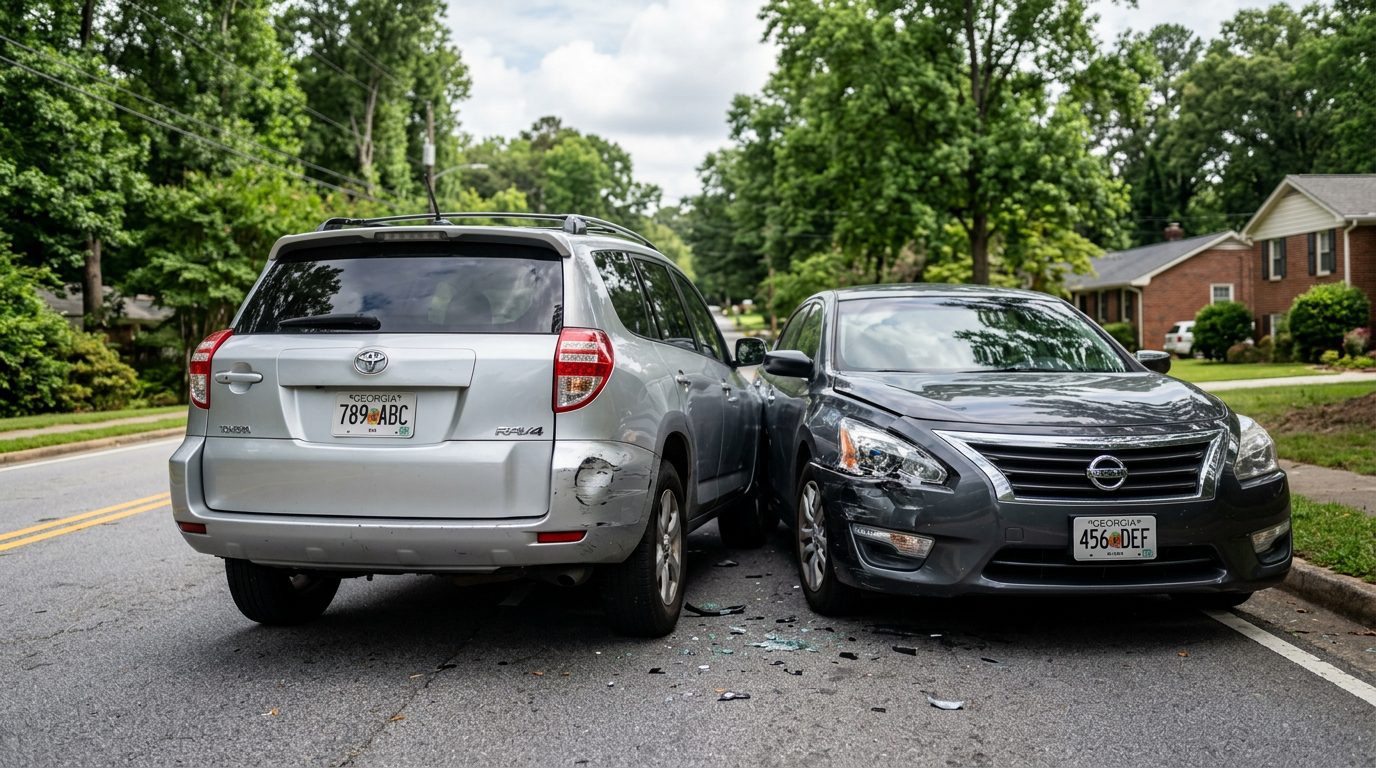
Georgia reduces an injured person’s damages by their own percentage of fault. A person found 50 percent or more responsible for the harm recovers nothing (O.C.G.A. § 51-12-33).
The jury decides the injured person’s percentage of fault. The judge then reduces the damages in proportion to that percentage (§ 51-12-33(a)).
Here is a simple example with round numbers. Suppose total damages were $100,000, and the injured person was 20 percent at fault. The reduction would be 20 percent, leaving $80,000. This is an illustration only, not a prediction of any result.
When more than one party is at fault, the jury divides the award among the liable people by each person’s share. That liability is not joint (§ 51-12-33(b)).
If the other side argues you contributed to a crash, an early legal review can help you see how that argument fits this rule.
How fault connects to insurance coverage in Georgia
Under O.C.G.A. § 33-7-11, Georgia law provides that no automobile liability policy may be issued in this state unless it contains uninsured motorist coverage, unless an insured named in the policy rejects that coverage in writing. That coverage pays the insured for bodily injury, loss of consortium, death, or property damage sustained from the owner or operator of an uninsured motor vehicle. In plain terms, the insured chooses uninsured motorist coverage limits: not less than $25,000 because of bodily injury to or death of one person in any one accident, subject to that limit, $50,000 for two or more persons in any one accident, and $25,000 for injury to or destruction of property, or, where the liability limits are higher, equal to the liability limits. The insured may also affirmatively choose limits less than the limits of liability.
Unless an insured named in the policy rejects this coverage in writing, the insured chooses the limits, and the law sets minimums of $25,000 per person and $50,000 per accident for bodily injury, and $25,000 for property damage (O.C.G.A. § 33-7-11). If the at-fault driver has no insurance or too little coverage, your own uninsured or underinsured coverage may matter. Whether it applies depends on your policy terms and the facts.
Commercial carriers often face higher federal minimums.
Damages are generally measured as compensation for injury, where the injury can be estimated in money (O.C.G.A. § 51-12-4), but if an injury is small or the mitigating circumstances are strong, nominal damages only are given. Medical records, bills, lost wages, and the severity of the injury all feed into that picture.
Not sure what your next step is?
Talk it through with our team — the first consultation is free, confidential, and carries no obligation.
What to do next if another driver caused your crash
If another driver caused your crash, the first steps are medical care, careful records, and caution with statements.
Get a medical evaluation and follow the treatment plan. Medical records are a key way to show the link between the crash and the injuries.
Keep your records. Save the crash report number, photos, medical bills, and a log of time missed from work. Keep the damaged vehicle and any phone photos or video you took.
Be careful with recorded statements and quick settlement offers. Many people feel pressure to answer an adjuster’s calls right away. Take time to understand your injuries before you agree to anything.
If you are researching for yourself or for a family member, these decisions can feel urgent. You may be hurting, dealing with bills, and getting calls from an insurance adjuster.
Frequently asked questions
What qualifies as an at-fault accident in Georgia?
It is a crash caused by a driver’s careless or unlawful conduct that led to the injuries. Fault is decided on the evidence.
Does a police report decide who was at fault?
No. A police report is useful evidence, but it does not by itself decide fault.
What happens if I was partly at fault in Georgia?
Your damages are reduced by your percentage of fault. You cannot recover damages if you are 50 percent or more responsible (O.C.G.A. § 51-12-33).
If another driver’s choices left you hurt and unsure how bills will be paid, our team can talk through your facts on a free, confidential first call. Request a free case evaluation at our contact page. La consulta inicial es gratuita, confidencial y sin compromiso de continuar.
Disclaimer: This page is general information, not legal advice. Adanna Ugwonali is the responsible lawyer for this page. Ugwonali Law Group, 3400 Peachtree Road NE, Atlanta, Georgia. Contact us through our contact page.
How Our Team Can Help
Free First Consultation
Call to talk through what happened. The initial consultation is free, confidential, and carries no obligation to continue.
Talk With Our Intake Team
Our intake staff can answer your first questions in English or Spanish.
Organized Next Steps
We explain the legal and medical process in plain language so you know what to expect at each stage.
Support for Families
When a loved one has died, our team helps families understand their options and the process ahead.
A Key Reminder
Get medical care for your injuries as soon as you can, and keep records of every visit, test, and bill. Speak with a lawyer before giving a recorded statement to an insurance company.
Crash Types We Discuss in This Guide
Truck Accidents
Large commercial vehicles can cause catastrophic harm. Learn how these cases differ from ordinary car crashes.
Car Accidents
Serious collisions involving fractures, hospital stays, and long-term treatment deserve a careful review.
Premises Liability and Slip and Falls
Injuries caused by unsafe property conditions can lead to serious medical care and real questions about responsibility.
Wrongful Death
When a crash or unsafe condition causes a death, families may need guidance through a difficult legal process.