

Truck and Construction Vehicle Crashes | Atlanta, Georgia
Hurt in a Dump Truck or Construction Vehicle Crash? You Don't Have to Sort It Out Alone.
Heavy vehicles and job-site traffic can cause serious harm. Our team explains the medical and legal steps in plain language, so you can make informed decisions at your own pace.
By Adanna Ugwonali · Published November 20, 2026
A dump truck or construction vehicle crash can change a family’s life in seconds. If you were hurt, or someone you love died, you probably have urgent questions about what comes next.
These crashes can support an injury or wrongful death claim against the people and companies responsible. Georgia generally gives injury claims two years to file (O.C.G.A. § 9-3-33; Kenneth B. Cameron v. Jmp Pizza, Inc (2026)). If you are looking for an Atlanta I-85 truck accident lawyer, this guide explains how these claims differ from ordinary car crashes and what to do first.
What a Dump Truck or Construction Vehicle Crash Claim Is
A dump truck or construction vehicle crash claim is a legal claim for injuries or a death caused by someone’s negligence. Negligence means failing to use reasonable care. These vehicles are often operated for a company, a contractor, or a job site.
People who are hurt in these kinds of incidents often have questions about their options. So can the family of a person who died. This page focuses on serious harm that needs real medical treatment, including:
- Fractures and other injuries that need hospital care
- Traumatic brain injury
- Spinal cord injury
- Other catastrophic injuries
- Wrongful death
These claims often involve a commercial insurance policy behind the party at fault. If you already know what happened to you, you can request a free case review and talk through your options.
If a dump truck or construction vehicle left you or someone you love with serious injuries or a loss, you may have a claim worth reviewing, and our team can talk it through with you. Talk it through with our team — the first consultation is free, confidential, and carries no obligation.

Why These Crashes Often Involve More Than One Party
Dump truck and construction vehicle crashes often involve more than one party that may be responsible. The driver, the employer, the vehicle owner, a contractor, and a maintenance provider can each play a role.
A single crash may involve:
- the driver
- the company that employs the driver
- the company that owns or leases the truck
- a general contractor or subcontractor that directed the work
- a company that maintained the equipment
Commercial vehicles are often insured under business policies. Those policies can differ from a personal auto policy.
Georgia’s fault rules work differently when many parties are involved. Under Georgia law, the jury considers the fault of people who contributed to the injury, even people who were never named in the lawsuit, but only when the plaintiff settled with that nonparty or a defending party gave notice at least 120 days before trial that the nonparty was wholly or partially at fault (O.C.G.A. § 51-12-33). Each liable party then owes its own share, and those shares are not joint liability.
Work zones on or near Interstate 85 can put trucks, lane shifts, backing movements, and workers close together. Those conditions can make a crash harder for other drivers to avoid.
Common Causes and Injuries in These Crashes
Investigators often examine blind-spot and backing incidents, rollovers, unsecured loads, driver fatigue, and poor maintenance. Each leaves records that can support or weaken a claim.
- Unsecured loads: Federal rules require commercial motor vehicles, when transporting cargo on public roads, to secure the cargo so it does not leak, spill, blow, or fall from the vehicle (49 CFR § 393.100).
- Driver fatigue: Federal rules limit how long a property-carrying driver may drive after rest (49 CFR § 395.3).
- Poor maintenance: Motor carriers must systematically inspect, repair, and maintain the vehicles they control (49 CFR § 396.3).
- Inadequate training: A company can face its own negligent training claim, as explained above.
Some injuries are not obvious at the scene. MedlinePlus notes that spinal cord injuries can have potentially permanent effects, and emergency care is recommended after a crash (MedlinePlus). Tell your doctor about any new symptoms, even mild ones.
Follow your doctor’s treatment plan and keep every appointment. Your medical records help show what happened to you. Georgia limits medical expense damages to the reasonable value of medically necessary care (O.C.G.A. § 51-12-1.1).
Who May Be Liable and the Evidence That Matters
The driver, the employer, the vehicle owner, a contractor, or a maintenance provider may be responsible, depending on the facts. Each role shapes which records matter most.
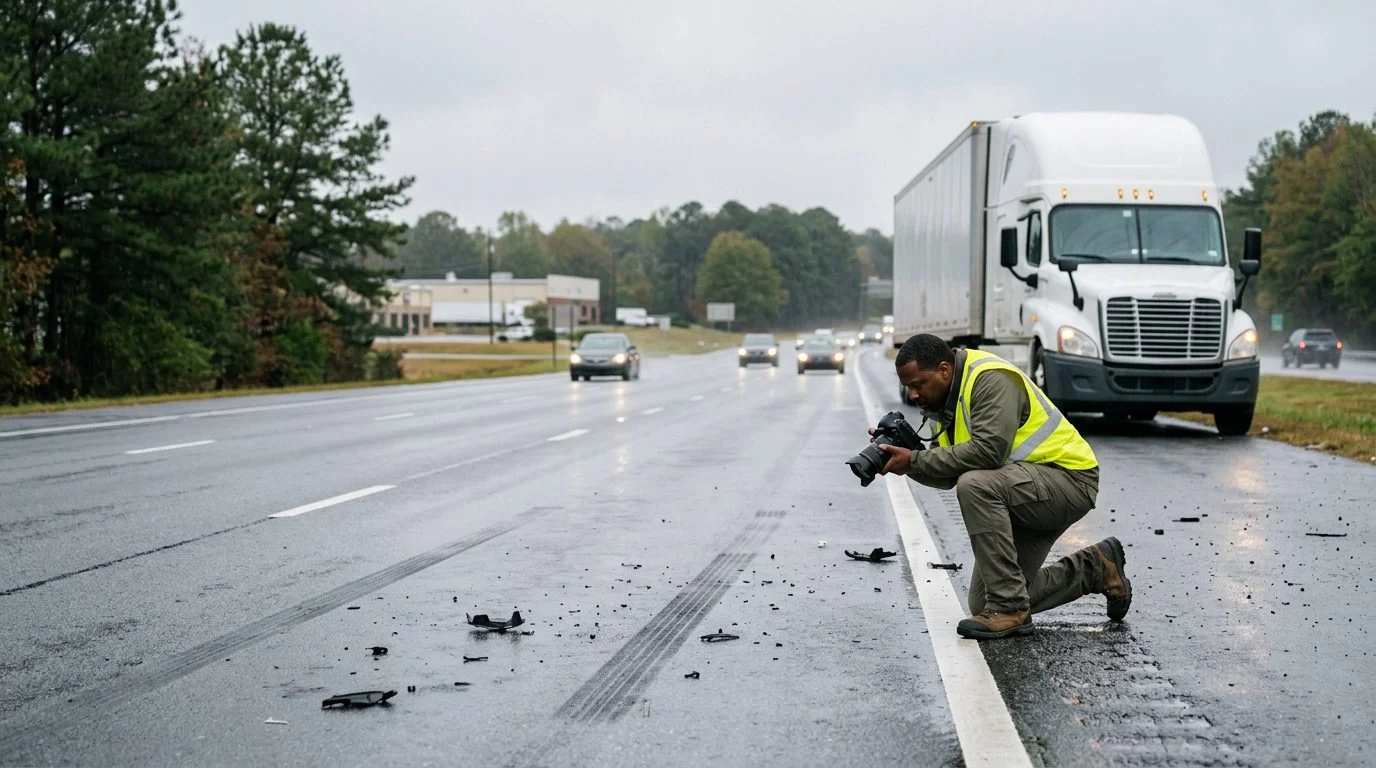
Evidence to preserve includes:
- the police crash report
- photos and video from the scene
- names and contact details of witnesses
- vehicle, load, and cargo details
- driver logs and hours-of-service records
- inspection and maintenance records
- your medical records and bills
Electronic records can be lost. Motor carriers generally must use electronic logging devices to record duty status, with some exceptions (49 CFR § 395.8). Federal rules also set how long maintenance records must be kept: 1 year where the vehicle is housed, and 6 months after it leaves the carrier’s control (49 CFR § 396.3). Because those periods run, early requests matter.
Georgia law also limits when a motor carrier’s insurer can be added to a lawsuit (O.C.G.A. § 40-1-112). It is allowed only in limited situations, such as when the carrier is insolvent or bankrupt, or when personal service cannot after reasonable diligence be effected against the driver or the carrier.
How the Claim Process Works, Step by Step
A claim usually moves from a free first review to evidence gathering, insurance negotiations, and a lawsuit only if needed. Each step builds on the one before it.
- Free first review. Our team gathers the basic facts of the crash and your injuries.
- Evidence requests. Letters ask for records and steps protect vehicle and log data.
- Medical documentation. Records are collected from the doctors and hospitals that treated you.
- Insurance claim. The claim is presented to the commercial insurer, and negotiations begin.
- Lawsuit if needed. If a fair resolution is not reached, a lawsuit may be filed.
Georgia generally gives injury claims two years after the right of action accrues, meaning the date the claim arises (O.C.G.A. § 9-3-33). Families in wrongful death cases should ask about timing early. Timelines vary from case to case, and no outcome or timeline is promised.
Fees, Case Costs, and the Free First Consultation
Our first consultation is free, confidential, and carries no obligation to continue. (La consulta inicial es gratuita, confidencial y sin compromiso de continuar.)
Fee terms are set out in writing, and you may still be responsible for court costs and case expenses. Intake staff can explain these terms in English or Spanish before you decide anything.
Our intake team can answer your fee questions by phone or chat, in English or Spanish.
Not sure what your next step is?
Talk it through with our team — the first consultation is free, confidential, and carries no obligation.
Why Work With Ugwonali Law Group
Ugwonali Law Group is a personal injury firm with its office at 3400 Peachtree Road NE, Atlanta, Georgia. Adanna Ugwonali is the responsible lawyer for this page. Our lawyers and support staff work with clients through each stage of a claim.
The firm handles truck accidents, car accidents, wrongful death, traumatic brain injury, spinal cord injury, catastrophic injury, premises liability, and slip and fall claims. It serves clients across metro Atlanta, including Fulton, Clayton, Cobb, and Rockdale counties, and across Georgia.
Our approach is to explain the legal and medical process in plain language. We keep communication clear at each stage. Intake support is available in English and Spanish.

Frequently Asked Questions
What should I avoid saying to an insurance adjuster?
Avoid guessing about fault or your injuries. Talk with our team before you give a recorded statement or sign anything.
Do I have to respond to the insurer right away?
You can talk with our team before you respond to an insurance adjuster.
How long do I have to file?
Georgia generally gives injury claims two years under O.C.G.A. § 9-3-33. Waiting can make evidence harder to get.
Our team can explain who may be involved in your family’s case.
If a dump truck or construction vehicle left you with a fracture, a brain or spine injury, or a loss in your family, you may have a claim worth reviewing. If you need an Atlanta I-85 truck accident lawyer to look at your crash, request a free case evaluation or chat with our intake team in English or Spanish.
What Clients Can Expect When They Call
A Real Person on the First Call
Our intake staff take your call in English or Spanish and listen to what happened, without pressure.
Focus on Your Recovery
We ask about your injuries and treatment so you can concentrate on getting better while we handle the paperwork.
Plain-Language Explanations
We explain the legal and medical process step by step, so you know what to expect at each stage.
Confidential, No-Obligation Review
Your first consultation is free, confidential, and carries no obligation to continue.
Be Careful With the Insurance Company
An adjuster for a trucking or construction company may call you soon after a crash. Before you give a recorded statement, sign a release, or accept any offer, talk with our team. Anything you say can be used later.
Why Heavy Vehicle Crash Cases Are Different
More Than One Company May Be Involved
A single crash can involve a driver, a trucking or construction employer, a contractor, and an equipment owner. Each may have its own insurance and its own records.
Evidence Can Disappear Quickly
Driver logs, dispatch records, maintenance files, and vehicle data are not always kept for long. Early action helps protect the information that matters.
Injuries Often Need Long-Term Care
Fractures, head and spinal injuries, and internal injuries can require surgery, rehabilitation, and follow-up visits with a medical doctor. Keeping complete records matters.
Families Facing Wrongful Death
When a loved one dies in a truck or construction vehicle crash, the family may need help understanding the legal process while they grieve. We are here to explain it clearly.
Hurt in a truck or construction vehicle crash?
Speak with Adanna Ugwonali and our team at 3400 Peachtree Road NE, Atlanta.