

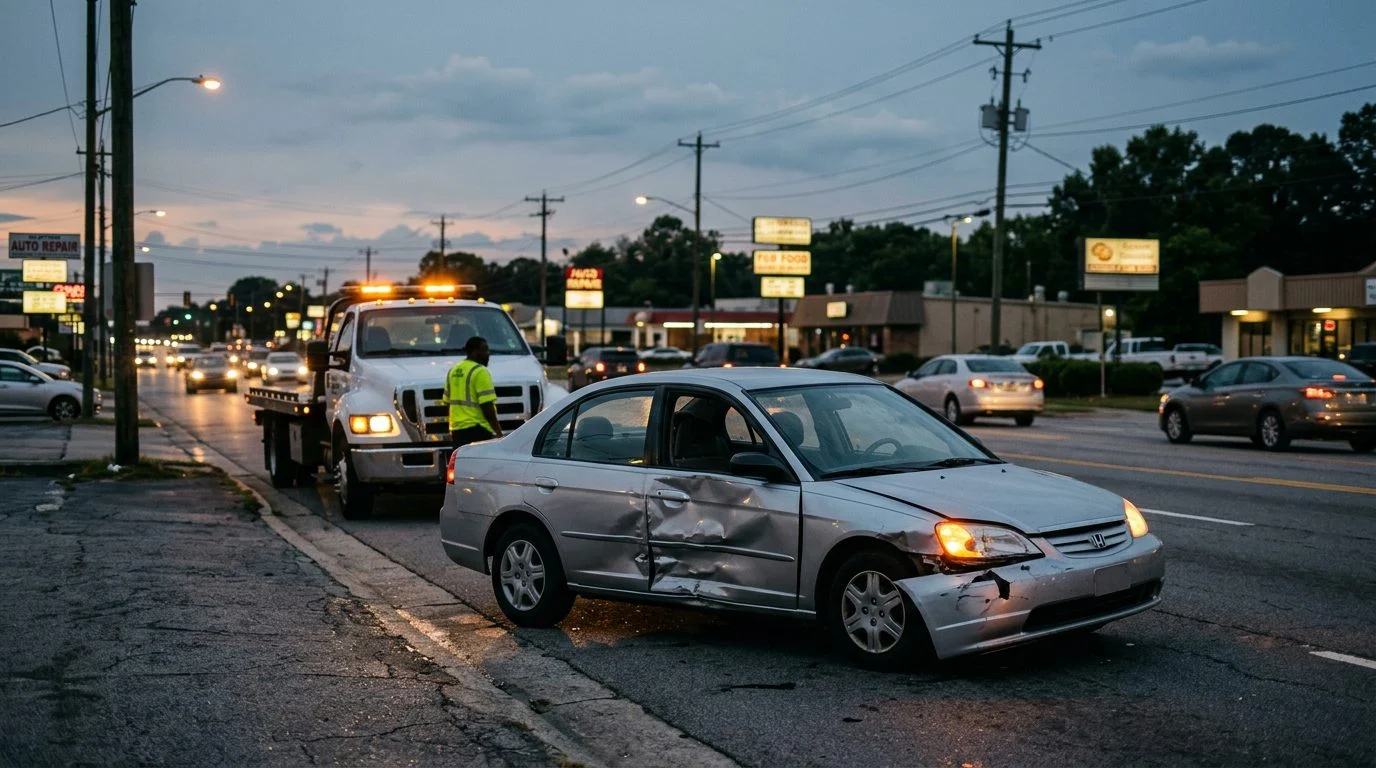
Car Accidents · Clayton County, GA
Serious Car Crash Injuries in Clayton County: You Don't Have to Sort Out the Next Steps Alone
Ugwonali Law Group helps people and families facing life-changing injuries from crashes on Clayton County roads, with plain-language answers from the first call.
Getting started with our firm
Free
Case review and first consultation
EN / ES
Intake in English or Spanish
Atlanta
3400 Peachtree Road NE
By Adanna Ugwonali · Published November 14, 2026
A serious car crash can leave you or someone you love in a hospital bed, facing surgery, and wondering what comes next.
If a serious injury has changed your daily life, this guide explains what the term means in Georgia, which medical steps protect your health and your claim, and how a claim moves forward for Clayton County families.
What Makes a Car Accident Injury Catastrophic in Georgia
A car accident injury is catastrophic when it causes long-term or permanent loss of function, needs extended care, or changes how a person can live and work.
- The medical record comes first. Severity is judged from imaging, surgical notes, rehabilitation records, and the treating doctors’ prognosis, which is their view of what to expect going forward. The crash alone does not settle it.
- Common markers. These include traumatic brain injury, spinal cord injury, multiple or complex fractures, internal organ injury, and amputation. An injury that keeps a person from returning to prior work can also fit this label.
- Why the label matters. It shapes how future medical needs and lost earning ability get documented. Georgia law says necessary expenses from an injury are a legitimate part of the damages estimate (O.C.G.A. § 51-12-7).
- Wrongful death follows a separate path. When a crash causes a death through criminal or other negligence, the personal representative is entitled to recover funeral, medical, and other necessary expenses resulting from the injury and death (O.C.G.A. § 51-4-5).
If a serious crash has left you or someone you love facing hospital bills and insurance calls, our team is ready to listen and talk through your options with you. Talk it through with our team — the first consultation is free, confidential, and carries no obligation.

Serious Injuries That Often Follow High-Impact Crashes
High-impact crashes often cause injuries that need surgery, repeated imaging, and months of treatment.
- Traumatic brain injury. Symptoms range from headaches and memory trouble to changes in mood, focus, and personality. Some symptoms appear days or weeks after the crash.
- Spinal cord injury. This can cause partial or complete loss of movement or feeling. The loss may be temporary or permanent. The Model Systems Knowledge Translation Center offers spinal cord injury factsheets.
- Fractures. Breaks of the pelvis, femur, ribs, or spine can need surgery, hardware, and long recovery.
- Hidden internal injuries. Internal bleeding and organ injury may not be obvious at the scene. Hospital imaging sometimes finds them.
- Burns and crush injuries. Vehicle intrusion or fire can cause these injuries.
- Many treating doctors. Complex injuries often involve several physicians, imaging studies, and therapy records over months.
Medical Steps That Protect Your Health and Your Claim
The most important medical step is getting checked right away, even when pain seems mild.
- Get an emergency evaluation. Some brain and spine injuries show symptoms later. A mild first day does not rule out a serious injury.
- Keep every appointment. Gaps in treatment are often used to question how serious an injury was.
- Describe the crash fully. Tell each provider what happened, so the medical record matches the facts.
- Request your records. Under O.C.G.A. § 31-33-2, when the patient or a person authorized under subsection (a)(2) makes a written request accompanied by a HIPAA-compliant authorization and a signed written authorization, the record is generally to be furnished within 30 days of the provider’s receipt of the request. However, if the provider reasonably determines that disclosing the record to the patient will be detrimental to the patient’s physical or mental health, it may refuse, and the record shall then be furnished to another provider the patient designates upon the patient’s written request.
- Keep a symptom journal. Track pain, sleep, headaches, concentration, mood, and work limits each day.
- Ask about mental health. Ask your doctor to document anxiety, depression, or post-traumatic stress symptoms when they appear.
- Save every bill. Keep receipts for rehabilitation, medications, medical equipment, and home changes.
How a Georgia Car Accident Claim Moves Forward
A Georgia injury claim generally moves from intake to evidence, medical proof, a demand to the insurer, and, if needed, a lawsuit.
- Intake. You share the crash details and treatment so far in a confidential review.
- Evidence. The crash report, photos, vehicle data, witness names, and scene details are preserved. Early letters can ask companies to preserve commercial vehicle records.
- Medical proof. Records are gathered and reviewed alongside the treating doctors’ notes.
- Demand. The claim and supporting records go to the insurance carrier, followed by negotiation.
- Lawsuit, if needed. Georgia generally gives two years to file an action for injuries to the person, except for actions for injuries to the person involving loss of consortium, which must be brought within four years (O.C.G.A. § 9-3-33). Timing matters early.
Serious cases often take many months. Treatment usually has to progress far enough to show the full extent of the injury.
Who Can Be Held Responsible and Which Insurance May Apply
Responsibility can fall on the at-fault driver, and in some crashes on the driver’s employer.
- The at-fault driver’s insurance. The liability policy of the driver who caused the crash is a common starting point for a claim.
- The employer. Georgia law makes a person liable for torts committed by a servant in the prosecution and within the scope of the business (O.C.G.A. § 51-2-2).
- Commercial policies. Trucking companies and fleets may carry higher limits. More than one party can share responsibility.
- Uninsured motorist coverage. Georgia auto policies must include provisions to pay the insured for bodily injury caused by an uninsured driver, within stated limits (O.C.G.A. § 33-7-11).
- Shared fault. Georgia reduces damages by the injured person’s share of fault. Recovery is barred if that share is 50 percent or more (O.C.G.A. § 51-12-33).
Losses Families Can Document After a Serious Crash
Families can document medical bills, lost income, daily-life changes, and the emotional effects of a serious injury.
- Medical bills. Medical expenses are limited to the reasonable value of medically necessary care. If the injured person has insurance, the evidence includes both the amounts charged and the amounts needed to satisfy those charges (O.C.G.A. § 51-12-1.1).
- Special and general damages. Special damages, such as bills and wages, must be proved. General damages are ones the law presumes flow from the wrong, and they may be recovered without proof of an amount (O.C.G.A. § 51-12-2).
- Lost income. Pay stubs, tax records, and employer letters show lost wages and any reduced ability to earn later.
- Daily help. Caregiving, household help, and home or vehicle changes after an injury belong in the record.
- A consistent timeline. Receipts, bills, and records that agree with each other make the medical story easier to follow.
Not sure what your next step is?
Talk it through with our team — the first consultation is free, confidential, and carries no obligation.
Frequently Asked Questions
Here are short answers to common questions.
What is classed as a catastrophic injury?
It is an injury with long-term or permanent effects on movement, thinking, or daily function, shown in medical records.
How much are most car accident settlements?
Amounts vary widely with the medical proof, the coverage available, and the fault picture. No figure can be predicted at the first call.
What mental health issues can occur after a car accident?
Anxiety, depression, post-traumatic stress symptoms, sleep trouble, and mood changes can follow. These are more common after a brain injury.
What is the hardest injury to prove?
Brain injuries that do not show clearly on basic imaging can be hard to prove. Consistent treatment records and the treating doctors’ opinions matter most.
What if I was partly at fault?
Georgia reduces recovery by your share of fault. You cannot recover damages if you are 50 percent or more responsible for the injury or damages claimed (O.C.G.A. § 51-12-33(g)).
Do I pay anything for a first meeting?
Your first consultation is free, confidential, and comes with no obligation to continue.
Why Ugwonali Law Group Serves Clayton County Families
Ugwonali Law Group serves Clayton County clients from its office at 3400 Peachtree Road NE in Atlanta, Georgia. The firm also represents clients across Georgia.
- Responsible lawyer. Adanna Ugwonali is the responsible lawyer for this page.
- Practice areas. The firm handles truck accidents, car accidents, wrongful death, traumatic brain injury, spinal cord injury, catastrophic injury, premises liability, and slip and fall.
- Language. Intake is available in English or Spanish.
- Areas served. The firm serves Clayton County and Jonesboro, along with other metro Atlanta counties and clients statewide.
Talk With Our Intake Team About Your Clayton County Crash
If a serious crash has left you or someone you love facing hospital care and insurance calls, you don’t have to sort it out alone. You can request a free case evaluation or chat with our intake team.
How we work with you
Plain-language explanations
We walk you through the legal process and the medical terms in your records, so you know what is happening and why.
Free, confidential first consultation
Your first consultation is free and confidential, with no obligation to continue.
Clear about fees
You may still be responsible for court costs and case expenses, and we will explain these before you decide.
Get medical care first
Even if you feel you can wait, see a medical doctor promptly after a serious crash. Keep every appointment, follow the treatment plan, and save discharge papers, bills, and the crash report.
Common questions after a catastrophic crash
What counts as catastrophic?
Injuries with long-term or permanent effects on movement, thinking, or daily life, documented in medical records.
What evidence matters?
Medical records, imaging, treatment notes, photos of the scene, the crash report, and records of lost work and daily limits.
What about insurance?
We review the policies that may apply, including any commercial or corporate coverage behind the other party, and explain what each one may cover.
What will the case involve?
We discuss the steps, from investigation and treatment records through negotiation or court, and what to expect at each one.