

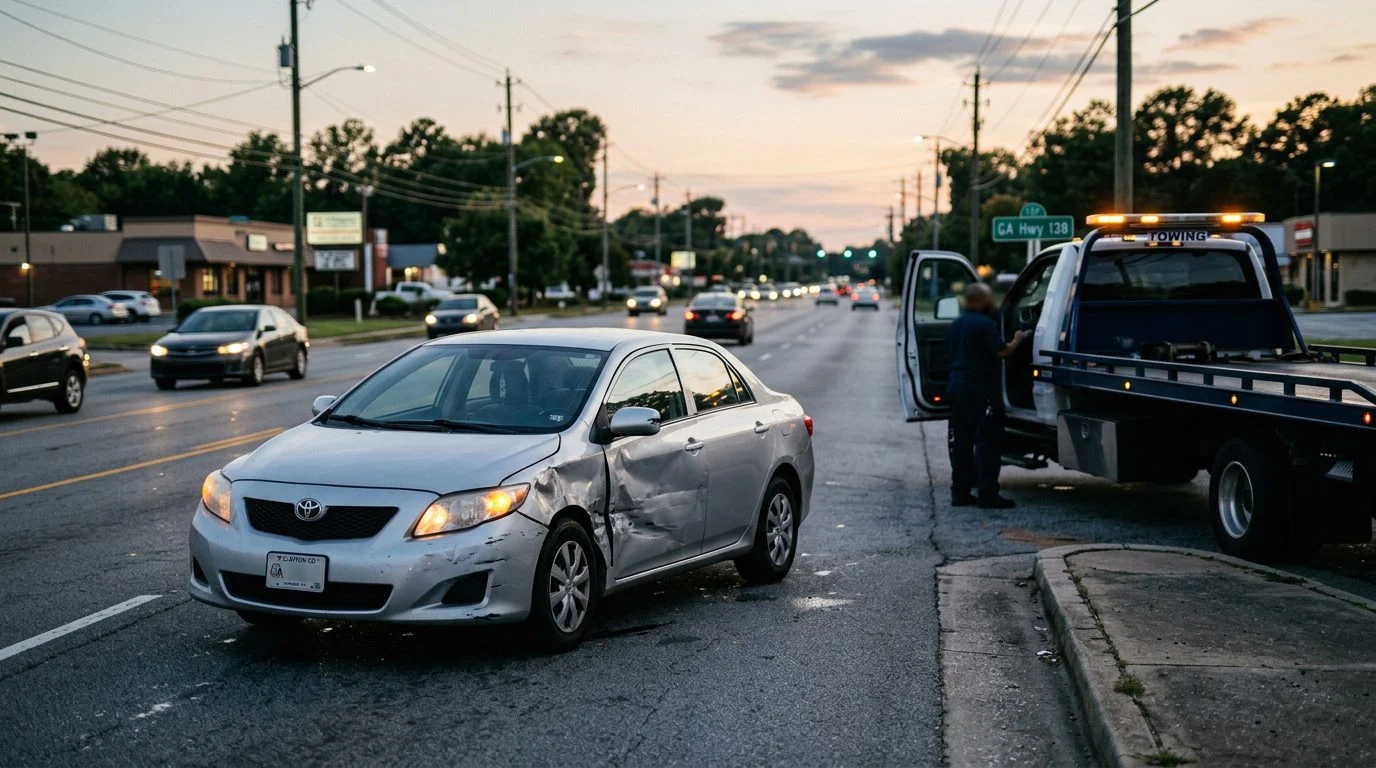
Car Accidents | Clayton County, Georgia
Where a Clayton County Car Crash Lawsuit Is Filed
Plain-language answers about venue for people seriously hurt in car crashes, from Ugwonali Law Group in Atlanta. Free, confidential case reviews are available in English or Spanish.
By Adanna Ugwonali · Published October 29, 2026
Short answer: where a Georgia car crash lawsuit can be filed
Where a case may be filed depends on the specific facts of each crash, and questions like that can be reviewed during a free case review.
Venue is a filing question. It is not a question about who caused the crash or how much a claim is worth.
This guide is for people with serious injuries, such as broken bones, hospital stays, brain or spinal injuries, or a family loss in a fatal crash. It explains how car crash lawsuit venue in Clayton County, Georgia works, and how the same ideas apply in Rockdale and Cobb counties.
If a crash in Clayton, Rockdale or Cobb County left you with serious injuries, our team can walk you through where a claim could be filed, at no cost to you. Talk it through with our team — the first consultation is free, confidential, and carries no obligation.

Venue and jurisdiction: two different questions
Venue and jurisdiction are not the same thing. Jurisdiction asks whether a court has power over the case and the parties. Venue asks which county should hear it.
Georgia’s rules say that if it appears a court lacks jurisdiction over the subject matter, the court shall dismiss the action. The official text of O.C.G.A. § 9-11-12 sets out that rule. Crash cases between Georgia parties are usually filed in Georgia courts, so the harder question is often which county.
The same crash can have more than one possible county. A driver may live in one county, a trucking company may be based in another, and the crash may have happened in a third. Each fact can point to a different place.
Venue is also separate from fault and from the filing deadline. Georgia’s deadline for injury claims to the person is generally two years after the right of action accrues, under O.C.G.A. § 9-3-33; injuries to the reputation must be brought within one year after the right of action accrues, and actions for injuries to the person involving loss of consortium within four years after the right of action accrues.
When the at-fault driver is an individual
Many people assume the county where the wreck happened is the only place to sue. That is not always so.
The address on the crash report and the driver’s insurance information are common places to look. These records can help show where the driver lives. They are a starting point for the venue question, not the whole answer.
A driver who lives outside Georgia raises extra questions. Those questions often involve how the driver can be served with the lawsuit and where the case can move forward. Out-of-state drivers need a close look at the records before anyone chooses a county.
If the driver cannot be located, the case may take more work before it can move forward. Delay can also make evidence harder to collect, so it helps to act early.
When the at-fault party is a company or trucking business
A company that runs trucks, keeps offices, or hires drivers in several places may connect to more than one county.
Whether the driver works for the company matters. Under O.C.G.A. § 51-2-2, a person is liable for torts committed by a servant in the prosecution and within the scope of the business. Under O.C.G.A. § 51-2-4, an employer generally is not responsible for an employee who runs an independent business and is not under its immediate control.
Companies can be served through an officer, a managing agent, or a registered agent. Under O.C.G.A. § 9-11-4, for a corporation incorporated or domesticated under Georgia law or a foreign corporation authorized to transact business in Georgia, if service cannot be had on its president or other officer, a managing agent, or a registered agent, the Secretary of State is an agent of that corporation for service of process, and the plaintiff or the plaintiff’s attorney must certify in writing that the process was sent by registered mail or statutory overnight delivery to the last registered office or registered agent listed with the Secretary of State, that service cannot be effected at that office, and that it therefore appears the corporation has failed either to maintain a registered office or to appoint a registered agent in this state.
Adding a trucking company’s insurer to the same lawsuit is limited. Under O.C.G.A. § 40-1-112(c), someone whose claim arises under the group of Georgia motor carrier statutes that contains this section may sue the motor carrier and its insurance carrier together in the same lawsuit, whether the claim is in tort or contract, only when one or more motor carriers related to the claim are insolvent or bankrupt, or when personal service on the driver of the vehicle giving rise to the claim, or on the motor carrier itself, cannot after reasonable diligence be effected.
When the crash location matters, and when it does not
When a driver and a company are sued together, each defendant answers for its own share of fault. Under O.C.G.A. § 51-12-33(b), each defendant’s share is its own, not joint liability, and is not subject to contribution.
The fact-finder (the jury or judge) also considers the fault of everyone who contributed to the injury.
Shared fault, also called comparative fault, can reduce what an injured person recovers. Georgia reduces damages by the injured person’s share of fault. A plaintiff who is 50 percent or more responsible recovers nothing, under O.C.G.A. § 51-12-33(g).
Claims against a county or other government entity follow different rules. This guide covers claims against private drivers and companies.
Clayton, Rockdale and Cobb: how the same rules apply in each county
The same venue ideas apply in each county, but the facts change the answer. The examples below are simple illustrations, not predictions about any real case.
In Clayton County, imagine a driver who lives in Clayton and is hurt in a Clayton crash. Both residence and crash location point toward Clayton. A company based elsewhere could add other options, depending on its ties to Georgia counties.
In Rockdale County, imagine a trucking company based in Rockdale with drivers working out of a yard there. That company may have a stronger tie to Rockdale for venue, even if the crash happened on a road in another county.
In Cobb County, imagine a commercial vehicle operator that runs an office and daily business in Cobb. That operator may have ties to Cobb. Whether a case can be filed there turns on the specific facts.
Ugwonali Law Group represents people hurt in car and truck crashes across metro Atlanta, including Clayton, Rockdale and Cobb counties, and across Georgia.
Not sure what your next step is?
Talk it through with our team — the first consultation is free, confidential, and carries no obligation.
What to gather and how a free case review helps
Before a county is chosen, the facts need to be gathered. Useful items include the crash report, the drivers’ names and addresses, insurance details, the company name on the truck, and photos from the scene.
Medical records and bills show the injury and the treatment. Keep every letter you receive from an insurance company, too. These papers help explain both the injury and the facts behind where a case could be filed.
The team at Ugwonali Law Group can review these records with you and explain the venue options that may apply to your situation.
If a crash in Clayton, Rockdale or Cobb County left you with fractures, a head or spinal injury, or a family loss, and you want to know where a claim could be filed, request a free case review through our contact page. Our first consultation is free, confidential, and comes with no obligation to continue. Ugwonali Law Group is located at 3400 Peachtree Road NE, Atlanta, Georgia.

Frequently asked questions
Where can you file a car accident lawsuit in Georgia?
A car accident lawsuit is filed in a county where venue is proper.
What is the difference between venue and jurisdiction?
Venue is the county where a case is heard. Jurisdiction is whether the court has power over the case and the parties.
Can you sue a company in the county where the crash happened?
Sometimes.
This page is general information, not legal advice. Adanna Ugwonali is the responsible attorney for this page. Ugwonali Law Group, 3400 Peachtree Road NE, Atlanta, Georgia.
How we support families in Clayton County
Plain-language explanations
We explain the legal and medical process step by step, so you know what to expect at each stage of your case.
Free first consultation
Your first consultation is free, confidential, and comes with no obligation to continue.
English or Spanish
Our intake team can speak with you in English or Spanish, whichever is more comfortable for you.
Serious injuries
We focus on serious crash injuries, including fractures, traumatic brain and spinal cord injuries, and wrongful death.
Talk with us before you speak with an insurer
Insurance adjusters may contact you soon after a crash. Before you give a recorded statement or sign any paperwork, consider speaking with our intake team about your situation.
What to bring to your free case review
Crash details
Note the date, time, and location, and any names, badge numbers, or insurance information you collected at the scene.
Medical records
Keep copies of emergency room visits, hospital discharge papers, imaging, and any treatment plans from your doctor.
Photos and evidence
Photos of vehicles, roadway conditions, and injuries can help, along with any dash camera or witness information.
Work and expense records
Gather documents showing missed work, medical bills, and other costs caused by the crash.
Talk with Ugwonali Law Group about your Clayton County car crash
Related practice areas
- Car Accidents in Georgia: What Injured People Should Know Before They Call a Lawyer
- Car Crash Claims When the Injured Person Is a Minor in Georgia: How the Deadline Can Change
- Car Accidents in Atlanta
- Car Accidents in Fulton County