

Atlanta, Georgia | Serious Injury Claims
Is Distracted Driving Negligence? A Georgia Guide After a Serious Crash
Phones, navigation screens, and other distractions behind the wheel can change who is responsible for a crash. Here is how Georgia law approaches distracted driving and what injured people and families can do next.
By Adanna Ugwonali · Published November 3, 2026
Is distracted driving negligence?
Is distracted driving negligence? In many situations, a driver who was distracted and caused a crash may be found negligent. Negligence, in plain terms, means failing to use the care a careful driver would use. This page explains how that works in Georgia, what evidence matters, and when the stakes are highest.
Not sure what your next step is?
Talk it through with our team — the first consultation is free, confidential, and carries no obligation.

Short answer: is distracted driving negligence?
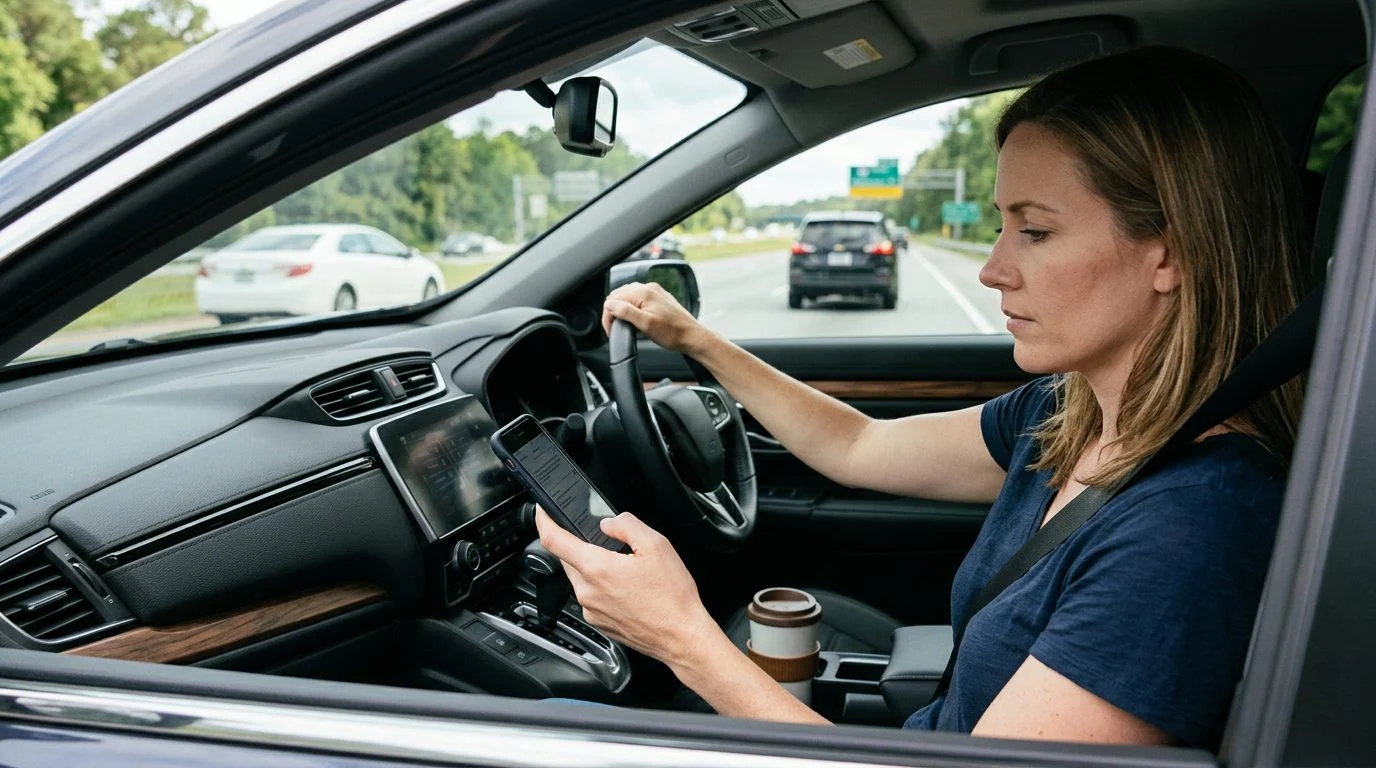
Distracted driving can be negligence when a driver’s attention drifts from the road and a crash follows. Georgia law describes ordinary negligence as the absence of ordinary diligence, which is the care that ordinarily prudent people use in similar circumstances (O.C.G.A. § 51-1-2). Looking at a phone instead of traffic is a clear example of falling short of that care. The word “may” matters, though. Whether a particular crash is negligence depends on the facts, so this page explains the general framework rather than predicting any result. The question carries the most weight when a crash causes fractures, hospital stays, spinal or brain injuries, or death.
What distracted driving means in Georgia
Distracted driving is any activity that pulls a driver’s attention from the task of driving. Attention can leave in three ways. The eyes can leave the road, the hands can leave the wheel, or the mind can leave the driving task. Georgia’s Governor’s Office of Highway Safety explains the state’s distracted driving rules.
Common examples include texting, reading or sending messages, reaching for a dropped item, adjusting a navigation screen, or working through an upsetting phone call. Many drivers think a glance is harmless. A short glance can still cause a driver to miss a brake light or a stopped car. For anyone who drives daily on Georgia roads, that is the point to remember.
The four elements a negligence claim must show
Each one needs evidence, and a missing piece can defeat the claim.
Duty. Georgia law says that when the law requires a person to perform an act for the benefit of another or to refrain from doing an act that may injure another, the injured person may recover for breach of that duty if they suffer damage (O.C.G.A. § 51-1-6).
Breach. A breach happens when a driver fails that duty. Looking at a phone instead of the road is one example.
Causation. The breach must connect to the crash and to the injuries that followed. The distraction has to be linked to what actually happened.
Damages. The injured person must have real losses. Georgia separates general damages, which the law presumes flow from a wrongful act, from special damages, which must be proved (O.C.G.A. § 51-12-2). Medical expenses are limited to the reasonable value of medically necessary care, treatment, or services (O.C.G.A. § 51-12-1.1).
How a hands-free phone violation is used as evidence
A hands-free violation is one piece of evidence, not an automatic finding of fault. A phone violation can help show what a driver was doing before a crash. A judge or jury still weighs it with everything else.
Many people assume a ticket decides the case. It does not. A citation starts the conversation, but it does not end it. The other facts matter just as much. Those include how the vehicles were moving, what the road looked like, whether the other driver had room to react, and what witnesses saw.
How distraction is proven after a serious crash
Distraction is usually proven through several sources of evidence working together. The crash report, witness statements, the driver’s own account, and photos or video are common starting points. Vehicle data can also help where it exists. In a lawsuit, phone records can sometimes be obtained to show activity near the time of the crash. Timing matters. Activity a few minutes before a crash can be read differently than activity seconds before it.
Medical records do a different job. They connect the crash to the injuries. Emergency, hospital, and treatment records show what the injuries were and how they were treated. That link is part of causation, so the medical story and the crash story have to fit together.
Evidence also needs attention early. Phone data, vehicle data, and scene details can be lost over time. Preserving records early helps protect the proof a claim depends on.
Not sure what your next step is?
Talk it through with our team — the first consultation is free, confidential, and carries no obligation.
Are drivers getting worse, and why one distraction matters
Georgia’s crash data links risky driving behaviors to serious crashes. It does not prove what caused any one crash. The Governor’s Office of Highway Safety’s 2020 risky-driving report reports shares of fatal crashes involving distracted driving, alcohol, speeding, drowsy driving, and unrestrained occupants. It also cautions that involvement in risky behavior does not necessarily establish that the behavior caused the crash. That caution matters when looking at a single crash.
For the injured person, one lapse can change a life. A single moment can lead to long treatment, lost work, and a family’s new daily routine.
How Georgia comparative fault can affect a claim
Georgia’s comparative fault rule reduces an injured person’s recovery by their own share of fault. The trier of fact decides the injured person’s percentage of fault, and the judge reduces the damages in proportion to it (O.C.G.A. § 51-12-33). If the injured person is 50 percent or more responsible, they cannot receive any damages under the same statute.
The rule has other parts. When more than one person is liable, each pays only its own share, not a joint share.
Another driver’s distraction does not erase the injured person’s own duty of care. Fault is often disputed. Each crash turns on its own facts, so the outcome depends on the evidence.

Serious injuries, commercial policies, and talking with our team
Crashes involving commercial trucks can raise additional questions about who may be responsible. Readers looking at a truck crash can learn more on our truck accident claims page.
Timing matters too. Georgia generally gives two years to bring an action for injuries to the person (O.C.G.A. § 9-3-33). The statute has exceptions, so the deadline depends on the facts. Early review helps protect that timeline.
Frequently asked questions
Is distracted driving negligence in Georgia?
In many situations, it may be. Whether a specific crash is negligence depends on the facts.
Can I still recover damages if I was partly at fault?
Georgia reduces recovery by your share of fault. Recovery is barred if your share is 50 percent or more (O.C.G.A. § 51-12-33; Quynn v. Hulsey (2020)).
If someone you love was hurt by a driver who was on a phone or otherwise distracted, you may be carrying medical appointments, bills, and hard questions all at once. Our team at Ugwonali Law Group serves metro Atlanta and statewide in Georgia. We offer a free first consultation, which is confidential and comes with no obligation to continue. Our intake team can help in English or Spanish. You can reach out through our contact page when you’re ready to talk.
This page is general information, not legal advice. Outcomes depend on the facts of each case. Responsible lawyer: Adanna Ugwonali, Ugwonali Law Group, 3400 Peachtree Road NE, Atlanta, Georgia.
What to expect when you contact our firm
Free case review
Call or request a free case evaluation to talk through what happened and what injuries you or your loved one have.
Confidential first consultation
Your first consultation is confidential and comes with no obligation to continue.
English or Spanish
Our intake team speaks with clients in English or Spanish, so you can explain your situation in the language you prefer.
Plain-language guidance
We explain the legal and medical process step by step, so you know what to expect at each stage.
Save what you can, then reach out
Distracted driving crashes can happen quickly and leave lasting injuries. If you are able, keep your medical records, photos of the scene, and the other driver's information. Then talk with our intake team as soon as you can.
Common forms of driver distraction
Handheld phone use
Texting, calling, or scrolling while driving takes a driver's eyes and attention off the road.
In-vehicle screens
Touchscreens, navigation, and entertainment controls can pull focus even when a driver's hands are on the wheel.
Eating, grooming, or passengers
Everyday activities inside the car can divide attention at the moment a hazard appears.
Commercial driving
Truck and delivery drivers who are distracted may raise questions about company policies, dispatch pressure, and fleet oversight.