

Truck Accidents | Atlanta and Statewide Georgia
Hurt in a Dump Truck Crash? Learn How the Claim Process Works
A plain-language guide from Ugwonali Law Group to the medical, insurance, and legal steps that follow a serious collision.
Getting Started With Our Firm
Free
First consultation, confidential, with no obligation to continue
English & Spanish
Intake team available in either language
Statewide
Serving metro Atlanta and clients across Georgia
By Adanna Ugwonali · Published November 18, 2026
A dump truck crash can upend a family’s health, work, and finances in a single day. If you’re trying to understand what comes next, here is the short answer: a commercial truck accident claim is a claim for injury or death against the people responsible for the crash, often including the trucking company’s insurer.
Those claims move in stages. They start with the crash facts and medical care, move through evidence and insurance contact, and may end in a settlement or a lawsuit. Georgia’s fault rules and filing deadlines shape every stage, so this guide walks through each one in plain language.
Why a Dump Truck Crash Often Leads to a Different Kind of Claim
A dump truck claim differs from a typical car claim because the truck is a commercial vehicle. Trucking rules and commercial insurance often come into play, and that changes how the claim is built.
Dump trucks weigh far more than passenger cars. When one collides with a car, motorcycle, or pedestrian, the force often causes broken bones, head injuries, and spinal injuries. Some of these injuries need long hospital stays and ongoing treatment.
Trucking companies must follow federal safety rules. These rules limit how long drivers may work and drive. For example, a driver may not drive after 14 consecutive hours from coming on duty, following 10 consecutive hours off duty, under 49 CFR 395.3.
Federal rules also set insurance minimums. The public liability schedule of limits in 49 CFR 387.9 prescribes the minimum levels of financial responsibility referred to in § 387.7, listing $750,000 for for-hire carriage of nonhazardous property in interstate or foreign commerce with a gross vehicle weight rating of 10,001 or more pounds. It is not a measure of what any claim is worth.
In plain terms, a commercial truck accident claim covers injury or death from a crash involving a commercial vehicle, such as a dump truck. It often involves more records, more parties, and more insurers than a standard car claim.
If you are still making sense of what a dump truck crash means for you or someone you love, our team can talk it through in a free case review. Talk it through with our team — the first consultation is free, confidential, and carries no obligation.
Who Can Be Responsible After a Dump Truck Accident
More than one party can be responsible after a dump truck crash. Who is responsible depends on what happened, which is why the facts of each crash matter.
The driver can be responsible for unsafe choices, such as speeding, distraction, impairment, or fatigue behind the wheel.
The company that employs the driver can also face claims. Under O.C.G.A. § 51-2-2, a business can answer for wrongful acts its worker commits in the prosecution and within the scope of the business.
A company can also be at fault on its own. In Quynn v. Hulsey, the Supreme Court of Georgia held that claims for negligent hiring, training, supervision, and retention are based on the employer’s own alleged negligent acts. Those claims ask whether the company made poor decisions about the driver, not only whether the driver made a mistake on the road.
Other parties may be part of the picture too. These can include the truck’s owner, a maintenance provider, or a party responsible for loading or securing the material in the bed. Several parties can be named in one claim, and Georgia’s fault rules then decide how responsibility is divided.
Steps to Take Right After the Crash
Get medical care promptly, report the crash, and document the scene while you can. Those steps protect your health and your claim.
Medical care comes first. Some injuries, including concussions, can seem mild at first. Keep every visit, discharge paper, and bill, because they show what was treated and when.
Report the crash. Under O.C.G.A. § 40-6-273, a driver in an accident that causes injury or death, or property damage of $500 or more, must immediately give notice. Inside a city, that notice goes to the local police. Outside a city, it goes to the county sheriff or the nearest state patrol office. Ask for the crash report number.
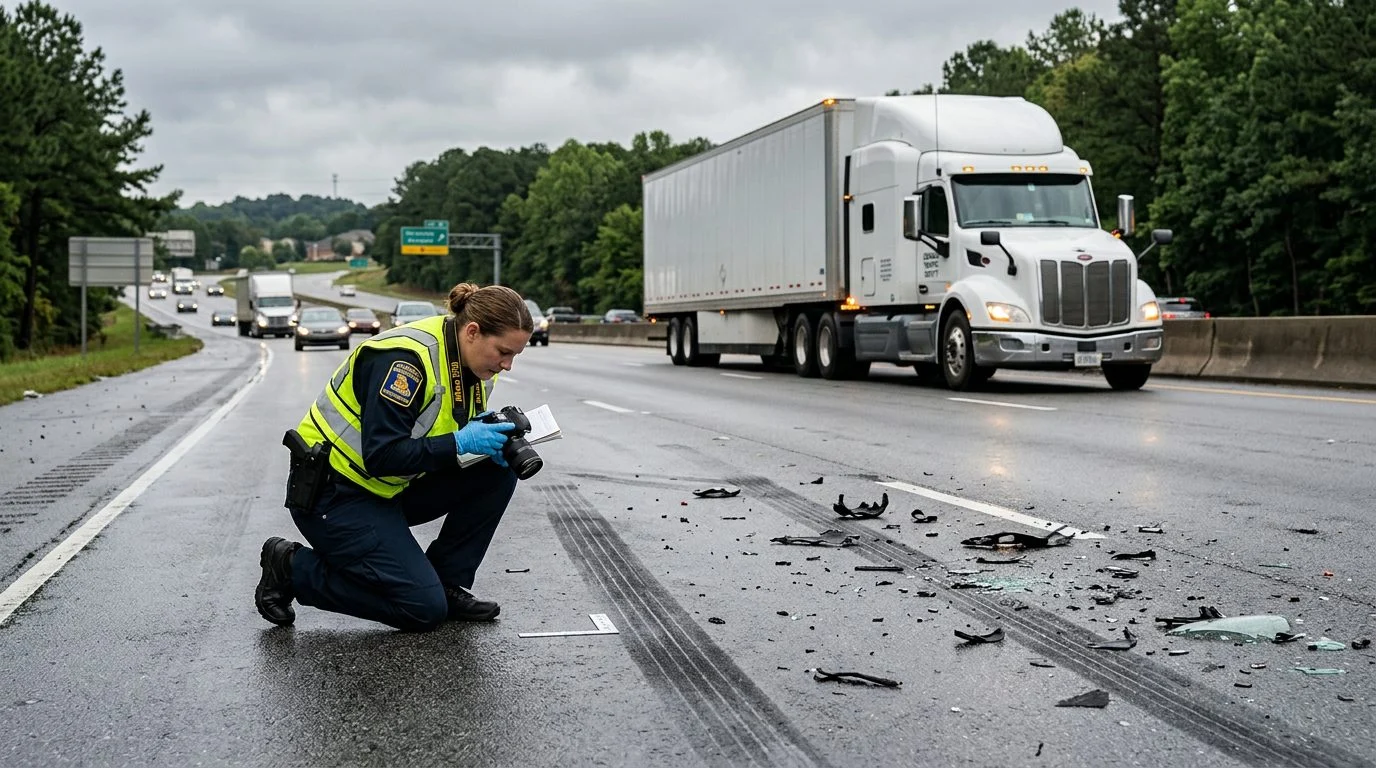
Record what you can. Photograph the truck, its markings, any company name, unit number, and license or DOT numbers if visible. Also capture vehicle damage, road conditions, and traffic signals. Collect witnesses’ names and phone numbers before they leave.
Limit what you say about fault. Stick to what you saw and felt. Avoid guessing about speed or what the driver was doing, and let the crash report and records answer those questions later.
The Evidence That Shapes a Dump Truck Claim
The evidence that usually matters most includes the crash report, photos, witness accounts, medical records, and the trucking company’s own files. Each one answers a different question about what happened and how badly you were hurt.
Company files can be central. A motor carrier must keep a driver qualification file for each driver it employs, and driver logs and rest records can show whether a driver stayed within federal limits.
Timing matters. The Federal Motor Carrier Safety Administration states that motor carriers must retain records of duty status and supporting documents for six months. That is a short window, so early requests and preservation letters matter.
Alcohol testing is another record. Under 49 CFR 382.303, after a crash involving a commercial motor vehicle operating on a public road in commerce, the employer must test its surviving drivers for alcohol as soon as practicable in two situations. The first is when the crash involved the loss of human life, for any surviving driver who was performing safety-sensitive functions with respect to the vehicle. The second is when a driver receives a citation within 8 hours under State or local law for a moving traffic violation arising from the accident, and the accident involved either bodily injury to a person who, as a result, immediately receives medical treatment away from the scene, or disabling damage to one or more motor vehicles that requires a tow truck or other motor vehicle to transport them away. The regulation also sets timing rules and certain exceptions. If no test is given within eight hours, the employer must stop trying and keep a record of why.
Medical records and bills tie the injury to the crash and show the care you needed. Electronic data from the truck can also be lost over time, which is why evidence is often requested early.
How Insurance Adjusters Handle Dump Truck Injury Claims
An insurance adjuster works for the insurer, and what you say and sign early can shape your claim. Slow down before you agree to anything.
Commercial insurers may contact you early, sometimes within days of the crash. They may ask for a recorded statement, a medical authorization, or a quick settlement. Each request is a step that can affect the claim.
Read any release before you sign it. A signed release can close the claim, so ask what it covers and what it gives up.
Georgia has rules for written settlement offers in motor vehicle injury claims. Under O.C.G.A. § 9-11-67.1, an attorney-prepared offer to settle a motor vehicle injury claim, made from the time a cause of action accrues until the filing of an answer by the named defendant or, if there are multiple named defendants, until all named defendants have filed their initial answers or been found in default, must be in writing and give a payment date not less than 40 days from receipt.
Talking with a lawyer before you accept an offer or give a detailed statement is one option many injured people weigh.

How Georgia Fault Rules Affect the Claim
Georgia reduces damages by your share of fault, and you recover nothing if you are 50 percent or more responsible (O.C.G.A. § 51-12-33; Quynn v. Hulsey (2020)). This rule can decide a claim as much as the injury itself.
Under O.C.G.A. § 51-12-33, a judge reduces the damages in proportion to the injured person’s percentage of fault. The same statute bars recovery entirely when the injured person is 50 percent or more responsible.
Fault can be split among several parties. Each liable party pays only its own apportioned share, not the whole amount.
The Georgia Supreme Court applied these rules in Quynn. The jury found the truck driver and employer 50 percent at fault and the pedestrian 50 percent, so the estate recovered nothing.
Fault disputes are common in truck cases. They are decided on the evidence, which is why the records described above matter so much.
Not sure what your next step is?
Talk it through with our team — the first consultation is free, confidential, and carries no obligation.
What a Dump Truck Injury Claim May Include
A claim can include economic losses, such as medical bills and lost pay, and general losses, such as pain and changes in daily life. Georgia law treats these two groups differently.
Under O.C.G.A. § 51-12-2, general damages are presumed to flow from a wrongful act and can be recovered without proof of any amount. Special damages must be proved. Bills and pay records usually do that work.
When a loved one dies, Georgia law addresses who may recover. Under O.C.G.A. § 51-4-2, a surviving spouse, or if there is no spouse, the children, may recover the full value of the decedent’s life, as shown by the evidence. When there is a surviving spouse, the spouse receives no less than one-third of that recovery.
No amount can be predicted in advance. The value of a claim turns on the injuries, the evidence, the fault picture, and the insurance available.
The Legal Process From Claim to Resolution
Most claims start with investigation and a demand to the insurer, then move to negotiation. Some end in a settlement, and some move on to a lawsuit.
Investigation gathers the records and the proof of how the crash happened. A demand presents the injuries and losses to the insurer. If negotiation does not resolve the claim, a lawsuit may be filed in the proper Georgia court.
Georgia generally requires a personal injury lawsuit within two years after the right of action accrues, under O.C.G.A. § 9-3-33. Loss of consortium claims have a four-year period under the same statute. Timing matters, so an early review helps.
Once a lawsuit is filed, discovery exchanges written questions and records. Depositions take sworn testimony. Mediation brings in a neutral person to help the sides talk through a settlement, and some cases go to trial.
For more on truck accident claims in Georgia, see our truck accident resources for Georgia.
Common Questions
How long do I have to file a truck accident lawsuit in Georgia?
Georgia generally sets a two-year deadline for personal injury lawsuits, under O.C.G.A. § 9-3-33. Waiting can cost time, so ask early.
Can I still recover if I was partly at fault?
Georgia reduces damages by your share of fault, and you recover nothing at 50 percent or more (O.C.G.A. § 51-12-33; Quynn v. Hulsey (2020)).
Do I have to report a commercial truck crash to police?
The driver must immediately give notice of an accident with injury, death, or $500 or more in property damage, under O.C.G.A. § 40-6-273.
Talking With Ugwonali Law Group About Your Dump Truck Crash
If you are researching a dump truck crash for yourself or for a family member who is recovering or grieving, you don’t have to sort it out alone. Ugwonali Law Group offers a free case review, and intake staff can speak with you in English or Spanish.
Bring what you have to a first conversation. That includes the crash report number, medical records and bills, photos, letters from insurers, and witnesses’ names. Missing pieces are fine; the list simply helps us start.
Adanna Ugwonali is the responsible lawyer for this page. Ugwonali Law Group is located at 3400 Peachtree Road NE, Atlanta, Georgia, and represents people across metro Atlanta and statewide in Georgia.
La consulta inicial es gratuita, confidencial y sin compromiso de continuar.
If you’re still working out what this crash means for you or your family, you can request a free case evaluation with our team.
This page is general information about Georgia law, not legal advice.
Common Steps After a Dump Truck Crash
Get Medical Care
Seek prompt evaluation from a medical doctor, even if your injuries seem minor at first. Records from treatment become an important part of how your claim is documented.
Preserve the Evidence
Photos of the scene, vehicle damage, your injuries, and any witness names can help explain what happened while memories are still fresh.
Track Your Losses
Keep notes on medical bills, time away from work, and how the injury affects daily life, including care for children, family, or household tasks.
Talk to a Lawyer Early
Our team can explain how truck crash claims are typically investigated, including the trucking company's insurance and safety records, and what to expect next.
What to Expect When You Contact Our Firm
A Free Starting Point
Your first call with our intake team is free and confidential, and it carries no obligation to continue.
Help in English or Spanish
Our intake staff can speak with you in English or Spanish, so you can explain what happened in the language you prefer.
Plain-Language Explanations
Ugwonali Law Group, led by attorney Adanna Ugwonali, focuses on helping clients understand each legal and medical step in clear terms.
Respect for Your Recovery
We understand that serious injuries and the loss of a loved one affect your whole family, and we aim to handle your case with patience and care.