

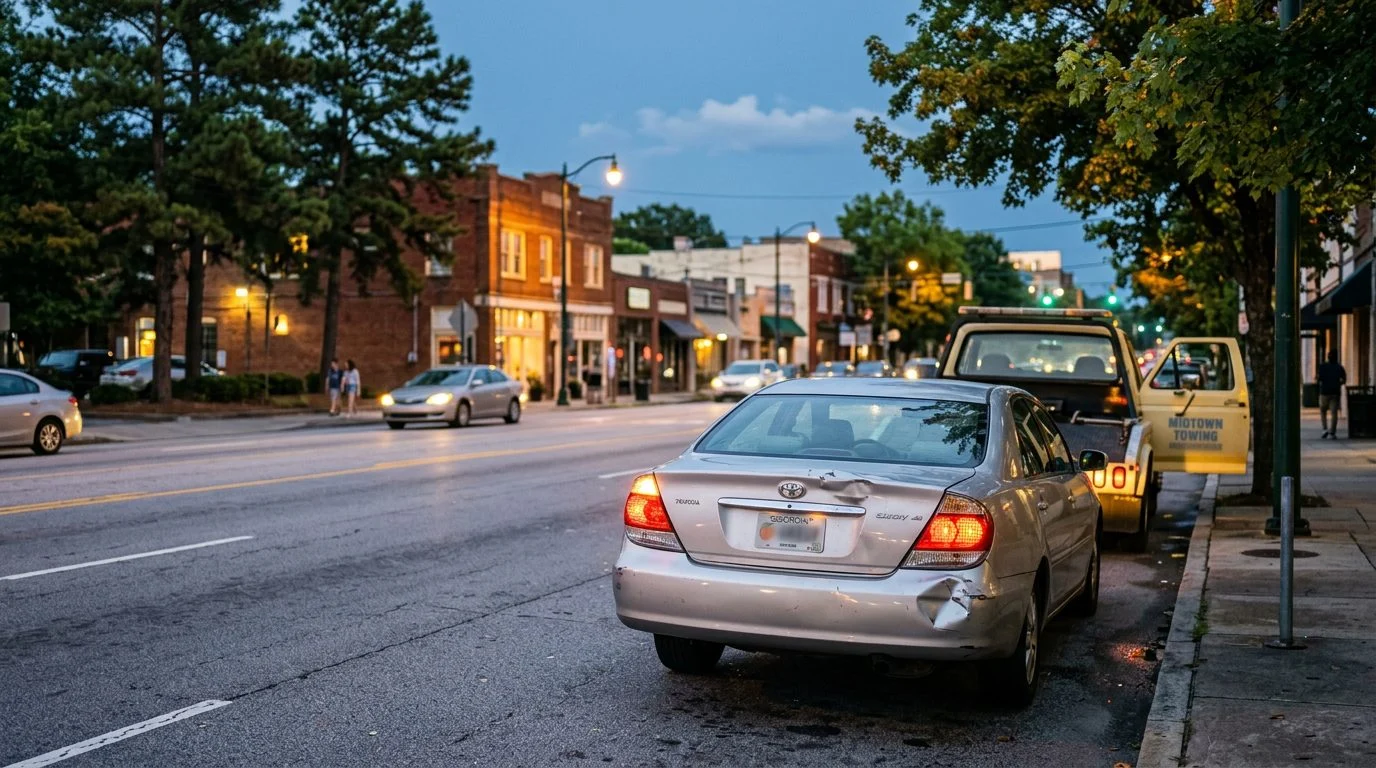
Car and Truck Accidents | Atlanta and Georgia
Hit From Behind? Understand Who May Be Responsible
A rear-end impact can cause injuries that are not obvious at the scene. Here is how these crashes are reviewed, which details matter most, and how to protect your claim from the start.
By Adanna Ugwonali · Published November 20, 2026
If a car hit the back of your car and left you hurt, the first question is usually who is at fault. In most rear-end crashes, the driver who hits from behind is the first driver held responsible. That is a starting point, not a final answer.
This guide explains how fault is usually assigned in a rear-end crash in Georgia, how shared fault changes what a person can recover, and which insurance policies may be involved. The focus is on crashes that cause real injury, medical treatment, or a total loss.
Who is usually at fault in a rear-end crash?
In most rear-end crashes, the following driver is the first one whose driving gets examined. Two terms help here. The lead vehicle is the car in front. The following vehicle is the car behind it. The impact is the point where the front of the following vehicle strikes the back of the lead vehicle.
Georgia judges driving care by the ordinary diligence standard. That standard asks what an ordinarily prudent person would do under the same or similar circumstances. The absence of that care is called ordinary negligence. O.C.G.A. § 51-1-2 sets out that rule. In a rear-end crash, the core question is usually whether the following driver could have stopped in time.
Fault is not always one-sided. Some crashes put part of the blame on the lead vehicle, and some involve a third driver. Each crash turns on its own facts, and the sections below explain the common patterns.
If a rear-end crash left you hurt and facing medical bills and insurance calls, our team can talk through your options in a free case review. Talk it through with our team — the first consultation is free, confidential, and carries no obligation.
Why the following driver often carries the first responsibility
The following driver usually carries the first responsibility because that driver controls whether the car can stop in time. Following too closely for the speed and traffic is a common problem. So is looking at a phone, reaching for something on the floor, or driving tired. A moment of looking away is enough to close the gap.
Insurers and police often start with the same question. Did the following driver have room and time to stop? If the answer is no, the following driver’s conduct usually becomes the center of the claim. Early photos and witness names can help show the spacing and speed at the moment of impact.
When the driver in front is responsible
The driver in front can share fault when a sudden or unexplained action caused the impact. Several situations come up often.
- A hard stop with no traffic reason, or a sudden stop after a cut-in in front of the following car.
- Brake lights or turn signals that did not work, so the following driver had no warning.
- A lead driver who reversed into the following car, or who stopped in a travel lane without warning.
- A lead driver who was impaired, or whose vehicle had a mechanical problem such as brake failure, that caused a sudden slowdown.
A lead driver’s share does not erase the following driver’s duty. Both drivers’ conduct gets weighed. Brake-light failures and cut-ins are easy to miss in a short police report, so photos of the vehicles and the road are worth keeping.
What about chain-reaction and multiple-vehicle crashes?
In a chain-reaction crash, each impact can have its own at-fault driver, so the order of the impacts matters. A driver in the middle may be hit from behind and may also have struck the car ahead. Each impact may need separate review.
Under O.C.G.A. § 51-12-33, damages are apportioned among the liable persons by each person’s percentage of fault. Those damages are each person’s own liability. They are not a joint liability, and they are not subject to any right of contribution.
In plain terms, each liable driver answers for the share assigned to that driver. Crash reports, witness accounts, and vehicle positions help sort out who hit whom, and in what order.
How Georgia’s comparative fault rule affects what you can recover
Under Georgia’s modified comparative fault rule, your recovery is reduced by your own share of fault. A share of 50 percent or more bars recovery of damages altogether. O.C.G.A. § 51-12-33 says the judge reduces the damages awarded to the injured person “in proportion to his or her percentage of fault.”
Here is a simple example using percentages only. Suppose a fact-finder places 20 percent of the fault on the injured driver and 80 percent on the other driver. The injured driver’s award would be reduced by 20 percent. The other driver would answer for the 80 percent share.
Insurers may argue that the injured driver deserves a larger share of fault. That is one reason careful documentation matters early. In Quynn v. Hulsey, the Supreme Court of Georgia addressed a jury that split fault 50 percent to a truck driver and his employer and 50 percent to a pedestrian. Under the 50 percent bar, the estate recovered nothing.
Am I at fault if someone backs into my car?
In most backing crashes, the driver who was reversing is the first one whose care is questioned. That driver can see what is behind the vehicle before moving. The question is whether the reversing driver took the care an ordinarily prudent driver would take under the same circumstances.
Cases get harder when the parked or stopped car was in an unexpected spot. They also get harder when lights or signals were not working, or when the backing vehicle was a truck with limited rear visibility. Each of these facts can shift how the crash is viewed.
Low-speed backing crashes in parking lots and driveways can still cause real injury, including back, neck, and head injuries. The same fault questions apply. Medical records and photos of the vehicles help connect the injury to the impact.
Not sure what your next step is?
Talk it through with our team — the first consultation is free, confidential, and carries no obligation.
Whose insurance pays after a rear-end crash?
The at-fault driver’s liability insurance is usually the first source for a claim against that driver. O.C.G.A. § 33-7-11 requires that an automobile liability policy issued in Georgia contain an endorsement or provisions undertaking to pay the insured damages for bodily injury caused by the owner or operator of an uninsured motor vehicle, within the policy’s limits. Your own policy may also include medical payments coverage. Its terms control what it pays.
When a truck or company vehicle is involved, more than one policy may matter. Federal rules set minimum public liability levels for for-hire carriers.
Under O.C.G.A. § 51-2-2, a person is liable for torts committed by a servant by the person’s command or in the prosecution and within the scope of the person’s business. Georgia’s high court has also recognized that claims such as negligent hiring and supervision are based on the employer’s own conduct. Under Quynn v. Hulsey, 310 Ga. 473 (2020), claims for negligent hiring, training, supervision, and retention are based on the alleged negligent acts of the employer.
An adjuster works for the insurance company, not for you. An early opinion on fault from an adjuster is not a final decision.
How adjusters decide fault, and how to protect your claim
Adjusters usually weigh the police report, driver statements, vehicle damage photos, witness accounts, and any dashcam or vehicle event data. These records often show the order of events more clearly than memory does. Gather what you can early.
- Get medical care promptly. Follow your treatment plan. Medical records are how injuries get linked to the crash.
- Photograph the scene. Capture the vehicles, the road, and any lights or signals that were not working.
- Keep records. Save repair estimates, work-absence notes, and a written timeline while memories are fresh.
- Be careful with recorded statements. An insurer’s early questions can shape how fault is viewed later.
Timing matters too. Under O.C.G.A. § 9-3-33, an action for injuries to the person generally must be brought within two years after the right of action accrues, unless another provision of the article applies; an action for injuries to the reputation must be brought within one year, and an action involving loss of consortium must be brought within four years.
Common questions
Can I still recover if I was partly at fault?
Georgia reduces recovery by your share of fault. A share of 50 percent or more bars recovery (O.C.G.A. § 51-12-33; Quynn v. Hulsey (2020)).
Does a chain-reaction crash change who is at fault?
Each impact can be reviewed separately. Each liable person answers for their own apportioned share.
Acting early protects your options.
Talking through your rear-end crash with our team
A rear-end crash can bring medical bills, time off work, and insurance calls all at once. You may be deciding whether to speak with an insurer, what to do about a totaled vehicle, or whether a truck or company vehicle changes the picture. You do not have to sort that out alone.
Ugwonali Law Group offers a free case review for people hurt in car and truck crashes in metro Atlanta and across Georgia. The initial consultation is free, confidential, and carries no obligation to continue. Intake is available in English or Spanish.
To talk through your situation, contact our team through the free case review page. Adanna Ugwonali is the responsible lawyer for this page. The firm’s office is at 3400 Peachtree Road NE, Atlanta, Georgia. This page provides general information and is not legal advice.
What Helps Document a Rear-End Crash
The Crash Report
A police or incident report records the date, location, vehicles involved, and the officers' initial observations.
Scene Photos
Pictures of vehicle damage, the roadway, traffic signals, and skid marks can capture details that fade quickly.
Witness Information
Names and contact details for anyone who saw the impact or its aftermath can be valuable later.
Medical Records
Emergency visits, imaging, referrals, and treatment notes connect your injuries to the crash and show how your care has progressed.
Be Careful With Early Insurance Calls
An insurance adjuster may contact you soon after a crash. Before you give a recorded statement, sign a release, or accept a settlement offer, consider talking with a lawyer about what you are agreeing to.
Common Questions After a Rear-End Crash
What about chain-reaction crashes?
One collision can involve several vehicles. Each impact can be reviewed on its own facts, and each driver's role can differ.
Can a serious injury come from a low-speed impact?
Ongoing treatment and follow-up care are worth discussing with a medical doctor and with our team.
What if a commercial vehicle hit me?
When a truck or company vehicle is involved, commercial insurance may be part of the picture. Our team can explain how that changes the claim process.
Hurt in a Rear-End Crash?
Our First Consultation Is Free, Confidential, and Carries No Obligation to Continue.
Related practice areas
- Hit by a Tractor-Trailer While on a Motorcycle in Georgia
- What Not to Tell Insurance After a Serious Crash in Georgia